Money flooding into South African bonds


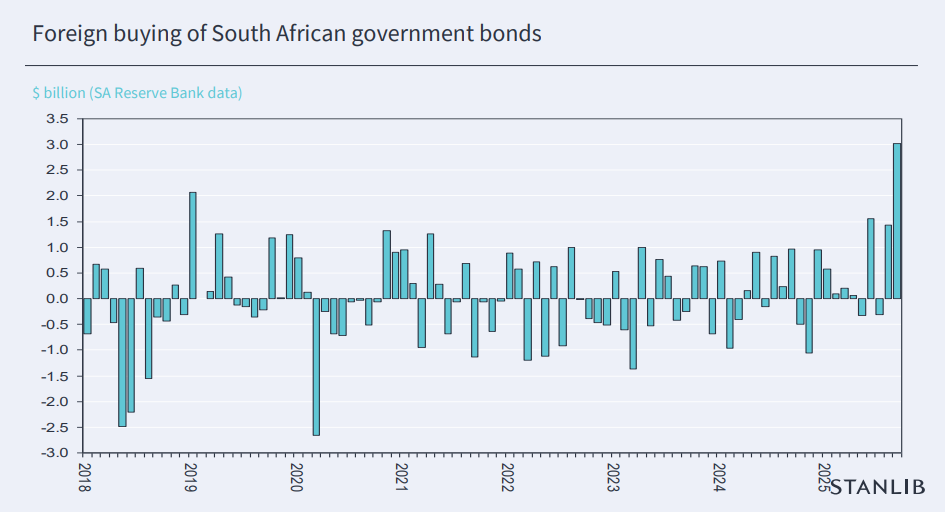
Foreign investors are pumping billions of rands into South African government bonds, as the elevated yield and improving state finances make the asset increasingly attractive.
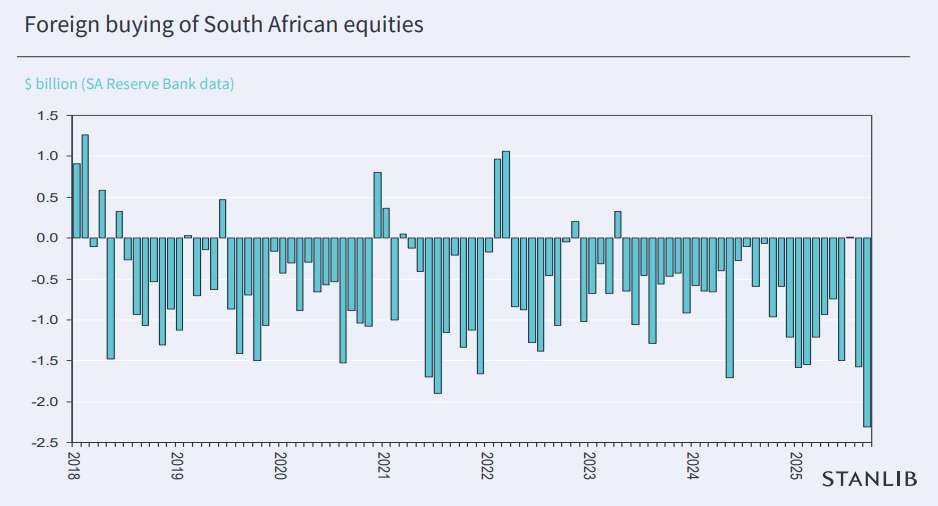
However, local equities have not received any love from foreign investors, who continue to dump shares in JSE-listed companies.
This reflects a growing trend whereby investors expect the government’s finances to improve, but local growth is expected to remain weak in the coming years.
As a result, government bonds are relatively attractive, while stocks are not as attractive because company earnings are somewhat limited by a stagnant South African economy.
The overall sentiment surrounding South Africa appears to have turned a corner after the Finance Minister’s Medium-Term Budget Policy Statement (MTBPS) revealed the country is on track to stabilise its debt burden as a share of GDP.
This is on the back of the minister projecting the government will run its third consecutive primary budget surplus and a narrow full budget deficit.
Investor sentiment was improving even before this news, with Stanlib chief economist Kevin Lings pointing out that foreign investors bought R77 billion worth of government bonds in August and September.
According to Lings, this is the strongest two-month period of foreign purchases since at least 1994, indicating that investors have increasing confidence in South Africa’s fiscal situation.
The trend has continued throughout October and November, with good news coming in the form of South Africa being removed from the greylist and the MTBPS.
JSE data shows that foreigners have bought R119 billion in local government bonds so far in 2025, compared to R74 billion during the same period last year.
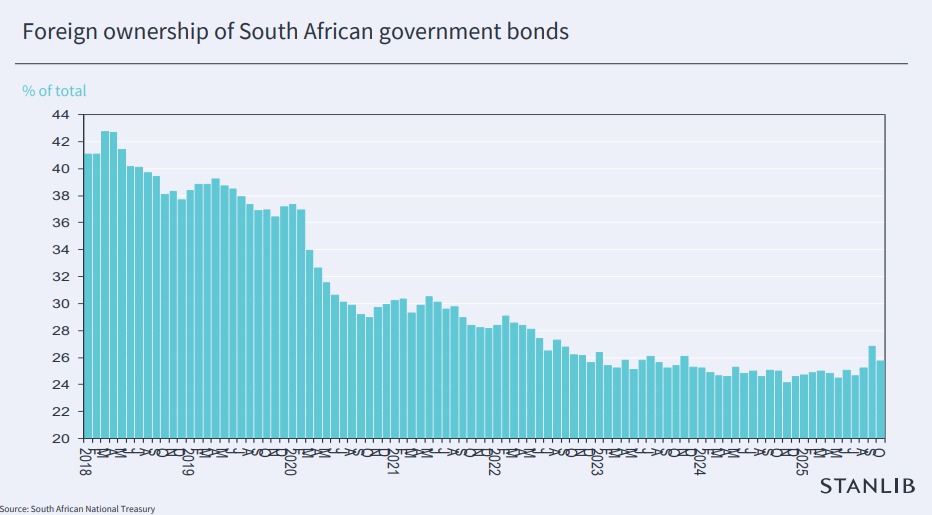
This strong buying activity has seen foreign ownership of local bonds rise to a level last seen at the end of 2023, arresting the decline.
Foreign ownership of bonds is vital as it limits the exposure of the local financial sector to a single asset in the form of government debt, making the overall system more stable.
It has also resulted in the JSE All Bond Index having one of its best years on record since 2000, which will push up the performance of low-risk investment funds and fixed-income investments.
Symmetry chief investment strategist Izak Odendaal explained that the main drivers behind this strong performance are an attractive yield at the beginning of 2025, falling interest rates, subdued inflation, and better fiscal policy.
This has also been coupled with increased investor interest in emerging markets as US financial assets appear expensive and commodity prices have risen strongly.
Odendaal expects this performance to continue into 2026, but cautioned that a repeat of the stellar 2025 is unlikely over the coming 12 months.
Foreign investors dump stocks
In contrast to local government bonds, South African equities have not felt the love from foreign investors, which continue to sell shares by the billions.
Since 2023, there have been only two months on record where foreign investors bought more shares on the JSE than they sold.
In the first eight months of 2025 alone, foreign investors have dumped R165 billion worth of JSE-listed shares, despite the All Share Index’s strong performance.
This is substantially more than the R93 billion sold in the same periods in 2024, despite a strong rally in precious metals prices that has benefitted the JSE.
The JSE has had one of its best years on record, with it surging by around 40% in dollar terms and far outpacing more developed global peers.
This is new territory for the exchange, with stocks and bonds typically moving in tandem, as both are impacted significantly by South Africa’s stagnant economy.
A stagnant economy limits growth in company earnings and tax revenue, typically putting pressure on bond prices and company valuations.
However, Old Mutual Investment Group (OMIG) portfolio manager John Orford explained that in 2025 this dynamic broke, with bonds and stocks not moving in tandem.
Bond prices have risen strongly amid increased investor interest, while the performance of South African-focused companies has been relatively flat so far.
This indicates that investors are still concerned about South Africa’s stagnant economy and its impact on company earnings, while being encouraged by the progress made in addressing the government’s financial challenges.
For South African-focused stocks to rerate positively, faster economic growth and concrete evidence of successful reforms are needed.
This is unsustainable in the long run, with improving sentiment around the government’s finances unlikely to continue without faster economic growth.
The Reserve Bank revealed in its latest Quarterly Bulletin that foreign investors sold R15 billion in the first eight months of 2025.
It attributed these sales to weak domestic economic growth and recurring policy disputes within South Africa’s government of national unity (GNU).




Comments