Rand on the rise as interest rate cuts loom


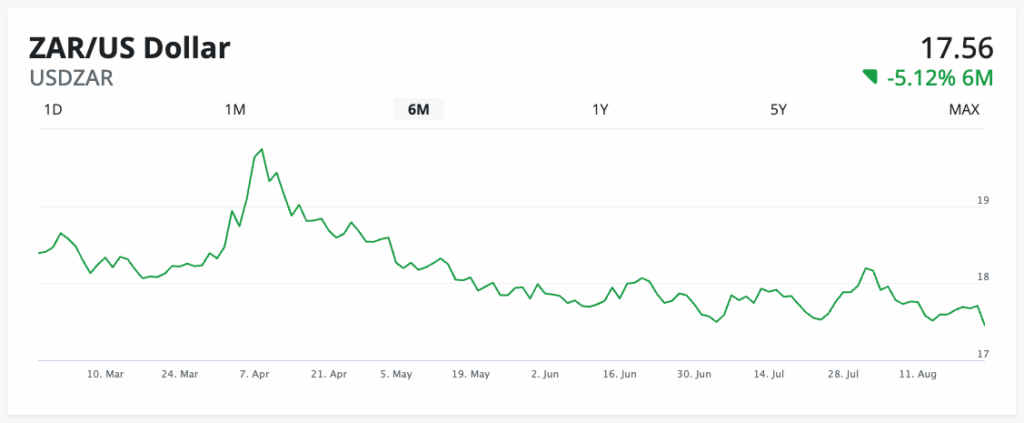
The rand has strengthened significantly over the past few days, which is set to continue as financial markets price in United States interest rate cuts for later this year.
Interest rate cuts in the United States would narrow the interest rate differential between the US and South Africa and improve risk-taking among investors, boosting the rand.
Investec chief economist Annabel Bishop recently outlined the reasons why markets are expecting an interest rate cut for the United States, and what this would mean for South Africa.
Her comments come after the US Federal Reserve (Fed) held its annual highly anticipated Jackson Hole symposium from 21 August to 23 August 2025.
At this symposium, Fed chair Jerome Powell outlined some of the risks to the United States’ inflation outlook and what this could mean for interest rates.
Starting with tariffs, he said their effects on consumer prices are likely to be relatively short-lived. The Fed plans to ‘look through’ this and not react with higher interest rates unless the price increases become entrenched.
In addition, Powell noted that, worryingly, downside risks to employment are rising, which, should they materialise, could do so quickly in the form of sharply higher layoffs and rising unemployment.
At the same time, he highlighted that the United States’ GDP growth has slowed. Historically, the US has reacted to slowing economic growth by lowering interest rates.
Bishop said financial markets have taken Powell’s speech as an indication that further US rate cuts are likely.
“Financial markets had worried that the Fed would react to higher tariff-led inflation in the coming months, and delay, or scupper expected interest rate cuts, but have experienced relief, continuing to see two more cuts this year in US interest rates,” she said.
“The US dollar has weakened as financial markets’ expectations of two more 25 basis point cuts this year, and a high probability of a third, have been strengthened.”
She explained that the rand has also strengthened on an expected narrowing of the interest rate differential.
This is because lower interest rates in the United States would make South African bonds, with higher rates, more attractive to investors. In turn, money flooding into local bonds would strengthen the rand.
The graph below shows how the rand has strengthened against the US dollar over the past six months.
South Africa could follow
Nedbank chief economist Nicky Weimar recently explained that, if the Federal Reserve were to cut rates later this year, South Africa could follow.
This is because inflation in the country is largely under control, despite a higher reading in July, and, combined with the rand’s recent strength, could give the Reserve Bank room to cut.
She said another rate cut for South Africa could be just what local consumers need to ease the cost-of-living pressures they are currently under. This will, in turn, be positive for the country’s economic growth in 2025.
So far, consumer spending has been strong in 2025, with households proving to be a reliable source of economic growth for the country.
Weimar explained that South African consumers want to spend, and do so, but need more help to do so consistently, which could come from easing inflation and lower interest rates.
She further emphasised how vital consumer spending is to South Africa’s economic growth, as producers are under too much pressure from both local and global constraints to make as meaningful a difference.
On the global front, risks to local producers stem from a combination of slower global growth and high United States tariffs on South African goods.
This heightens local pressures, as South African producers already struggle to keep costs low enough to compete with goods from other countries.
High local input costs, particularly electricity and logistics costs, combined with higher tariffs mean local producers will need to keep an even closer eye on costs going forward.






Comments