The rand is much weaker than it appears


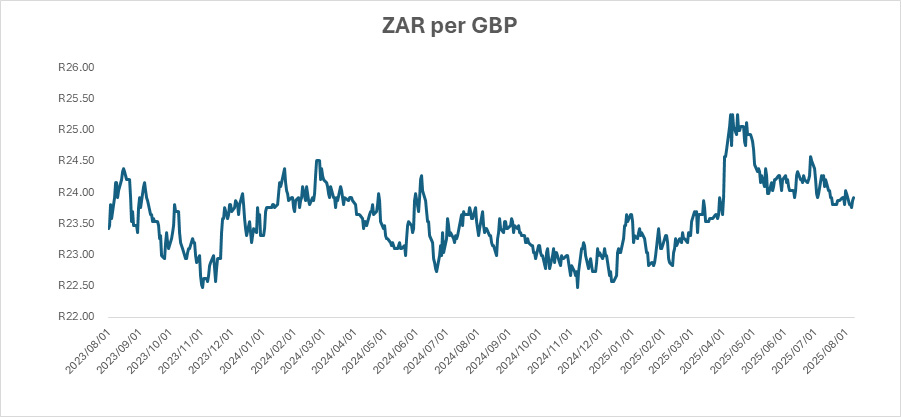
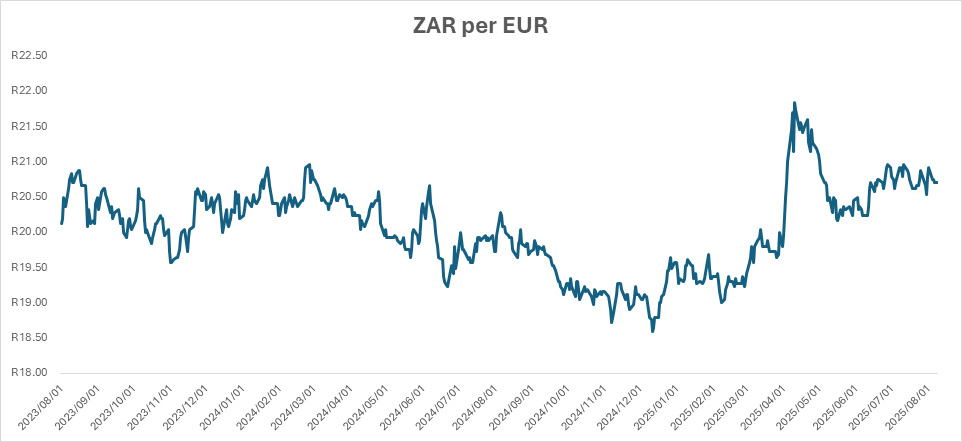
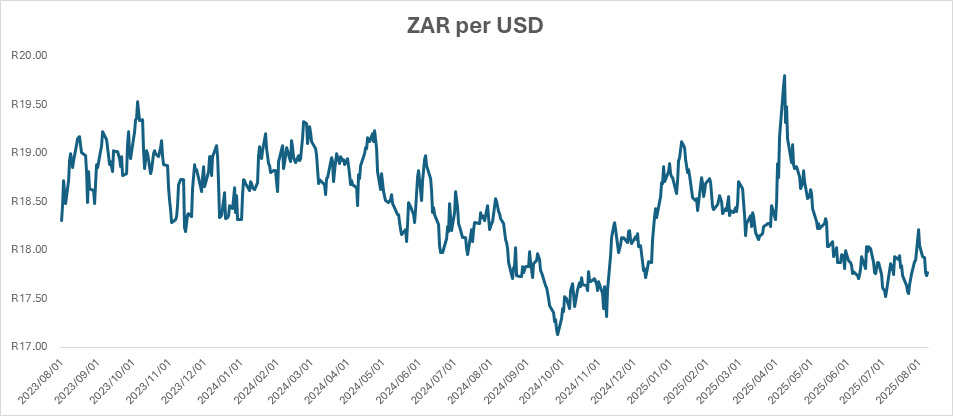
Although the South African rand strengthened against the US dollar, it weakened against other hard currencies, including the British pound and the euro, as measured from 1 August 2023 to 1 August 2025.
The rand is one of the world’s most volatile currencies because of domestic problems and global investor sentiment.
It is one of the most traded emerging market currencies, which results in rapid swings in response to positive or negative developments.
One of the most significant domestic developments was the formation of the government of national unity (GNU) last year.
Many investors saw the GNU as an avenue of reform within South Africa. They anticipated the new government addressing structural issues within the country.
The market loved this news, and the rand rallied. It went from well above R19.00 to the US dollar before the election to R17.10 by September 2024.
Since then, there have been many ups and downs. It weakened to R19.77 against the US dollar in April 2025, amidst the United States’ tariff announcement and the 2025 Budget debacle.
However, it quickly strengthened again. By July 2025, the rand was trading at around R17.50 to the greenback. The local currency is now trading at higher levels than two years ago.
However, the South African rand’s strength against the US dollar belies the reality that the rand is weaker against most hard currencies.
When the rand is measured against the British pound and the euro, it is weaker than it was last year.
The rand’s strength against the greenback is mostly due to dollar weakness rather than rand strength.
The US dollar weakened due to a range of factors, including erratic economic and trade policies since President Donald Trump took office.
Foreign investors who previously benefited from unhedged exposure to United States assets are increasingly adding hedges, effectively selling dollars and amplifying depreciation.
The value of the US dollar against other currencies dropped about 11% in the first half of this year, the biggest decline in more than 50 years, ending a 15-year bull cycle.
Morgan Stanley Research estimated the US dollar could lose another 10% by the end of 2026.
So, while the rand strengthened against the greenback, this does not accurately reflect the strength of the local currency.
When one also compares it to the British pound and the euro, it becomes evident that it has continued its downward spiral.
The table and charts below show the rand’s two-year performance against the world’s most prominent currencies.
The performance of the rand for the past 2 years
| Currency | 1 August 2023 | 1 August 2025 | Performance |
| USD/ZAR | R18.31 | R18.05 | +1.4% |
| GBP/ZAR | R23.42 | R23.98 | -2.4% |
| EUR/ZAR | R20.12 | R20.92 | -4.0% |
Charts of the performance of the rand against hard currencies (1 August 2023 – 1 August 2025)
 Loading ...





Comments