Silver bullet for South Africa’s government


South Africa’s Government of National Unity (GNU) may receive a tax windfall from elevated prices of precious metals, similar to the commodity boom in 2021/22.
The rise in prices of platinum group metals (PGMs) and gold has led to a significant rally in companies mining and processing these metals.
While South Africa’s participation in the historic rally of gold prices is limited due to the country having largely mined out its endowment of the mineral, the rise in PGM prices promises to boost the JSE and the government’s coffers.
Crucially, South Africa is the largest producer of PGMs, and Russia, the second-largest source, is effectively sanctioned, leaving the country in the prime position to benefit.
What remains essential, however, is how the government decides to use the potential additional revenue from the commodity boom.
This is feedback from Old Mutual Investment Group’s (OMIG) head of equity research, Meryl Pick, who outlined the driving forces behind the recent rally in PGM prices and what it could mean for South Africa.
In the short term, the price of platinum has been largely driven by a slowdown in sales of electric vehicles across the European Union (EU) and the United States.
European carmakers have delayed their plans to electrify their existing product ranges and are pivoting towards a continuation of internal combustion engines (ICE) and hybrid vehicles.
The EU itself has pushed back regulations that would force its carmakers to increase production of electric vehicles and has dialled down the incentives for buyers to purchase them.
As a result, the demand for ICE cars is expected to remain strong alongside hybrid vehicles, with carmakers releasing new models with these powertrains.
The biggest industrial use of PGMs is in catalytic converters, used in traditional ICE engines to reduce their emissions.
With demand for these vehicles expected to remain strong, investors are increasingly betting on demand for PGMs to be more resilient than expected, Pick said.
While the slowdown in demand for electric vehicles has pushed platinum prices higher, over the long run, the main driver has been declining supply.
Mining companies have been hesitant to invest heavily in new capacity or in expanding current mines, due to fears of declining demand for PGMs.
These companies have also looked to diversify their revenue by increasing their investments in copper mines and crop nutrients businesses.
The supply of PGMs is highly constrained at a time when demand may prove more resilient than expected, squeezing prices higher.
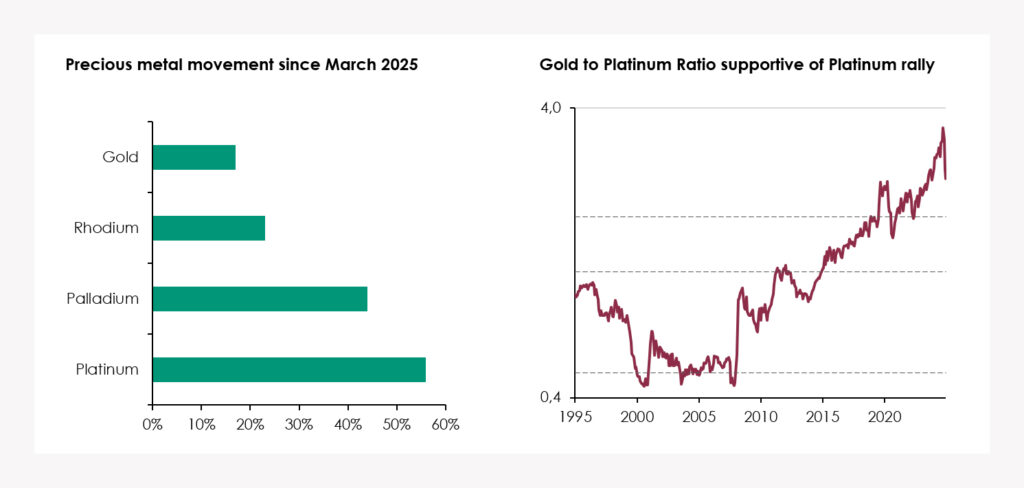
As a result, the price of platinum has soared nearly 50% over the past six months, with palladium up 33% over the same period.
The graph below shows increases in the price of PGMs, alongside a comparison of the price of platinum to that of gold.
GNU’s windfall
Pick explained that this has the potential to create a commodity-driven tax windfall for South Africa that could alleviate the government’s financial pressures and spur growth.
Following a sustained rise in the price of PGMs in 2021, the government collected an additional R120 billion in revenue.
The key question is how these funds will be used, with Pick advising investment in infrastructure or paying down the government’s debt rather than increasing consumption and higher salaries.
This windfall positions the GNU for potentially its first ‘big win’, which could justify the immense optimism surrounding its formation.
It may also ease tensions within the coalition, as the potential windfall would greatly reduce fiscal pressure in the current financial year and the coming years.
More crucially, this windfall may come at a time when South Africans and investors begin to realise that the GNU has not delivered the ‘big wins’ it promised.
OMIG portfolio manager, Jason Swartz, said the reforms needed to reach the GNU’s 3% economic growth target are progressing terribly slowly.
These slow reforms are making investors increasingly anxious about the ANC’s next elective conference in 2027, which may see the end of the GNU and ongoing reforms.
So far, the GNU has had small wins in the form of reduced load-shedding, increased efficiency at Home Affairs, and increased investment in infrastructure.
However, the bigger issues of restructuring Eskom and Transnet have slowed, Swartz said, with not enough attention being given to the logistics sector.
Eskom has failed to meet its 70% energy availability factor target, and progress towards it has slowed. While Transnet’s performance has stabilised, it remains below the peaks seen in the last decade.
These structural constraints are still the biggest handbrake on South Africa’s economic growth and, without significant reform, threaten to ensure the country’s economy remains stagnant.




Comments