Increasing taxes on wealthy South Africans reduces government revenue and slows economic growth


Renowned economist Thomas Sowell has stated that the most effective way to increase tax revenue from wealthy citizens and stimulate economic growth is to lower their tax rates.
South Africa has run consistent budget deficits over the last 17 years, forcing it to increase its debt significantly.
The country’s debt-to-GDP ratio has increased from 23.6% in the 2008/09 financial year to 76.1% at the end of the 2024/25 financial year.
The African Development Bank (AfDB) anticipates that this concerning trend will persist. South Africa is projected to borrow R581.9 billion in 2025, up from R415.7 billion in 2024.
This higher debt comes at a significant cost. The government’s debt-service costs are projected to be R424.9 billion in the current financial year, equivalent to R1.1 billion per day.
To avoid a financial disaster, the International Monetary Fund has recommended that South Africa reduce its debt-to-GDP ratio to 60% of GDP, in line with that of its peers.
The only way for the government to reduce its debt is to generate more tax revenue or reduce spending. The latter is politically unpalatable, which leaves increasing tax revenue.
However, there is a challenge. South Africans are already overtaxed, which means that increasing taxes will decrease tax revenue.
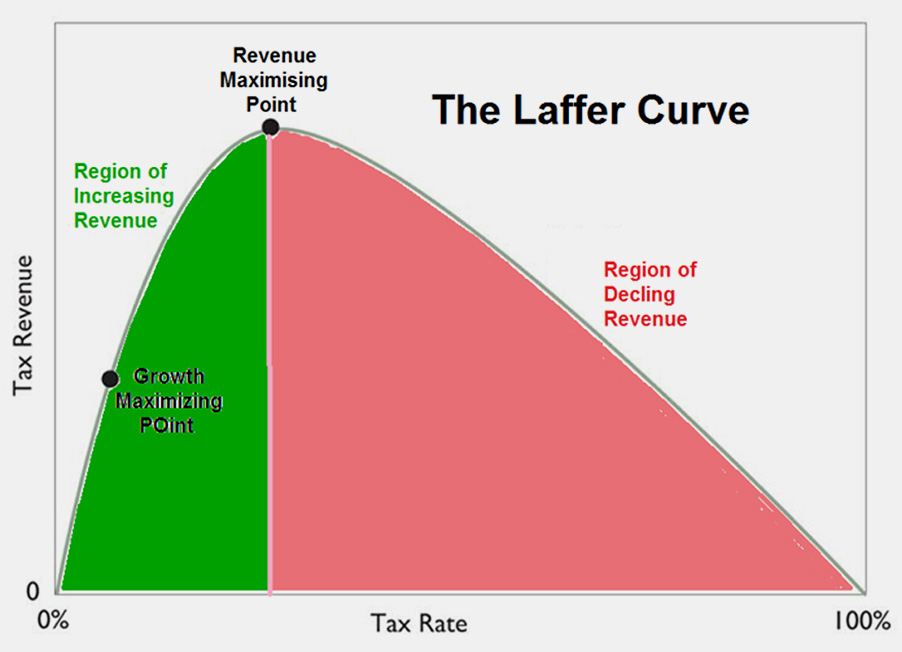
The Laffer Curve, developed by Arthur Laffer, an economist who served as an adviser to United States President Ronald Reagan, explains South Africa’s tax predicament.
The Laffer Curve explains the relationship between tax rates and tax revenue by examining the extremes of a 0% tax rate and a 100% tax rate.
At a 0% tax rate, the government would receive R0 in tax revenue. The same goes for a 100% tax rate, as people would stop working.
There is an optimal tax rate between 0% and 100% at which the government would receive the highest revenue.
If the government moves beyond this point, as is the case in South Africa, it would generate less tax revenue than at lower tax rates.
Generating additional tax revenue through reducing tax rates
In his book “Trickle Down Theory and Tax Cuts for the Rich”, Sowell said lowering tax rates can generate higher government tax revenue and stimulate economic growth.
Many people mistakenly believe that higher tax rates are needed to help the government collect more tax revenue.
However, this does not take into account that individuals change their behaviour in response to tax rate changes.
Sowell explained that human beings aren’t static in their reactions to changes in tax rates, but instead constantly respond to them.
When taxes are raised to extract more money from rich people, they avoid these taxes by arranging their finances so that they are out of the government’s reach.
He explained that Treasury Secretary Andrew Mellon and Presidents John F. Kennedy, Ronald Reagan, and George W. Bush all lowered tax rates.
In each case, economic growth increased, accompanied by a corresponding rise in government tax revenue.
“In the early 1920s, the tax rate on the top income was 73% and people earning over $100,000 annually paid 30% of all taxes,” he said.
By the end of the decade, the tax rate on top income earners had been cut to 24%. At that stage, people earning over $100,000 annually paid 65% of all taxes.
“The reason is simple. When the tax rate is 73%, people simply don’t pay it. They put their money into areas out of the reach of the government,” he said.
He said that high tax rates are typically a symbol used by politicians to show that they are tough on the rich, to gain votes. However, it is detrimental to tax revenue collection.
Tax rates in South Africa

Daily Investor tested Sowell’s suggestion by applying it to South Africa, using the effective tax rate for each top tax bracket from 1981 to 2024.
An effective tax rate is the actual tax rate that an individual pays. The effective tax rate is lower than the tax bracket rate because all taxpayers receive a tax rebate.
The effective tax rate was used because taxpayers make financial decisions based on their actual tax payment rather than a tax rate on paper.
This analysis used the effective tax rate for an individual who received the lowest salary to fall within the uppermost tax bracket.
Since 1981, there have been several periods of increasing and decreasing effective top tax rates. In 1989, the effective tax rate in the top bracket was 26.7%. Today, it is 35.5%.
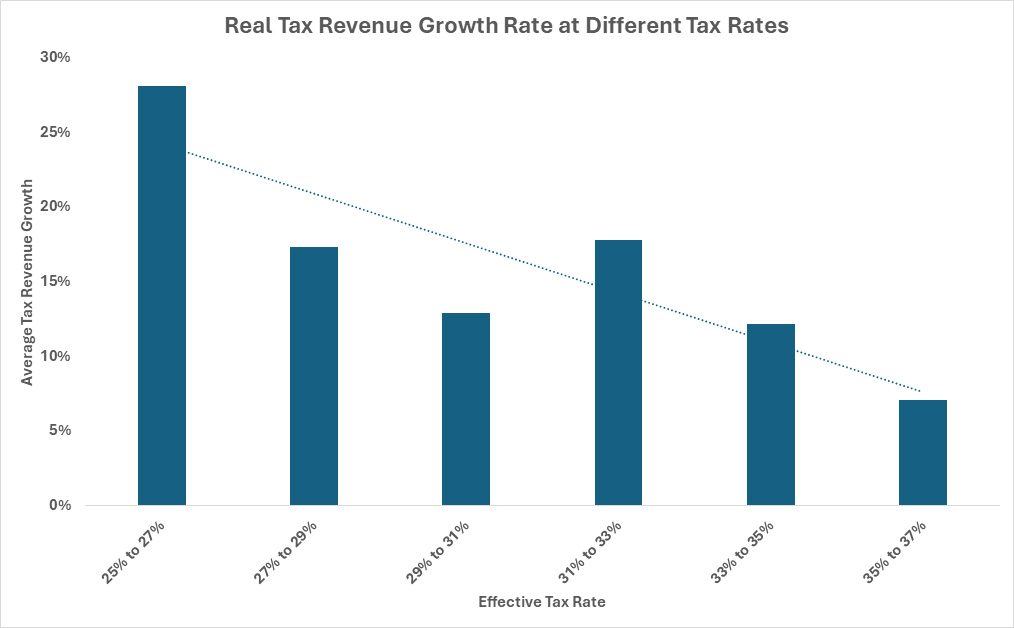
Daily Investor analysed the average real government tax revenue growth in South Africa from 1981 to 2024 within different tax rate ranges.
The average growth rate of government tax revenue was then calculated within each tax rate range.
The empirical data from the South African economy showed a downward trend in government tax revenue growth as tax rates in South Africa increased.
The government enjoyed the highest average tax revenue growth rate of 28% in the lowest tax rate range between 25% and 27%.
The South African government experienced the lowest average tax revenue growth rate, 7%, in the highest tax rate range.
Tax rates and economic growth
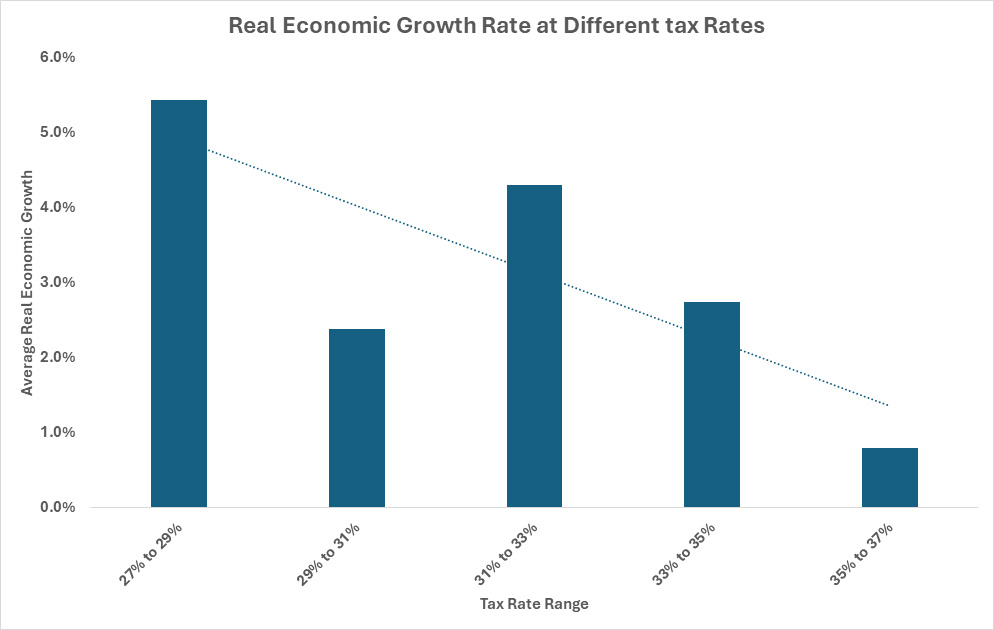
Daily Investor also analysed South Africa’s real economic growth rates for different tax rate ranges.
The same tax rate range was used to analyse how South Africa’s economy grew in real terms within the different tax regimes.
The empirical data from South Africa’s economy confirmed Sowell’s findings. South Africa experienced the highest average real economic growth of 5.4% in the lowest tax rate range.
South Africa experienced the lowest average real economic growth of only 0.8% in the highest tax rate range.
Based on South Africa’s empirical data, the country would be significantly better off if the government lowered tax rates substantially.
This will have a positive effect on individuals within the economy and on the government’s tax collections.
It will increase real economic growth and state revenue, thereby reducing its concerning debt burden.






Comments