Rand on shaky ground


The rand’s strength in recent weeks is not necessarily due to underlying strength in South Africa’s economy but rather part of a global trend influenced by a weak US dollar.
Bureau for Economic Research senior economist Shannon Bold recently said that the rand has surprisingly performed well in the face of ongoing global economic and political instability.
Many feared for the local currency when United States President Donald Trump made his return to the White House.
These concerns became more prevalent when Trump’s administration started focusing on South Africa, and tensions between the two countries grew.
While the rand has taken several hits due to these tensions, the local currency has remained surprisingly strong, and the US dollar has weakened by over 3% against the rand this year to date.
Bold explained that this is, in part, due to local economic factors that are supporting the local currency.
For example, the country’s somewhat better-than-expected current account deficit in the fourth quarter of 2024 and South Africa’s monetary policy stance could support the rand.
“With a relatively high real interest rate, the rand remains an attractive currency for yield-seeking investors,” she said.
In addition, the South African Reserve Bank is expected to cut rates by less than the US Federal Reserve, which could give the rand some short-term tailwinds.
However, she said that while the rand looks strong, it’s important to understand that this isn’t necessarily a reflection of South Africa’s economic health. Rather, the rand’s resilience is part of a global trend.
“Since the start of the year, many currencies, including most emerging market currencies, have been doing better against the US dollar, and much of this can be attributed to what’s known as a ‘weak dollar story’,” she explained.
“Global investors have been adjusting their expectations around US monetary policy amid heightened uncertainty about the strength of the US economy, which has caused the dollar to soften.”
In fact, Bold said South Africa’s risk premium has been climbing steadily since mid-December, and recent surges in 10-year bond yields signal that investors remain cautious.
South Africa’s Credit Default Swap spread – which measures sovereign default risk – has also increased over this period.
“In short, the rand’s strength is driven more by global market dynamics than by any strong local economic fundamentals,” she emphasised.
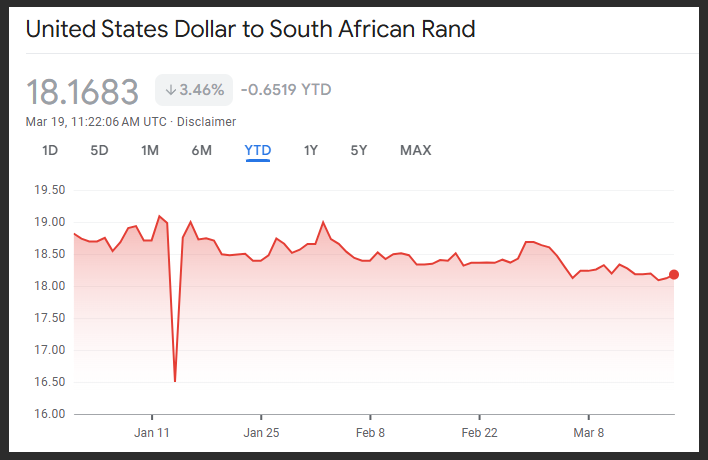
Rand is on shaky ground
Bold further explained that while the rand is resilient now, inflation, interest rate differentials, and external account pressures may drive the currency to a depreciating trend by 2026.
Standard Bank recently revealed its expectations for the rand in its 2024 results. The banking giant’s bear scenario has the currency at R19.32/USD, while its bull case sees the rand end at R16.54/USD.
In its base scenario for the year, Standard Bank expects the rand to be at R17.75/USD. Overall, Standard Bank expects the rand to continue strengthening against the dollar throughout 2025.
It explained that the rand’s performance against the dollar will be driven by improved economic growth in South Africa, albeit from a very weak base, and healthier government finances.
The bank said local bonds have benefitted from the improved political and policy background following the formation of the Government of National Unity (GNU).
However, it cautioned against being overly optimistic as local bonds still discount a significant risk premium due to investor concerns about the government’s ability to engineer higher economic growth and fiscal consolidation.
Regardless, the country’s declining risk premium has resulted in a stronger rand, reduced inflation, and created space for the Reserve Bank to cut interest rates.
Standard Bank broadly expects this trend to hold despite elevated tension among GNU partners and increasing global uncertainty.
In fact, it said increased global uncertainty may benefit the rand in a strange way, with investors flooding to US Treasury Bills as a safe haven.
This will push down US bond yields and make South African bonds relatively more attractive, resulting in increased capital flows into these assets, strengthening the rand.






Comments