Nedbank shares bad news about interest rates in South Africa


The South African Reserve Bank will not ease interest rates as much as previously expected as global inflation and uncertainty pick up throughout 2025.
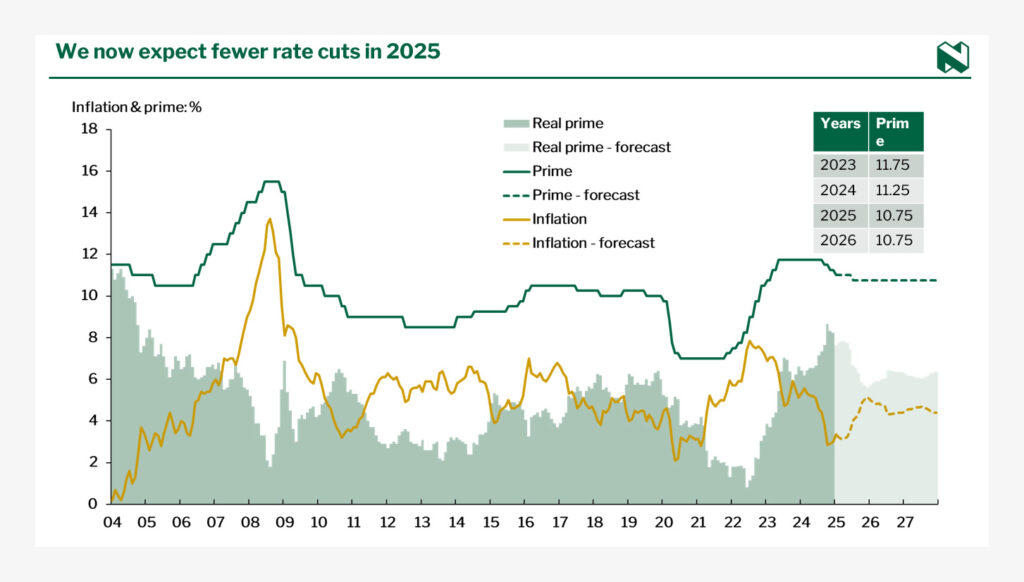
This is feedback from Nedbank chief economist Nicky Weimar, who outlined why the bank only expects one more 25 basis point cut in 2025 at a recent presentation in collaboration with SA REIT.
Weimar explained that the South African economy relies heavily on consumer spending for growth, with personal consumption making up over half of the country’s GDP.
This means that the economy is very sensitive to inflationary shocks and changes to interest rates as they impact consumer spending.
Towards the end of 2024, consumer spending grew strongly as inflation declined to below 3%, and the Reserve Bank began cutting interest rates in September.
Weimar said this resulted in retail growing by 10% year-on-year in October 2024 and 7.7% in November. In December, retail sales also grew strongly.
Implementing the two-pot retirement system, giving South Africans early access to a portion of their savings, also provided a boost.
However, the main factor behind increased spending was the reduction in inflation throughout 2024, particularly the sharp decline in the pace of goods inflation.
“Everything depends on where inflation will go and, secondly, where interest rates will go. Whether the consumer will keep on carrying the economy will depend on those two things,” Weimar said.
South Africa is in a similar position to the rest of the world when it comes to inflation, as the future is largely dependent on which policies the Trump administration implements.
Closer to home, Weimar said that goods inflation has come down as far as it can and will begin to tick up off a low base.
The same applies to food inflation, which came down dramatically in 2024. However, it has come down so far that its next move will likely be up.
“Now, fuel prices are starting to rise, with increases implemented over the past few months. This will effectively push headline inflation higher as it is a universal input.”
“Thankfully, services inflation is likely to remain constrained. But that low inflation rate is going to start increasing again.”
Weimar said the Reserve Bank would be watching this closely, but because it is coming from such a low level, there is still space to absorb any shock.
And so, there is likely to be one more cut in 2025, but no more as the Reserve Bank adopts a wait-and-see approach to what goes on in the US.
Another concern for Weimar is a potentially weaker rand as the dollar is expected to strengthen throughout 2025.
Amid elevated global uncertainty, investors tend to flock to the dollar and US-based assets as a safe haven, strengthening the greenback and weakening emerging market currencies.
Weimar explained that Trump’s stated trade policies and stance on immigration are almost guaranteed to be inflationary if implemented as he wishes.
As inflation picks up in the United States, the Federal Reserve is unlikely to cut rates further and may even have to hike rates later in the year.
Given the US’s position in the global financial system, this may have a ripple effect, with other central banks following the US’ lead.
Other central banks may also hike rates due to imported inflation from the US and other developed economies.
However, given the low inflation in South Africa, the Reserve Bank is unlikely to have to hike rates at all in 2025 and will most likely cut them once more.
This may have the unintended consequence of weakening the rand versus the dollar as the interest rate differential between the two countries will narrow.
A narrower interest rate differential will make US-based assets much more attractive to investors on a risk-adjusted basis.
As a result, capital is expected to flow into the US and out of emerging markets, strengthening the dollar and weakening emerging market currencies, such as the rand.
In turn, this will make it more expensive for South Africa to import goods, raising prices and inflation.
Weimar said this is what the Reserve Bank would be most concerned about, as it intensely focuses on the stability of the currency.






Comments