South African rand hit by a perfect storm


South Africa’s rand hit a one-year low amid growing domestic political uncertainty and heightened expectations for a United States interest rate hike.
On top of this, the aftermath of the artificial intelligence (AI) sell-off in global financial markets has also led to risk-off sentiment, further weakening the rand.
South Africa’s rand has always been and remains beholden to movements in the US dollar and global financial market risk sentiment.
This is because, as Old Mutual Wealth investment strategist Izak Odendaal described, “South Africa is a small boat on a large ocean”.
“Its markets have always been at the mercy of global developments, particularly movements in the dollar, commodity prices, and international risk appetite in general,” Odendaal said.
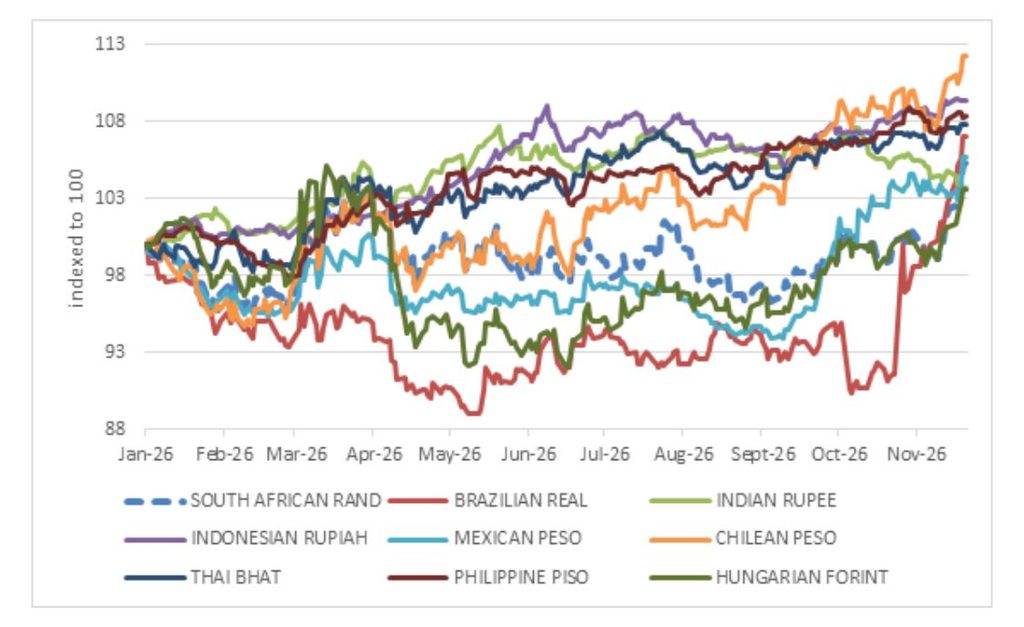
The rand has felt the negative effect of this over the past two weeks, with the local currency weakening to R17.62 per dollar on 22 November, its worst level in a year.
The currency has since strengthened to R17.38/USD at the close of business on Monday, 23 November. However, this is still among the weakest levels the rand has seen in 2026 to date.
Odendaal said it is clear, based on declines in other emerging market currencies, that the rand’s weakness is part of a global trend rather than primarily due to domestic political uncertainty.
Notably, this is not to say that local factors have not contributed to the rand’s weakness over the past two weeks.
Investec chief economist Annabel Bishop said South Africa’s currency risk has risen as market concerns grow over the outcome of the November local government elections.
“Market concerns have grown over political risk as the DA appears to be set to be frozen out of a number of coalitions,” she said.
“Negative investor sentiment towards South Africa will likely intensify if the ANC enters coalitions without the DA in the main in local government, as investors fear the largest political party could turn against the DA, threatening its inclusion in the GNU.”
Bishop explained that, historically, the end of the year typically designates a period of strength for the rand.
However, these political uncertainties have seen the rand break this trend, weakening amid concerns that the ANC is favouring coalitions with many non-centrist parties.
This, she said, could result in unstable coalitions and poor service delivery, heightening South Africa’s risk perception.
Global factors pressuring the rand
While these local uncertainties have contributed to the rand’s weakness, Odendaal and Bishop said global factors cannot be overlooked.
Two external pressures in particular have been weighing on the domestic currency: an AI sell-off in global markets, and heightened expectations of an incoming US interest rate hike.
Odendaal explained that, despite Anthropic’s record initial public offering on 19 November, global equities declined last week as unease spread over the durability of the AI capex boom.
“The JSE was not spared, despite its limited direct exposure to AI. This is typical when a ‘sell first, ask questions later’ mindset takes over,” he explained.
At the same time, he said there has been growing anxiety that the United States Federal Reserve (Fed) will raise rates aggressively in response to sticky inflation.
“This not only pressured equities but also led to a surge in the US dollar,” he explained.
“The strong dollar in turn put considerable pressure on precious metals prices, with gold falling to the lowest level in a year.”
Up until recently, higher precious metals prices have supported the rand and local markets in 2026. However, Odendaal said that support has now faded somewhat.
Bishop explained that higher US interest rates, driven by elevated inflation, have shifted market sentiment toward lower risk-taking, negatively affecting emerging market currencies.
“In addition, South Africa is on a flatter interest rate trajectory, negatively impacting investor sentiment on the interest rate differential,” she said.
In other words, the gap between the United States’ interest rate and South Africa’s would narrow if the Fed decides to hike at its next meeting.
This narrowing between South Africa and the US will reduce the relative returns on interest-rate-linked assets, making local assets less attractive.
Bishop pointed out that the rand’s weakening this close to the end of the year could spell trouble for the rest of 2026.
“Trade in the rand thins as year-end nears, and moving into the period on a weakened base erodes the currency further,” she said.
This, in turn, increases the local currency’s sensitivity and volatility to market-moving events, threatening further weakness if South Africa’s political risk continues to rise.
Login or register for unlimited free access.






Conversation
1 commentsI think the ‘perfect storm’ is over.