The idea Adrian Gore had while having a bath that made Discovery a global powerhouse


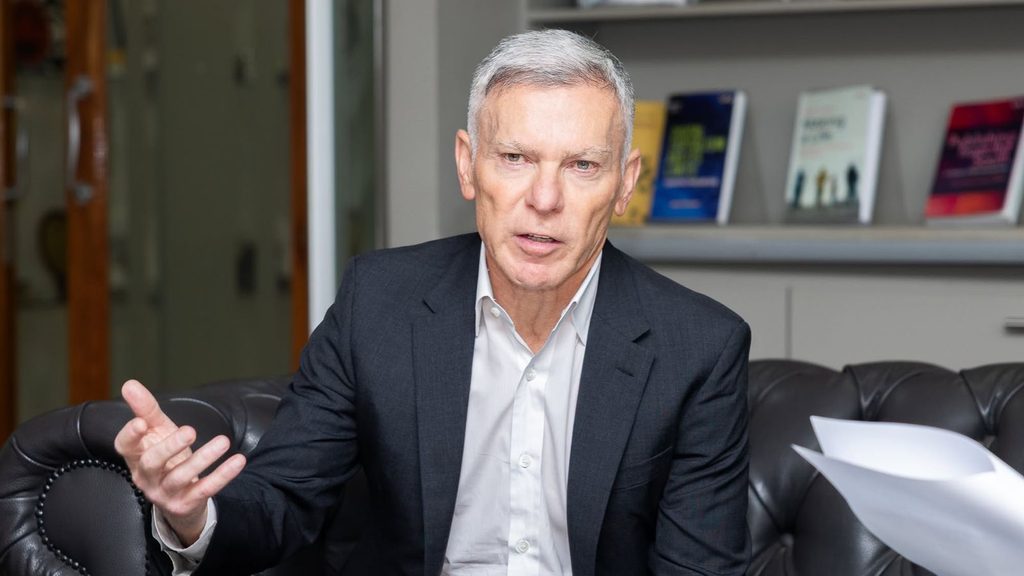
While having a bath after a run in 1997, Adrian Gore had the idea to reinvent health insurance using a Shared-Value Model that would become known as Vitality.
This idea flipped conceptions of health insurance on its head, away from purely managing risk and paying for sickness towards actively encouraging people to be healthier.
Gore explained that this idea is arguably the most pivotal in the history of Discovery apart from the decision to start the company in the first place.
In his book, The Four Principles, Gore explained how one idea can have an outsized impact on a company that makes other ideas and decisions effectively a rounding error.
This is part of his explanation of the fourth principle, which is the Pareto Tail and is the natural consequence of implementing the first three principles.
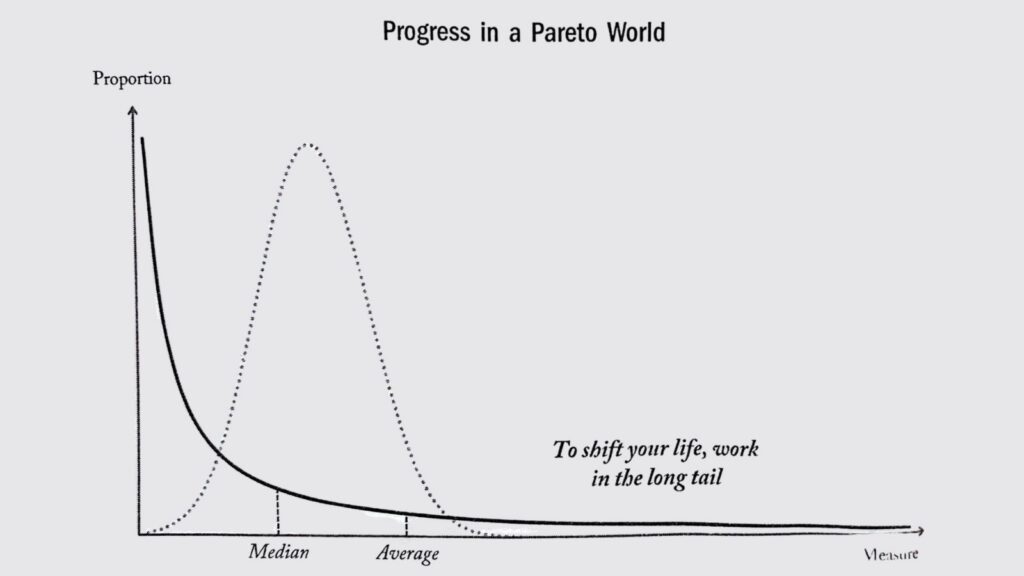
Gore explained that life is power-law distributed and does not follow the normal distribution we are taught in school as a bell curve.
A few ideas and decisions in the tail, such as where we live, who we marry, and where we work, have an extraordinarily outsized impact on our lives.
These are effectively the few decisions that really matter, as they determine much of our lives, whereas the bulk of ‘average’ decisions are not the determinants.
Gore explained that the only distributions in life that follow a typical bell curve are those of naturally occurring, isolated factors shaped by biology, such as height, weight, and IQ.
“We are taught in school that many phenomena follow a normal distribution. It is a comforting idea. It matches our preference for fairness, balance, and predictability,” Gore said.
However, this is misleading and a mistake. “Outside of nature, such neat patterns are rare. Almost no system conforms to a normal distribution because real-world systems are rarely independent.”
In contrast, life is dominated by Pareto distributions, where a small number of causes generate a large share of the effects.
This is often known as the 80/20 rule, with roughly 80% of outputs coming from 20% of inputs. For example, 80% of a company’s sales may come from 20% of its products.
This happens across all spheres of life. At the 2024 Olympics, 20% of countries won 83% of the medals. In academia, 20% of papers receive 80% of all citations.
In Discovery’s case, five chronic conditions – cardiovascular disease, cancer, respiratory illness, obesity, and diabetes – account for 94% of claims costs.
“Pareto is so pervasive that it should no longer surprise us: it is the norm, not the exception,” Gore said.
The idea in a bathtub
Gore used the example of an idea he had while having a bath after a morning run to illustrate how the Pareto tail has impacted Discovery.
This single idea formed the basis of the company and is responsible for much of its success, despite Gore having millions of other ideas that helped Discovery in one way or another.
“It seems remarkable to consider that, having worked twelve-hour days for more than three decades, a thought that took a few seconds could have such a disproportionate impact,” Gore said.
The idea was to reimagine health insurance, which Gore described as historically being characterised by insurers simply paying for sickness.
Gore’s idea was ot active incentivise people to be healthy by guiding them to do healthy things through rewards and points.
“It may sound obvious in hindsight, but at the time it was a radical shift: from transactional and passive insurer to active partner in our customers’ health and wellbeing,” Gore said.
Gore explained that the idea was far from fully formed, but it still forms the basis of Discovery’s Vitality model to this day.
To show how impactful the idea was, Gore pointed out that Discovery in 1997 only operated in South Africa and had 200,000 customers.
Today, the company generates R66 billion in revenue and serves 50 million customers around the world, with partners operating in 37 countries.
“A moment in the bath juxtaposed with a global business illustrates that a few critical decisions can have disproportionate impact and transform lives, businesses, and industries,” Gore said.
The idea Gore had in a bathtub now underpins Discovery’s Shared-Value Model, which has been applied across its businesses.
The model is most obviously used in the health insurance business, but is also used in the motor insurance business through Vitality Drive and in banking with Vitality Money.
Login or register for unlimited free access.