Finance Minister Enoch Godongwana gets a R54.1 billion gift


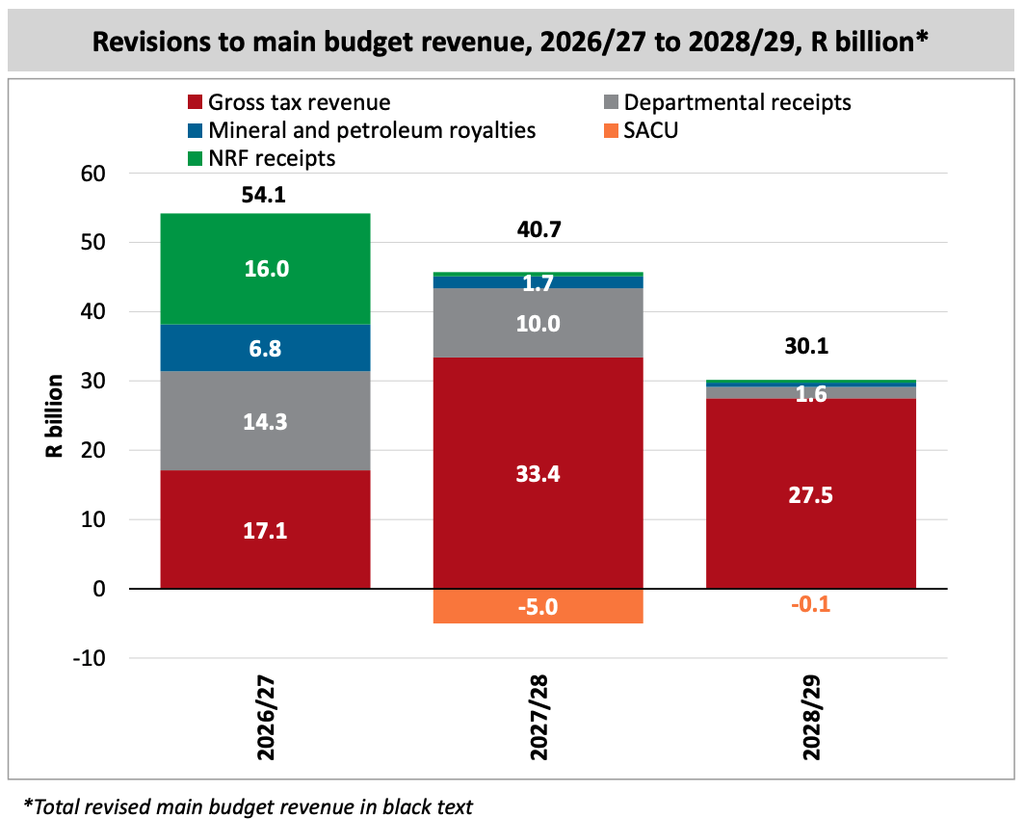
Finance Minister Enoch Godongwana revealed that the state’s revenue outlook is R54.1 billion stronger than expected.
This is mainly due to higher collections from corporate income, dividends, and value-added tax.
The good news does not stop there: revenue over the next two years is also projected to be R70.8 billion higher than expected.
Godongwana relayed this good news in his Medium-Term Budget Policy Statement (MTBPS) on Wednesday, 21 October 2026.
The Finance Minister said the state’s gross tax revenue has been revised upwards by R17.1 billion compared to projections in the February Budget.
“A large portion of this improvement is due to higher commodity prices and these gains are expected to dissipate over the medium term,” Godongwana noted.
Aside from the higher tax revenue, the state’s coffers also benefited from:
- R16 billion in National Revenue Fund receipts
- R14.3 billion in department receipts, bolstered by cash surpluses from public entities surrendered to the fiscus
- R6.8 billion from mining royalties, driven by high commodity prices
Overall, South Africa’s gross tax revenue is projected to increase from R2.14 trillion this year to R2.53 trillion in 2029/30.
This will be due to fuel levy collections normalising after this year’s relief and stronger corporate earnings.
Godongwana said this extra revenue will allow the government to increase its 2026/27 expenditure by R45.5 billion.
This will accommodate spending items such as disaster relief, provisional infrastructure allocations, and fuel levy relief.
Even with this additional spending, Godongwana said the Treasury remains on track to narrow the state’s main budget to 3.9% of GDP, down from 4% in February.
Standard Bank’s Head of South Africa Macroeconomic Research, Elna Moolman, said this MTBPS is positive for investors and the credit rating agencies.
She said the state’s revenue windfall can be used to spend more on infrastructure, which Treasury believes should boost growth and employment.
“Furthermore, it is very encouraging to see the range of interventions being implemented to improve municipal finances and services,” she said.
“It will, by nature, take time for these reforms to have a visible impact, but at least constructive policy interventions are gaining momentum.”