South Africa’s government spends R1.2 billion a day on ‘nothing’


South Africa’s government will spend R1.2 billion a day servicing its debt burden in the current financial year.
Annually, this amounts to R441.5 billion and is the largest single expenditure item in the national budget.
This money could be better spent on education, infrastructure, and public safety, but the current government has to pay the price for historic financial mismanagement.
Finance Minister Enoch Godongwana revealed this in his 2026 Medium-Term Budget Policy Statement (MTBPS) on 21 October.
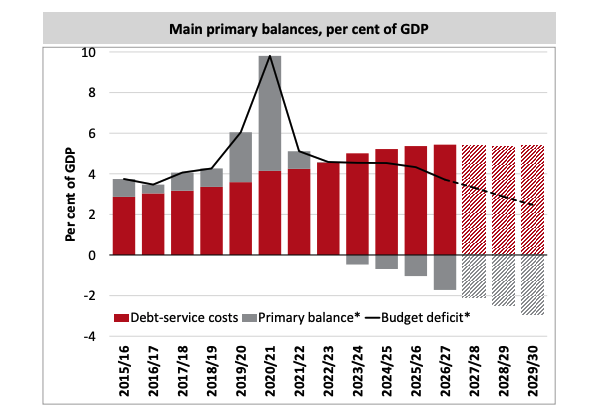
Godongwana also pointed out that debt-servicing costs will rise from R441.5 billion in the current financial year to R509.3 billion in 2030.
Crucially, however, it will remain the same percentage of South Africa’s GDP, indicating that it is stabilising as the government’s debt burden begins to decline.
This growth is also slower than the historic rate, which made debt-servicing costs the fastest-growing expenditure item in the national budget.
These costs are wasteful, as the money does not go towards improving economic growth or enhancing service delivery.
Rather, it is the price the current government and South African taxpayers are paying for past financial mismanagement from 2008 onwards.
The 2007/08 financial year remains the last time South Africa’s government ran a full budget surplus. Since then, spending has surged.
Running a budget deficit is not a problem in itself, but running consistent budget deficits results in a ballooning debt burden and slows the country’s economic growth rate.
The increased government spending since 2008 has not translated into faster economic growth, leaving South Africa with a debt burden that has peaked at 78.4% of GDP.
South Africa is now servicing this debt at relatively high interest rates, resulting in 22% of all tax revenue collected going towards interest payments.
The Centre for Risk Analysis’ Anlue Keeve pointed out that this is essentially dead money that cannot be used productively in other areas of the economy.
As a share of GDP, South Africa has experienced one of the fastest increases in government debt in history, from 24% in 2008/09 to over 76% at the end of the 2025 financial year.
This sparked fears of a debt spiral, where new debt would have to be issued to service existing liabilities.
However, the National Treasury’s process of fiscal consolidation appears to have worked in this regard, with South Africa avoiding the worst-case scenario.
South Africa’s debt burden has peaked and is beginning to decline, Godongwana revealed. This is thanks to the National Treasury’s policy of fiscal consolidation.





Conversation
2 commentsThey actually spend billions more on “nothing”
The CCs and hyenas are eating machines