End of an 18-year era for South Africa’s finances



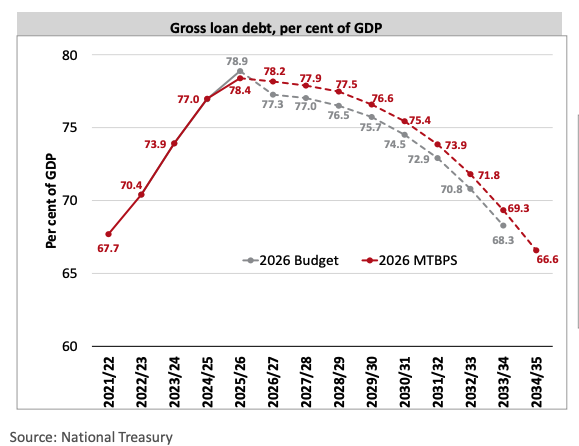
Finance Minister Enoch Godongwana announced that South Africa’s debt burden peaked at 78.4% of GDP and is beginning to decline.
This means the 2026/27 financial year will be the first since 2007/08 where South Africa’s debt burden has not grown, and it brings a decade of missed projections to an end.
Stabilising the debt burden is important for the country, as it will free up more capital to invest in infrastructure and growth.
South Africa currently spends R1.2 billion a day to service its debt, or 22% of every rand collected in taxes, squeezing out spending on education, safety, and infrastructure.
“We have consistently said that debt would stabilise in 2025/26 and then begin to decline,” Godongwana said in his Medium-Term Budget Policy Statement (MTBPS).
“Debt as a percentage of GDP is now falling, creating a stronger foundation for investment, growth, and job creation.”
“The fiscal space created through disciplined budgeting allows us to protect frontline services, preserve the jobs of teachers, doctors, and nurses, while protecting the social wage for the most vulnerable.”
Credit rating upgrades on the cards
It will also greatly improve South Africa’s standing with international credit rating agencies and put the country on track to reach investment grade in the coming years.
“Earlier this year, all three major credit rating agencies announced positive treatment actions on South Africa, despite a challenging environment,” Godongwana said.
Despite these positive changes, South Africa is still classified as “junk” by all three, meaning that global pension funds and other investment vehicles cannot allocate capital to the country.
This limits the pool of capital available to fund fixed investment in infrastructure, equipment, and machinery, which drives economic growth.
93% of fixed investment is funded by domestic savings, thereby limiting the pool of capital available for this purpose.
As South Africa claws its way back to investment-grade status, foreign capital will be allowed to flow into the country’s financial assets and fixed investment.
The improvement in South Africa’s finances has not come without significant pain and is largely thanks to the fiscal consolidation imposed by the National Treasury.
This has been done by enhancing tax revenue through increased enforcement by SARS and by limiting tax relief by minimising inflationary adjustments to personal income tax brackets.
Coupled with this is much closer control of state spending, limiting growth below inflation.
Ultimately, this results in primary budget surpluses, which means the state is spending less money than it brings in through taxes. This excludes debt-servicing costs.
The upshot is that the debt burden does not grow and, over time, enables the state to pay it down. This is where South Africa is now, after five years of fiscal consolidation.
Standard Bank’s head of South Africa macroeconomic research, Dr Elna Moolman, said the MTBPS is positive for investors and the credit rating agencies, as it reiterates the commitment to restoring fiscal sustainability.
Moolman said there might ultimately be further positive rating action.
More importantly, the MTBPS signals a shift from the National Treasury towards economic growth.
In recent years, Treasury was focused on restoring fiscal credibility and sustainability – in other words, stabilising the government’s debt.
The focus is now shifting to the clear prioritisation of economic growth, Moolman said.