Tables turn on Finance Minister Enoch Godongwana



Finance Minister Enoch Godongwana faces one of his toughest Medium-Term Budget Policy Statements (MTBPS) in his five-year tenure in charge of South Africa’s finances.
This would not have been what Godongwana was expecting after unveiling the 2026 Budget in February, which showed the country had seemingly turned the corner.
The South African Institute of Taxation (SAIT) explained that Godongwana would have been celebrating along with the rest of the country in February.
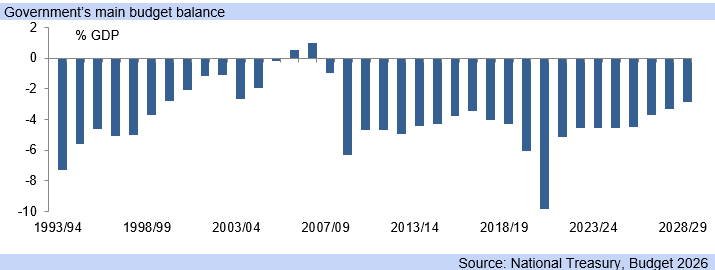
Debt was stabilising for the first time in 17 years, South Africa had exited the grey list, and the country had received its first credit rating upgrade in 16 years.
This was coupled with relief for taxpayers as the National Treasury withdrew the R20 billion in tax increase proposed to plug a revenue shortfall.
Godongwana adjusted personal income tax brackets for the first time in two years and increased the contribution limit on tax-free savings.
Small businesses were not left out of the party, seeing the VAT registration threshold more than doubled from R1 million to R2.3 million.
This euphoria was short-lived as three days later, the United States and Israel launched airstrikes on Iran. “That budget was written for a world that no longer exists,” SAIT said.
South Africa’s expected economic growth of 1.8% has been cut to 1% by most economists as oil prices surge and the rand comes under pressure.
Godongwana’s MTBPS will likely be made with oil prices above $100 per barrel. Diesel prices have risen from R17 per litre to R33 per litre, and petrol is at record highs.
This has pushed inflation higher, with Stanlib chief economist Kevin Lings expecting it to cross 5% when the latest fuel increases are factored in.
As a result, the Reserve Bank has hiked interest rates twice, taking the repo rate to 7.25% on 23 September. This is a far cry from the expected cuts at the beginning of 2026.
This will slow economic growth, with the latest data from Stats SA showing the economy contracted by 0.2% year-on-year in the second quarter.
Slower economic growth has significant implications for tax revenue. As companies’ earnings come under pressure, so do wages and consumer spending.
SAIT also noted that Godongwana gave up R17.2 billion in revenue by granting temporary fuel relief from April to June.
What to expect
The MTBPS differs from the Budget Speech at the beginning of the year in that it does not directly address government spending and revenue.
While Godongwana will give an update regarding this in the MTBPS, he will focus more on how the National Treasury aims to achieve macroeconomic stability and support growth.
This will show how the government’s finances are holding up amid the conflict in the Middle East and whether any tax changes will be made to bolster revenue.
“February’s Budget was a credibility budget. This MTBPS will be a resilience test,” SAIT CEO Keith Engel explained.
“The Minister kept his promise not to raise taxes in 2026. The real question on 21 October is whether that promise survives anaemic growth, a fuel shock, and two rate hikes.”
SAIT does not expect the MTBPS to bring any changes to tax rates, but it will reveal whether the government will have to consider increases in its 2027 Budget.
In particular, it expects a wider budget deficit and delays to the National Treasury’s debt stabilisation forecast.
The Budget projected the government’s deficit falling to 4% of GDP in the current financial year and total debt dropping to 77.3%.
However, SAIT expects both targets to be challenged as higher interest rates and a weaker rand raise debt-servicing costs.
More importantly, slower economic growth will affect tax revenue, making it likely that the National Treasury will delay debt stabilisation.
SAIT expects Godongwana to spend much time discussing South Africa’s economic growth challenges, with it forecasting growth slipping below 1%.
The National Treasury expected the local economy to grow by 1.6% in 2026, with this rising to 2% by 2028 as structural reforms bear fruit.
Ongoing geopolitical tensions, disruptions to global trade and renewed volatility in energy markets may place pressure on both global and domestic growth forecasts.
SAIT expects Treasury to revisit these assumptions in the MTBPS and provide an updated assessment of the risks facing South Africa’s growth trajectory.


Comments