South African rand is the world’s worst-performing currency after interest rate surprise


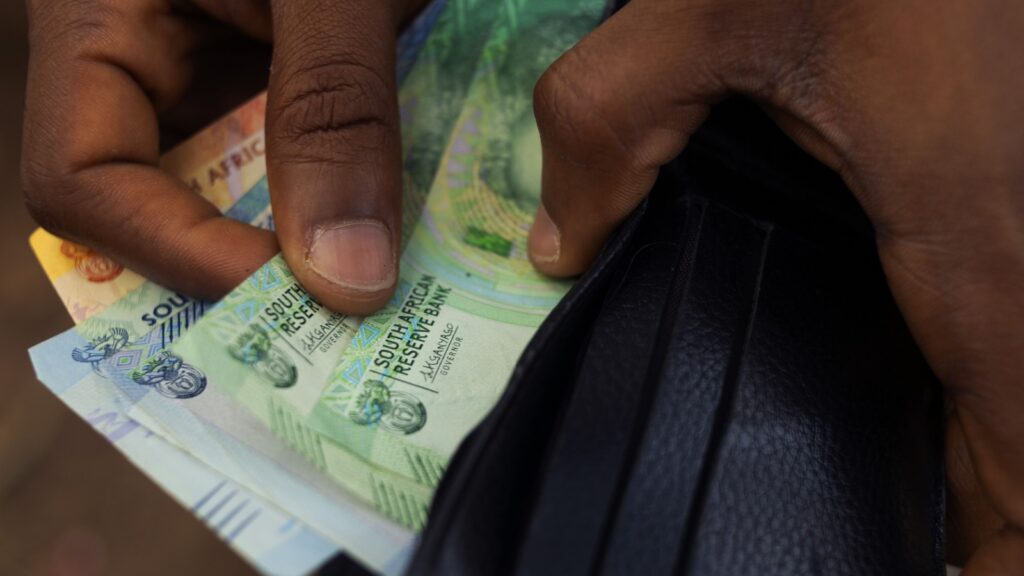
The South African rand slumped after the central bank defied expectations by leaving interest rates unchanged to support economic growth and revised its inflation forecasts lower.
The six-member monetary policy committee maintained the benchmark policy rate at 7%, Governor Lesetja Kganyago told reporters in Pretoria on Thursday.
Only three of 20 economists surveyed by Bloomberg had expected a hold, with the rest predicting a 25 basis-point increase.
“The inflation outlook has improved slightly since our last meeting, but inflation is still too high, while growth is weak,” Kganyago said.
“We are setting policy to achieve 3% inflation over time, ensuring the current supply shock does not de-anchor inflation expectations.”
The rand fell as much as 2.5% and traded 2.2% weaker at 16.76 per dollar by 5:51 p.m. in Johannesburg — the world’s worst-performing currency on the day.
The yield on the benchmark 10-year bond rose 16 basis points to 8.96%.
The currency drop was a “pronounced and immediate reaction to the unexpected hold,” said Razia Khan, head of Africa research at Standard Chartered.
Four members of the MPC backed the hold, and two favoured a 25-basis point increase.
The committee highlighted risks to growth from weaker consumer and business confidence and highlighted that most of the inflation overshoot has so far come from higher fuel costs.
It said goods prices have been relatively well contained, while cautioning that for services inflation, conditions look problematic.
The fallout from the Middle East conflict has impacted inflation across the world. The South African Reserve Bank’s decision follows rate holds in Nigeria and Canada this month and hikes in Ethiopia and South Korea.
South African policymakers also outlined a scenario in which they would need to hike again if consumer prices remain persistently above their 3% target and spill into food costs and core inflation because of the intensification of fighting between the US and Iran.
“My base case is that we do see another hike out of the SARB, but it’s careful adjustments rather than a whole series of rate hikes,” said Lauren van Biljon, portfolio manager at Allspring Global Investments.
“Looking ahead, the key is going to be how events in the Middle East play out, and whether we see the gap between headline and core inflation continuing to grow.”
South African inflation rose at its fastest pace in two years in June to 5%, moving further away from the central bank’s 3% target.
It’s forecast to stay about 4% until early next year and is now seen averaging 4% over 2026 as a whole, compared with 4.4% previously.
Officials see economic growth at 1.4% this year, compared with a previous forecast of 1.2%, while warning that it could slow in the second and third quarters.
The rate decision “was not about inflation, it was about growth,” said Kristof Kruger, a fixed-income trader at Prescient Securities. “Hiking further into a supply shock risked tipping a fragile economy toward recession.”
The central bank’s closely watched quarterly projection model indicated a slight upward revision in the expected policy rate, with the year-end forecast rising to 6.79% from 6.7%.
“We will take every decision meeting by meeting, depending on the data, the outlook, and the balance of risks to the outlook,” Kganyago said.



Comments