Major international bank sends interest rate warning for South Africa


The Bank of America (BofA) said it expects South Africa to see a second interest rate hike in July 2026, as the country’s inflation expectations continue to creep higher.
BofA is the second largest bank in the United States by total assets, as well as the second largest bank in the world by market capitalisation, behind JPMorgan Chase in both instances.
In a newly released report, the bank said the South African Reserve Bank (SARB) would likely raise interest rates by another 25 basis points, following a similar move in May.
The SARB’s Monetary Policy Committee (MPC) will hold its next meeting on 23 July, where it will announce its decision on the movement of South Africa’s interest rates.
BofA said it fully expects a hike up to 7.25%, although it conceded that the MPC’s decision will come down to a “close call” between hiking rates or holding them where they are.
“We expect SARB to hike by 25bp at the 23 July meeting, following the May hike to 7.00%, and then pause,” BofA said. “However, the decision is not one-sided.”
“The May MPC vote was split 4-2, with two members favouring no change, so the July meeting is likely to involve another close call between a hike and a hold.”
BofA explained that the prospect of a hold had increased somewhat due to declining oil prices as a result of the mid-June ceasefire agreement reached between the US and Iran.
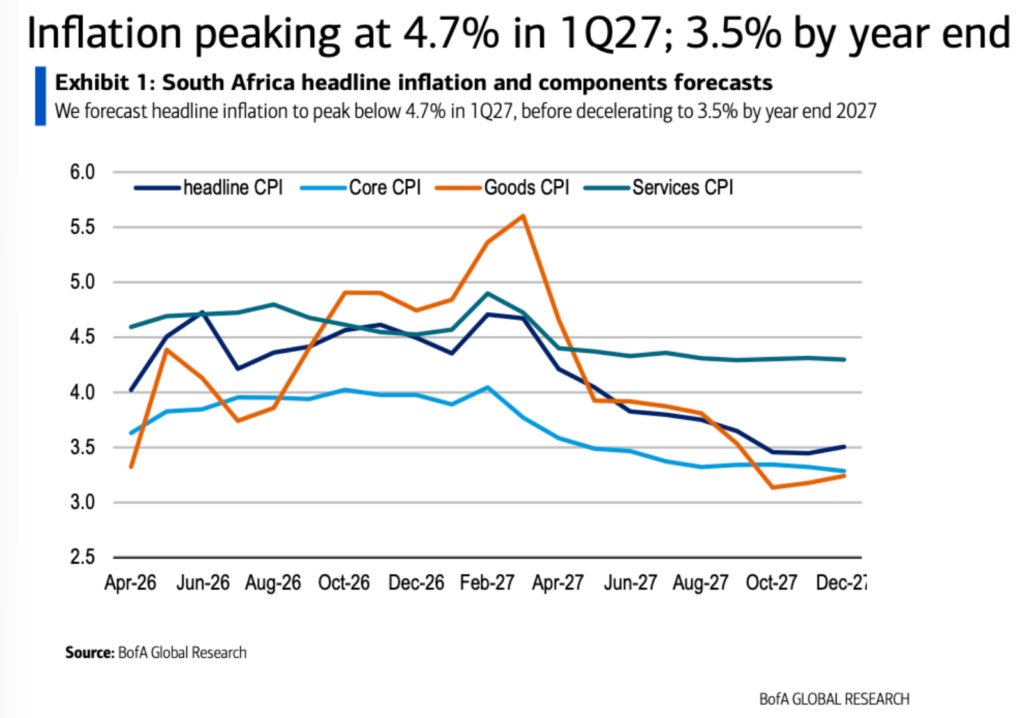
However, it said a hike was more likely as inflation expectations had risen from 3.6% up to 4.4% in the second quarter of 2026, well above the SARB’s 3% inflation target.
Additionally, the bank said it predicted consumer price inflation (CPI) would rise to 4.7% in June, before declining again to 4.2% in July.
“Besides fuel, June inflation should be supported by an increase in rental inflation, which is typically surveyed in June and therefore adds upward pressure to the headline index,” BofA said.
“Food inflation is expected to remain contained, with disinflation in components such as edible oils, fruits and vegetables helping offset broader price pressures.”
SARB doesn’t need to follow the Fed
Because the United States monetary policy plays a key role in determining global financial conditions, BofA said the SARB may ask itself if it should follow the Federal Reserve’s example.
BofA’s economic analysts revised their Fed forecasts from a sustained hold in 2026 to a prediction of three rate hikes between September and December.
However, BofA said that while the two banks generally tend to move in the same direction, they both maintained key differences in the timing and extent of their actions.
“Historically, the SARB has often moved ahead of the Fed, particularly during inflationary episodes, while ultimately delivering a smaller cumulative tightening cycle,” BofA said.
“The most recent hiking cycle illustrates this clearly. The SARB began raising rates in November 2021, several months before the Fed’s first hike in March 2022.”
During this cycle, the SARB raised interest rates by a total of 475 basis points, while the Federal Reserve hiked the United States’ interest rates by as much as 525 basis points.
Another factor which BofA said is just as critical to consider is the significant decline in South Africa’s sovereign risk premium over the last two years.
10-year government bond yields decreased from around 12% in May 2024 to around 8% or so in May 2026, representing almost 400 basis points.
BofA said this was reflective of several positive economic developments in South Africa, namely a higher policy predictability under the Government of National Unity.
Other factors included the country’s progress toward tackling energy supply constraints, its stronger fiscal results, and its more positive medium-term growth prospects.
“While Fed policy remains an important influence on global financial conditions, it does not automatically determine the SARB’s policy path,” BofA said.
“Historical experience shows that the SARB often moves independently, responding to domestic inflation pressures, inflation expectations and local financial conditions.”






Comments