War for talent in South Africa’s technology and finance industries


Amid South Africa’s skills shortage, particularly in highly specialised fields such as technology and finance, PSG Financial Services managed to integrate 147 newly qualified graduates in just one year.
Even more impressively, around 30% of PSG’s core staff have come from the firm’s graduate programme in the past eight years.
This accomplishment comes as South Africa is facing a so-called “talent war”, which is making retention and succession key priorities for many local asset managers.
Alexforbes’ head of research, Premal Ranchod, explained in the asset manager’s latest Manager Watch Annual Survey that this has become a necessity to compete.
“Firms compete not only on performance, but on the strength of their investment benches – the depth of analysts, the quality of debate in investment committees and the resilience of their talent pipelines,” he said.
However, Ranchod said this is easier said than done in South Africa, as the country still grapples with deeply entrenched inequalities in education, skills development and workforce readiness.
He explained that South Africa’s talent pipeline for investment narrows long before firms begin hiring.
This is because weak mathematics and science outcomes at the school level significantly limit the number of students able to pursue quantitatively demanding degrees, shrinking the pool of investment-ready graduates.
Recent international assessments of South Africa’s education system have found that over 80% of Grade 4 learners cannot read for meaning, and in 47% of secondary schools, no child reached the intermediate maths benchmark.
“For the asset management industry, the implications are profound – the talent pipeline that feeds analysts, portfolio managers and investment leaders is constrained by upstream gaps in schooling, STEM achievement and workplace readiness,” Ranchod said.
He warned that if firms and regulators persist with hiring for optics rather than capability, the local asset management industry risks stagnating.
“The result is a capital flight or emigration phenomenon (across race or gender) as qualified professionals seek roles where hiring is based on their skill sets rather than race or gender scorecards,” he said.
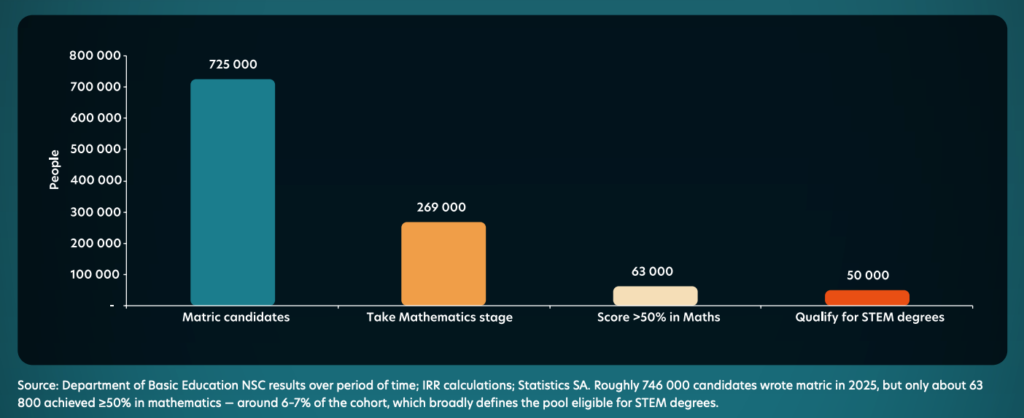
The graph below, courtesy of Alexforbes, shows South Africa’s National School Certificate Results for 2025.
PSG’s approach to attracting and retaining talent
In an interview following the company’s latest annual results, PSG CFO Mike Smith told Daily Investor that, because of South Africa’s skills shortage, PSG considers taking on new graduates a top priority.
However, the buck does not stop there, with the company also focusing on training these graduates through its five-year programme and providing them with a long-term career path within PSG.
“For us, one of the key things is taking on new graduates and growing that talent in our business,” he said.
PSG’s latest annual results for the 2026 financial year showed that the company’s total employees have grown at a compound annual growth rate (CAGR) of 5% since 2016, with the figure now standing at 3,371.
Over the same period, PSG’s assets under management have grown at a CAGR of 14%, while its recurring headline earnings have grown at a rate of 15%. In 2026, PSG’s return on equity also reached a high of 31.7%.
Smith attributed this strong growth, in part, to PSG’s highly successful graduate programme.
“Bringing in smart, energised people, giving them the right opportunity, I think, has helped grow the business,” he said.
Smith explained that the reason for PSG’s focus on hiring graduates from its programme is that it allows the company to align these employees with its own structures and way of working.
“What you find also when you take someone from an existing place, it takes a long time for them to adapt and take out some of the bad habits,” he explained.
“Where you bring in graduates, you can actually mould and align them more efficiently.”
He said this is particularly important for PSG, as it prefers to “bottom fill” any vacancies in the company, meaning newer, entry-level employees replace the vacancy created when a more senior employee is promoted.
This not only ensures better continuity within PSG but also shows younger employees that there is a long-term career path within the company.
“A successful business that grows like us, we’ll be able to hire more people, remunerate well, so it’s all of these positive aspects that make it a positive place for people to want to join,” he said.






Comments