Tax on a plastic bag went from 3 cents to 32 cents in two decades


The levy charged on plastic bags in South Africa has gone from 3 cents per bag in 2004 to 32 cents per bag in 2024, an over 966% increase across two decades.
This levy was introduced in 2004 in response to the growing problem of plastic pollution, intended to dissuade shoppers from using plastic bags in favour of more eco-friendly alternatives.
Ever since, South Africa’s plastic bags levy has been hiked seven times, with the biggest jump coming in 2020, when it was raised from 12 cents to 25 cents.
This was revealed in the Reserve Bank’s recent Tax Chronology report, which outlined various changes in South Africa’s tax system between 1979 and 2026.
In this report, the Reserve Bank described the increases in the plastic bags levy between 2009 and today.
According to the South African Revenue Service, this levy applies to certain types of plastic carrier and flat bags, “the disposal of which is littering the environment”.
The levy charged on these bags falls within the broader category of Environmental Tax in South Africa.
Initially, the government had introduced regulations banning the manufacture and use of certain types of plastic bags.
However, in 2003, it was announced that these regulations would be reversed, and instead, a levy on plastic bags would be introduced.
South Africa’s 2003/04 Budget Review said some of the revenues collected from this levy will be earmarked for the recycling of plastic bags.
Thus, the levy on plastic shopping bags was introduced at 3 cents per bag in 2004/05. It would remain at this rate until 2009, when the Treasury proposed hiking it to 4 cents.
“Together with the agreement between government and the retail sector to charge for such bags, this levy has helped to reduce waste,” the 2009 Budget stated.
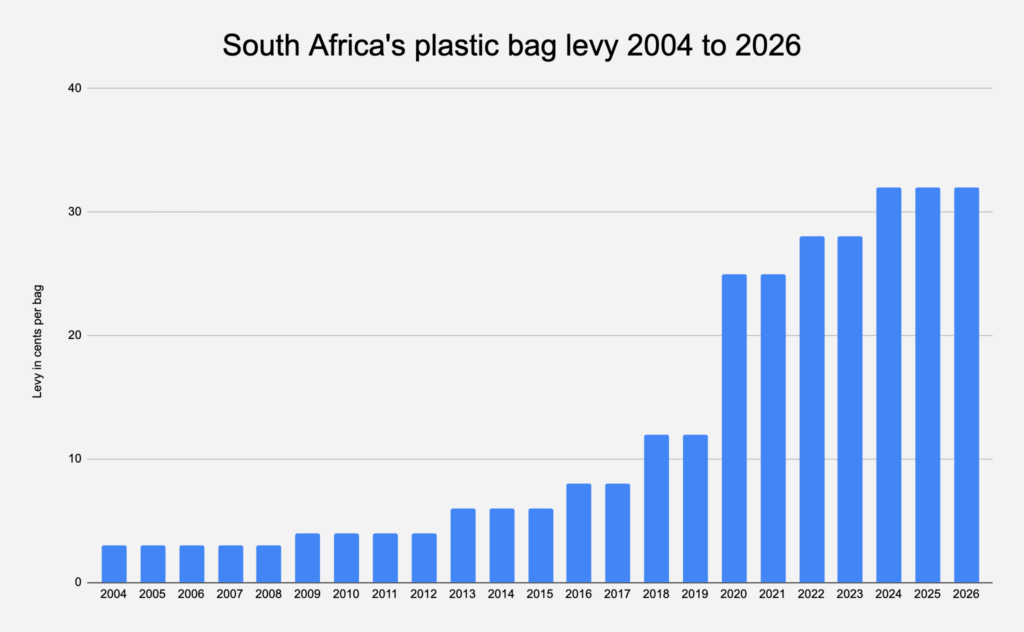
In the years to follow, the plastic bags levy would increase every few years, eventually reaching 32 cents per bag in 2024.
South Africa’s plastic bags levy
According to the Reserve Bank’s report, the plastic bags levy remained at 4 cents from 2009 until 2013, when it was hiked to 6 cents per bag. Three years later, it was raised to 8 cents per bag.
Another hike would come two years later, in 2018, when the levy was increased to 12 cents per bag.
At the time, the National Treasury said in its 2018 Budget Review that this is intended to reduce litter and dissuade customers from buying plastic bags.
The levy remained at this level for two years, but saw its biggest hike yet in 2020, when the Treasury increased it to 25 cents. The 2020 Budget Review explained that an estimated 12.7 million tonnes of plastic litter the world’s oceans.
“While progress has been made in the domestic environment, plastic pollution remains a significant problem, particularly for marine life,” the Treasury said.
“The National Treasury will consult on extending the current levy on plastic bags to all single-use plastics used for retail consumption, including plastic straws, utensils and packaging.”
Therefore, to support the shift to a greener economy, the 2021 Budget Review announced that the government would start to differentiate levies on fossil-based and bio-based plastic bags.
While plastic bags were taxed at 25 cents per bag, a reduced levy of 12.5 cents per bag applied to bio-based plastic bags.
In 2022, the Treasury hiked the plastic bags levy to 28 cents per bag, which it said was in line with inflation.
“Government aims to reduce single‐use plastics. An upstream plastic tax and a tax on single‐use plastics will be investigated,” it said in the 2022 Budget Review.
Two years later, the government increased the levy to 32 cents per bag, where it remains today.
Over all of these years, the plastic bags levy emerged as a small but not insignificant source of revenue for the government.
For 2024/25, the government collected R698.71 million in revenue from the plastic bags levy. In 2004/05, when the levy was introduced, it contributed around R40 million.



Comments