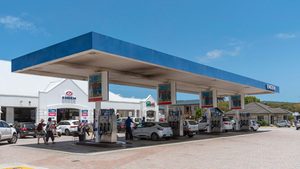
South African petrol stations changing in front of everyone’s eyes


Declining fuel demand is forcing petrol stations to evolve into diversified energy and retail hubs, with electric vehicle (EV) charging, renewable energy, and expanded services offering a path to future profitability.
According to Nedbank, now, more than ever, is an uncertain time for fuel stations. The bank said the decline in fuel sales has become a market trend.
The industry estimates that global retail fuel purchases will have declined by as much as 9.2% between 2019 and 2030.
This is driven by a slowing global economy, the adoption of EVs, and the rise in both remote work and online shopping.
Now, this issue is being further compounded by the US-Israeli war on Iran, which broke out on 28 February. This conflict has led to the closure of the Strait of Hormuz, through which around 20% of global oil supply is transported.
As a result, oil prices have shot up globally, with the Department of Mineral and Petroleum Resources noting that the average price of a barrel of Brent crude rose from $69 in the previous period to $93.67 over the past month.
South Africa has been hit hard, as the rand’s weakness has amplified the impact of the oil price shock by making imports more expensive.
As a result, the country’s petrol prices increased by over R3 per litre, while diesel surged by over R7 per litre on 1 April.
Experts such as independent economist John Loos have already noted that the conflict and surging fuel prices could cause a work-from-home resurgence in South Africa.
Taken together, these factors point to potentially sustained declines in petrol and diesel sales. For fuel stations, this will not only affect their core business but also lead to a decline in business for forecourt retailers.
Nedbank stressed that petrol station owners should be preparing for the future. This means that, soon, forecourts may look a lot different from what South Africans are used to.
What petrol stations should be doing

Ironically, although EVs are reducing demand for fossil fuels, Nedbank said the technology also gives fuel retailers the opportunity to develop a new revenue stream.
Industry estimates predict that demand for EV charging at fuel stations will have increased by 36% between 2019 and 2030.
South Africa’s automotive industry is likely to transition away from internal combustion engine vehicles relatively slowly.
However, the European Union’s ban on new petrol and diesel engine sales from 2035, in line with climate action commitments, means the local manufacturing industry will have to pivot to EVs.
Rising international market demand, which is driving the development of local manufacturing capacity, should also stimulate investment in EV infrastructure across South Africa’s supply chain.
With improved economies of scale, South African EV prices should come down over time. All these factors will strengthen the outlook for local EV charging infrastructure.
Existing fuel stations are ideally placed to support this transition, even though it will take time and investment to scale up EV manufacturing and infrastructure.
According to Nedbank, installing EV charging facilities offers fuel retailers strong revenue potential. Only around 100 of South Africa’s more than 5,000 fuel stations currently offer EV charging.
This means there is enormous potential as the market evolves and matures, especially for fuel retailers who move early.
Although the range per charge is still a key factor in determining the location of EV charging stations, this range is improving constantly and will become less important as the number of charging stations increases.
Nedbank noted that adding charging stations is not the only opportunity available to forecourt owners in South Africa.
A recent real estate study by Cushman & Wakefield/Broll indicates a shift away from reliance on fuel sales, which currently generate about 90% of revenue, toward a more diverse set of ‘mobility solutions’.
This would see fuel stations offer a wider range of fuel options, including natural gas, electricity, and green hydrogen.
Because EV charging takes longer than refuelling with fuel, hydrogen, or gas, fuel stations can expand their offerings beyond existing forecourt retail.
These could include parts, repairs, and vehicle services, as well as non-automotive businesses such as pharmacies, laundries, and even coworking spaces.
Nedbank said letting customers multitask while they recharge their batteries expands a station’s retail opportunities.
Turning fuel stations into green energy leaders

EVs reflect the growing demand for alternative energy. Far from remaining dependent on oil, many oil companies are diversifying their energy offerings and pivoting towards green energy.
Sasol, for example, has several projects underway to advance the manufacturing and adoption of green hydrogen in the heavy-vehicle sector.
The fuel is produced from water using renewable energy, allows for quick refuelling, and has the energy density needed to power heavy vehicles over long distances.
Green hydrogen can also be supplied by existing stations, further diversifying the product offering beyond petrol and diesel.
Like many other South African businesses, fuel station owners have incurred high costs in the fight against load-shedding.
Diesel and generator costs have hit fuel stations’ bottom lines, and many cannot reduce them by installing solar or renewable energy because of contracts with site owners who are more committed to petrol and diesel.
However, as the Sasol example shows, this mindset is changing. As the global shift to renewable energy accelerates, fuel station retailers are well-positioned to lead the market.
Their buildings and forecourts offer ample roof space in the sun, making them ideally suited for solar photovoltaic installations.
Nedbank added that, despite changing market conditions and global uncertainties, the outlook for fuel stations is more positive than it appears.
Installing renewable energy systems and upgrading sites to offer alternative energy supplies and enhanced retail services will cost money upfront, but it presents a viable, future-proof strategy for keeping forecourts profitable.





Comments