Top economist shares bad news about interest rates in South Africa


PSG Financial Services chief economist Johann Els said the Reserve Bank will likely place any interest rate cuts on hold until global uncertainty subsides.
This comes as the US’ war with Iran rage on, keeping uncertainty high as it remains unclear when the conflict will end.
However, this is not to say that more interest rate cuts are completely off the table, as a quick end to the conflict and a return to pre-war oil prices could still lead to three more 25-basis-point cuts in 2026.
For the South African economy as a whole, Els explained that the outlook for 2026 still appears somewhat better.
“Structural constraints in the economy are gradually easing, while cyclical conditions are also improving,” he said.
“Lower inflation and earlier interest rate cuts have helped support consumer spending, and private sector fixed investment should increasingly begin to contribute to growth.”
Based on these factors, Els expects economic growth to edge higher from around 1.4% in 2025 to roughly 1.9% in 2026. Stats SA’s latest date release confirmed that GDP growth was 1.1% in 2025.
However, he warned that global developments present a notable risk to this outlook. As a small, open economy that is heavily dependent on exports, South Africa is highly vulnerable to external shocks.
While not directly involved, South Africa is already feeling some pressure from the conflict in the Middle East, specifically in the form of a weaker rand and higher oil prices.
The rand has weakened since the start of the conflict, as investors flock to the US dollar as a safe-haven asset, with the stronger greenback weakening South Africa’s currency.
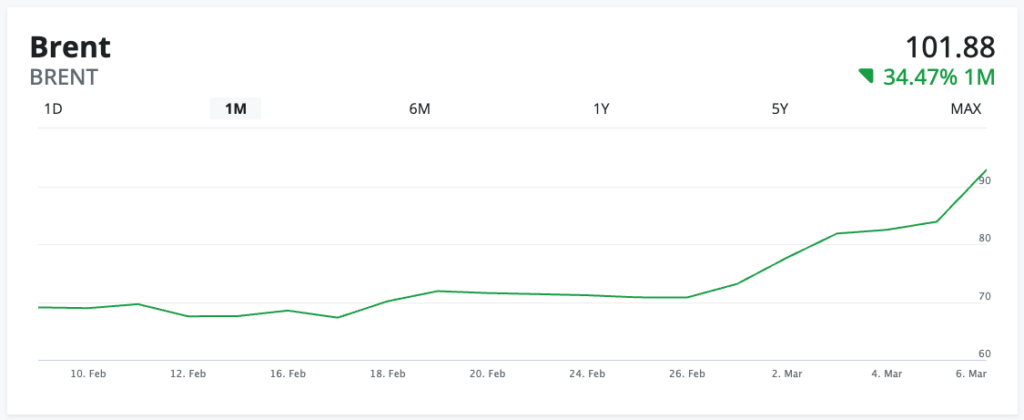
At the same time, oil prices have skyrocketed, with the rand oil price rising to R1,814/bbl earlier this week from R1,161/USD at the end of February.
This has already led to a rise in petrol prices for South African motorists, with more expected should the conflict continue.
It should be noted that on Tuesday, 10 March, oil prices have come down to around $90/bbl.
Inflation and interest rates
Els said that, at current levels, it appears possible that the petrol price in South Africa could rise by as much as R4 per litre in April.
This is expected to put upward pressure on inflation in South Africa, with Els saying it would push CPI inflation temporarily towards around 4% for April.
This is far higher than his previous estimate of roughly 3.4% for next month, and one percentage point higher than the Reserve Bank’s target of 3%.
“As a result, average inflation for 2026 could rise from around 3.2% to closer to 3.7%,” Els said.
This spells bad news for interest rates in South Africa. While the Reserve Bank’s 3% inflation target has a one percentage point tolerance band, Governor Lesetja Kganyago has made it clear that the preferred level for inflation is 3%.
Kganyago has emphasised that any inflation outcome above or below 3% will be responded to with monetary policy adjustments.
Therefore, any inflation print or expectations above 3% could lead to South Africa having higher interest rates for longer, as the Reserve Bank remains highly cautious in an uncertain environment.
“Given these global risks and the uncertainty around the duration of the conflict, I expect the South African Reserve Bank to keep interest rates unchanged for the foreseeable future, until there is greater clarity about the global outlook,” Els said.
Before the recent escalation in geopolitical tensions, Els expected three 25-basis-point interest rate cuts for 2026.
“If the conflict ends relatively soon and oil prices fall back towards pre-war levels, those rate cuts could still materialise later in the year,” he said.
“Ultimately, the duration of the conflict will determine how the outlook for inflation and interest rates evolves.”
Investec chief economist Annabel Bishop has shared a similar outlook, saying the oil price shock would likely be looked through by the Reserve Bank’s Monetary Policy Committee.
However, this is contingent upon high oil prices being short-lived and no second-round effects flowing into other prices. Should this materialise, she said interest rates will likely remain unchanged.
However, Bishop warned that higher food and other prices would increase the chance of a hike.
In this case, the oil price would need to be at $110/bbl or higher, and the rand would need to be at R16.80/USD or weaker over the remainder of the first half of 2026.
This, she said, would push CPI inflation above 4.0% in the second quarter of 2026, increasing the chance of an interest rate hike this year. However, Bishop added that this is not the expected outcome.




Comments