Discovery set to do the impossible


Discovery is well on track to effectively double the size of its business by its 2029 financial year, with the company’s business units showing strong momentum in its new phase of “scaled organic growth”.
Doubling the size of a business that generated over R70 billion in revenue in its 2023 financial year and R6.6 billion in profit is no mean feat.
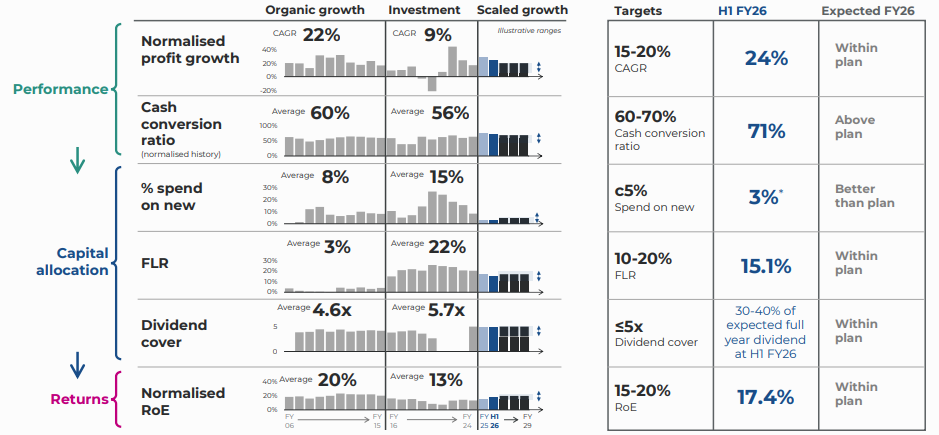
To do so, Discovery aims to grow its normalised profit at over 15% until 2029, boosted by reduced spending on its new business units as they become profitable.
The company’s return on equity will rise to between 15% and 20%, with its cash conversion ratio soaring to over 60% under this plan.
Despite exceeding these targets for the first full year under the new phase of growth and in the first half of the 2026 financial year, CEO Adrian Gore is under no illusions as to how hard this will be.
“I mean, we are at an interim phase. It has been a very good period, but we are still kind of guiding towards just saying we have got this target and that is where we are going,” Gore told Daily Investor.
“As I have said before, if you are compounding growth at 15% or higher, the effect of that is immense. As an example, in the past two years we have grown by more than we did in the decade prior.”
Gore explained that if growth continues to surprise on the upside, that provides significant optionality for Discovery, with opportunities emerging that it did not think of when it entered the new phase.
Discovery’s CEO is not one to get caught up in short-term hype, or even the immense growth his company has experienced over the past 18 months.
Gore has been clear that the company will take a long-term view on its decisions, with it not looking to achieve quick wins at the expense of sustainability.
“Our view is that we are not traders. We are operators and do not speculate on short-term fluctuations. We do not take a single view on anything for the immediate benefit. We look at things over the long term,” Gore explained.
Discovery’s strong performance during the first few sets of financial results under the new phase of growth can be seen in the graph below. Currently, the company is tracking ahead of plan on all metrics.
The secret sauce
The driving force behind this is the underlying momentum of Discovery’s business units, which is built on its shared-value model.
Gore went into more detail regarding this model and how it generates positive outcomes for the company and its customers during the interim results presentation.
“You can’t compound at 15% forever, but the momentum of the businesses throughout is tremendous,” Gore told Daily Investor.
“I showed it on the one slide. It is hard to understand, but that showed the actual contributors to growth, and it is across the board.”
“I think the contributions across the board are because of the efficacy of our model and how well it is working. I think that has a lot of legs and the group is still embryonic in terms of the bank’s growth and in other areas.”
The key behind this sustained momentum across the board is the model that all of Discovery’s businesses are based on.
Gore explained the model in relation to Discovery’s Vitality Life business in the United Kingdom, with this unit undergoing a dramatic turnaround in recent years due to disciplined implementation of this model.
This model is made up of various elements, which, when combined, generate value for Discovery and the business.
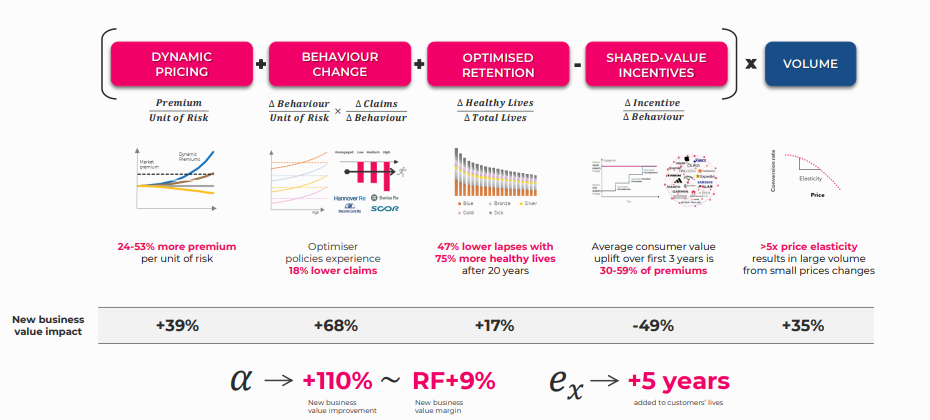
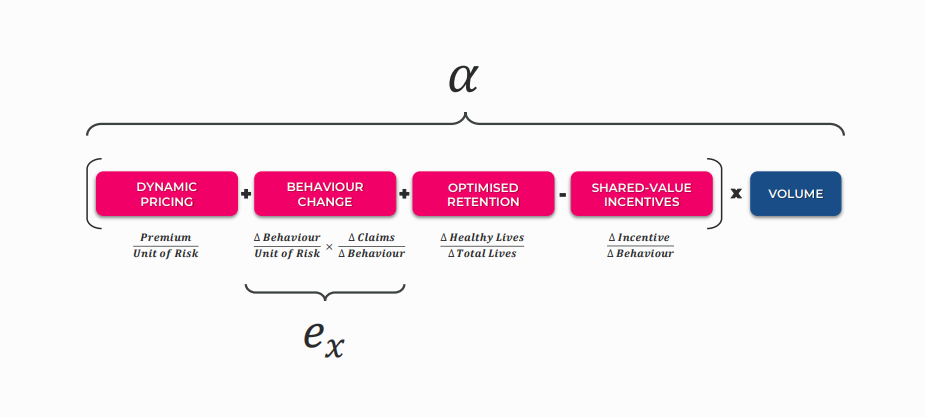
These elements are dynamic pricing, behaviour change, optimised retention, and shared-value incentives. All of these factors are multiplied by volume.
In relation to the Vitality Life business, dynamic pricing ensures that Discovery can generate around 24% to 53% more premium per unit of risk. In other words, the business can generate more value without taking a higher risk.
Typically, premium moves in tandem with risk. As risk increases, the premium charged to the customer and generated by the insurer rises. Discovery’s model breaks this, enabling it to generate more premiums without taking on more risk.
The second element is behaviour change, which uses data and rewards to drive better lifestyle choices. As a result, Vitality Life’s customers are generally healthier, resulting in lower claims.
This is driven through the shared-value incentives, which aim to reduce the risk to Discovery of insuring the client while improving their health and lifestyle.
Gore said that optimised policies by driving behaviour changes result in 18% lower claims in relation to the Vitality Life business.
Dynamic pricing ties in with behaviour changes, with Gore explaining that Discovery does not just underwrite risk when first creating the insurance policy, but constantly updates it based on lifestyle changes and health outcomes.
This constant updating is what enables it to have dynamic pricing, which helps lead to higher volumes and market share with higher-quality clients.
“You have got a highly commoditised market. You have got agents and brokers and intermediaries and advisors using portals to price. So, you can outbid any margin to win business,” Gore explained.
“But, using the dynamic underwriting and dynamic pricing of the shared-value model, with all the incentives, we have managed to get massive amounts of business on the right terms that are sustainable.”
“This has given us growth at a good margin. I think it is excellent and you can see, I think, the quality of the Vitality Health offering as being substantially better than anything else in the UK.”
Ultimately, this model translates into Discovery being able to generate higher margins than its competitors and create more value for its clients, with the Vitality Life product adding, on average, five years to an individual’s life were they not with Vitality.
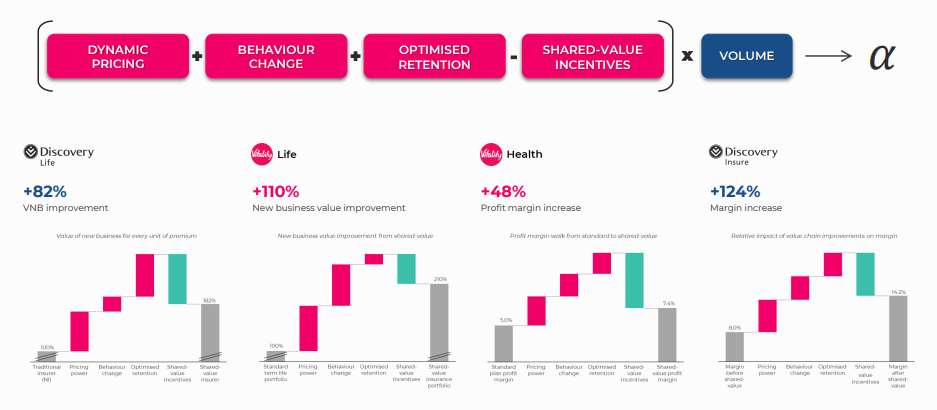
Gore’s model can be seen below in relation to Vitality Life, with a more basic version following and the impact on the company’s business units.






Comments