Rand goes from hero to zero


The rand has lost significant ground against the US dollar over the past five days, as conflict in the Middle East has sent investors running towards safe-haven assets.
This risk-off behaviour has favoured US assets like bonds and, therefore, the dollar, leaving South Africa’s rand far weaker.
The rand is down around 3% against the greenback, stuck above the R16/USD level, over the past five days.
The local currency’s weakening has been in response to the US-Israel conflict with Iran that intensified over the past weekend.
On Saturday, 28 February 2026, the United States and Israel launched a coordinated, large-scale offensive against the Iranian regime, with the stated aim of enacting regime change.
Iran responded with a counter-attack, expanding the conflict beyond Israel and the United States.
While it is still unclear just how far this conflict will extend, US President Donald Trump has warned that it will likely persist for several weeks.
The conflict has led to heightened uncertainty across global financial markets, triggering risk aversion among investors.
As a traditionally safe-haven asset, the US dollar has benefited from this, putting pressure on South Africa’s rand.
Efficient Group chief economist Dawie Roodt explained that the immediate impact of the conflict was a higher oil price, gold performing well as a safe-haven asset, and the US dollar strengthening.
“Those are all signs of uncertainty in the financial markets,” Roodt said in a statement about the Iran conflict.
The conflict’s effect on oil prices has been pronounced, with Brent crude jumping from around $72/bbl on Friday to nearly $84/bbl on Wednesday.
Some have speculated that oil prices could reach $100/bbl as the conflict continues, though many experts believe this is unlikely and said that, even if oil prices reach that level, they likely won’t stay there for very long.
“My suspicion is that much of this conflict will be resolved relatively soon and that oil and other prices are likely to stabilise and perhaps come down a little bit,” Roodt said.
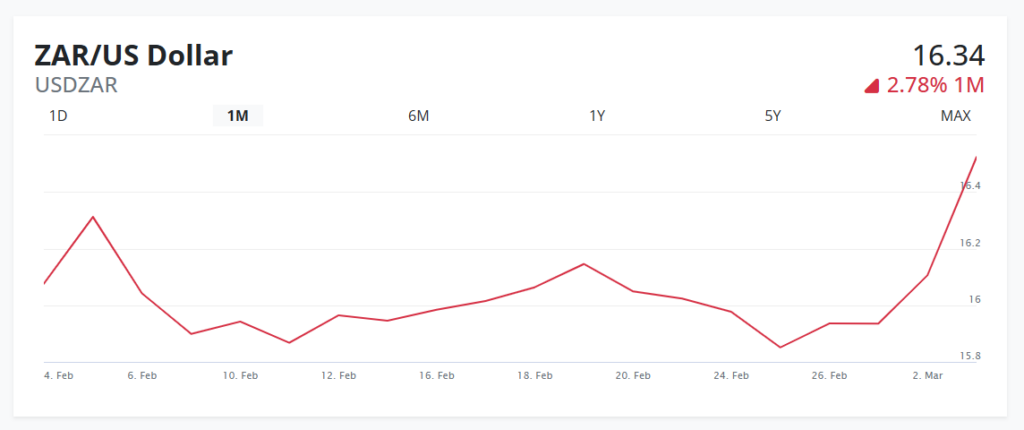
Rand vs dollar
In the meantime, the rand has continued to take a beating from the stronger dollar, with this recent bout of weakness having broken the local currency’s winning streak.
The rand has benefited from a weaker dollar, an ongoing commodity boom and, more recently, a positive reception of South Africa’s 2026 Budget.
Investec chief economist Annabel Bishop explained that there is a risk of further rand weakness, as the US dollar is proving to be a safe haven now.
“Our expected case does not see the tensions persistently spread through the Middle East, but the risk has risen,” she explained.
However, she warned that there could be other consequences for South Africa’s economy, as persistently high oil prices will push up fuel prices in the country.
“The fuel price change for March has already been essentially completed, based on the previous month’s change in the rand cost of petroleum products, which is indicated between 20 to 30 cents per litre increase at the moment,” Bishop said.
“This would contribute near 0.1% m/m to the CPI, having a minor effect. However, if the USD/ZAR stays around current rates, and the oil price remains near $80/bbl over March, then about a 9% month-on-month increase occurs in the fuel price.”
This, in turn, would have an inflationary effect, with Bishop pencilling in a roughly 0.4% month-on-month contribution to CPI inflation in April.
This would lift South Africa’s CPI inflation to 3.3%, up from the current 2.9% forecast for April.
However, Bishop said that, even if these scenarios play out and a high oil price pushes up local inflation, this likely won’t lead to higher interest rates for South Africa.
“If the oil price elevated sharply further, and the rand weakened against the US dollar substantially, South Africa’s MPC would most likely look through this if it’s a temporary shock and not raise interest rates,” she said.
The worst-case scenario is one of persistently high inflation, a near doubling from the current rate of 3.5%, which would lead to higher interest rates and a repo rate above 12%.
Bloomberg reported that Interest-rate traders have moved to price in a chance of a South African interest rate hike later this month, with a 24% chance of a 25-basis-point hike pencilled in.
 Loading ...





Comments