Government spending R1.2 billion a day on ‘nothing’


South Africa’s government is budgeted to spend R432.4 billion to service its debt in the current financial year, which is the highest single expenditure item in the budget by function.
This translates into an average expenditure on interest payments of R1.18 billion a day over the coming financial year, or 21% of total government spending.
The good news is that the National Treasury expects the growth in debt-servicing costs to increase by a marginal 2.15% in the next year.
This marks a sharp decline from previous years when debt-servicing costs were the fastest-growing line item in the Budget.
Stanlib chief economist Kevin Lings explained that this is a key metric to watch in South Africa’s financial turnaround, with debt-servicing costs effectively being dead money.
The rapid surge in the country’s debt-servicing costs over the past decade resulted in fears of a debt spiral where the government would have to borrow money to pay down existing debt.
However, the National Treasury’s process of fiscal consolidation appears to have worked in this regard, with South Africa avoiding the worst-case scenario.
This does not mean that payments on interest are not costing South Africa dearly, with R432.2 billion having the potential to eliminate the state’s full budget deficit.
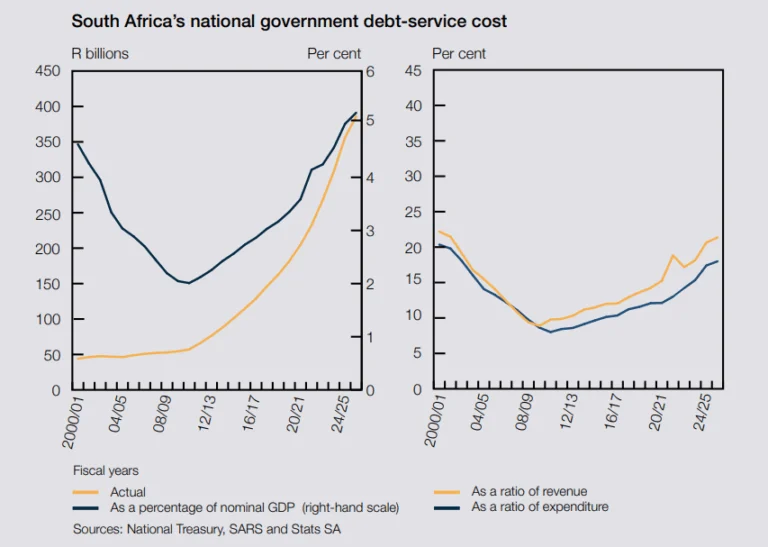
Government spending on debt-servicing costs has surged in the past decade from 9.4% of total expenditure to over 20%.
This rapid growth means that spending on interest payments is crowding out expenditure in other areas of the economy, which are far more productive.
In the coming years, at the current trajectory, spending on interest payments will even begin to crowd out education expenditure and healthcare spending.
The Centre for Risk Analysis’ Anlue Keeve pointed out that this is essentially dead money that cannot be used productively in other areas of the economy.
“This is important because, if we are not careful, there is still a risk of debt running away from us. We are still in very high-risk territory,” Keeve said.
As a share of GDP, South Africa has experienced one of the fastest increases in government debt in history, from 24% in 2008/09 to over 76% at the end of the 2025 financial year.
This is far faster than South Africa’s emerging market peers over the same period and has resulted in the risk premium the country pays skyrocketing.
Turning the corner
The good news from Lings is that the government has turned the corner in this regard, with some help from the boom in precious metals prices.
Lings explained that the improved investor sentiment towards emerging markets, including South Africa, has boosted the country’s financial turnaround story.
This has translated into lower borrowing costs for the government in the past year, allowing it to refinance some of its debt at lower interest rates and raise new debt relatively cheaply.
“Interest expenditure, if you follow the numbers, has been ramping up very sharply in recent years. At one point, interest spending was going up at 16% per annum,” Lings said.
“This year, the government is budgeting for the interest spending on government debt to go up by only 2.8%. That is the benefit of getting inflation down. That is the benefit of the bond yield moving lower. That is the benefit of limiting expenditure and reducing the debt-to-GDP ratio.”
This will have real benefits for ordinary South Africans, with more of the government’s spending, in time, being freed up for other areas of the economy.
Furthermore, it will alleviate some of the financial pressure on the state, which will reduce the likelihood of tax increases in the future.
“This is a very clear indication that the fruits of fiscal discipline are starting to manifest and, over the medium term, we will see further benefits,” Lings said.
“Ultimately, that should free up money for the government to effect other initiatives or other priorities. You do not want to be spending 21% of your budget on interest.”
Lings explained that if you take that down to just 10%, you would free up over R200 billion for infrastructure, increased social support, and economic growth.
However, Lings did caution that this will take sustained discipline, with hard work to limit government spending increases still being required.
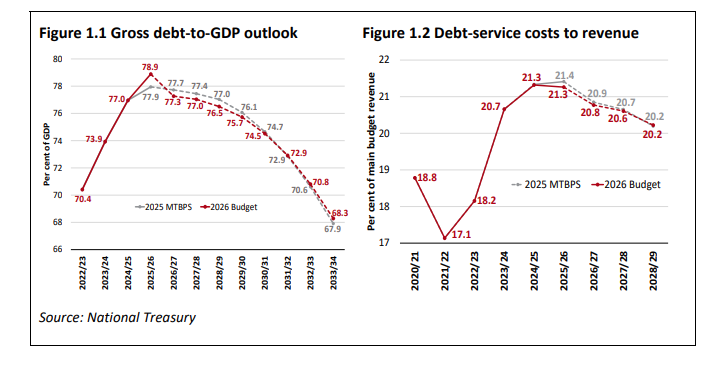
The National Treasury expects debt-servicing costs as a share of state revenue to decline from 21.3% in the current financial year to 20.2% in 2028/29.
 Loading ...





Comments