Where Standard Bank sees the rand going in 2026


Standard Bank thinks the rand is trading close to its fair value, with any strength beyond current levels unlikely to stick unless South Africa’s economic fundamentals change.
In the same vein, the bank does not expect the currency to weaken significantly from its current level over the coming year.
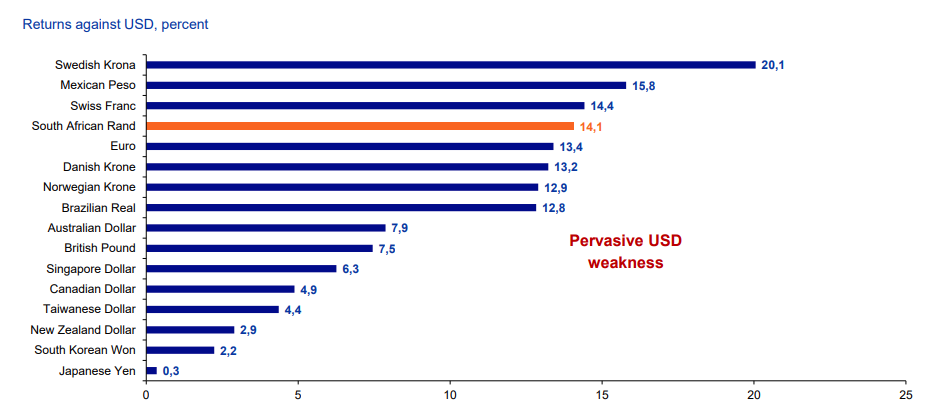
This is largely due to what the bank’s chief economist, Goolam Ballim, sees as pervasive United States dollar weakness and the rand’s relative strength against its peer currencies.
Ballim explained that the rand’s strength against its peers shows its underlying resilience and ability to hold its ground even if global factors become unfavourable.
However, this is not to say that the rand’s current strength is not a function of elevated commodity prices, with this being a major factor behind the currency’s strength.
“The rand was fairly burly last year and continued its assault stronger this year, and that has been more than just a case of dollar weakness,” Ballim said.
“In other words, the rand has appreciated against the dollar, but it has also appreciated against a raft of other meaningful currencies.”
Ballim explained that this has largely been driven by the rand experiencing one of the largest positive terms-of-trade shocks in the world.
“What do we mean by that? We simply mean that our export basket prices rose, while the import basket of goods remained more or less steady,” Ballim said.
“We were giving out one ounce of gold for far more imported products, because gold was fetching more in price.”
This terms-of-trade shock is immensely beneficial for South Africa, with wide-ranging effects on the local economy, corporate profits, and tax revenue.
South Africa has long had a close relationship with commodity prices, with their rise and fall often closely correlating to rand strength and weakness as well as the government’s financial health.
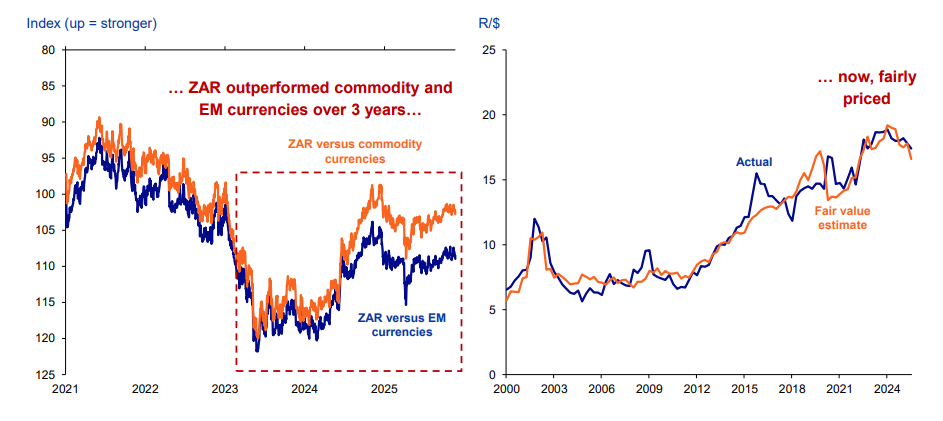
“This is also a boon for the local currency. The rand has been gaining, not just against the dollar, but has also been relatively strong against peer currencies,” Ballim explained.
“Whether the peer currency is a commodity-based currency or an emerging market currency, the rand has been relatively strong in global markets.”
The fair value of the rand
Despite the rand’s ongoing strength, the currency is unlikely to continue its positive march as it is trading near its fair value.
“At prevailing levels, with the rand below R16 to the US dollar at times, we do believe that it is trading at its fair value,” Ballim said.
“The fair value of the rand, by our calculations, is in the vicinity of R16 to the dollar and R16.50 to the dollar.”
This means the currency is unlikely to continue strengthening towards R15 to the dollar, with it hitting resistance at R16 to the dollar.
“We do think the currency can go stronger, particularly in the current environment of a weaker dollar and should two things happen,” Ballim said.
“These two things are commodity prices remaining elevated, and that confidence in South Africa’s reform process remains strong.”
Ballim’s forecasts for the coming three years reveal that Standard Bank thinks the rand will average R16.38 to the dollar in 2026.
It also shows that the bank expects the currency to steadily weaken again in 2027 and 2028, averaging R16.74 and R17.07, respectively.
The bank also expects the rand to weaken against the British pound and the euro, as political instability ratchets up in South Africa amid local government elections.
However, the major threat to the currency is likely to come from the ANC’s elective conference in 2027, which could spell the end of the Government of National Unity.
“The rand is both a benefit and a responsibility when it is strong. While it can temper exports, it is a net benefit for all the other reasons, whether it is lower inflation, higher profits, and improved government revenue,” Ballim explained.
“It is a benefit to South Africa, but the rand is also a responsibility for the authorities to guard its credibility so that the rand does not suffer some domestic weakness because of policy missteps.”
“That said, the currency is at fair value at current levels with the possibility of further strength, but we do believe the rubber band is fairly stretched and the likelihood that a stronger currency sticks is unlikely.”






Comments