South Africa heading for serious financial trouble


Without faster economic growth, the National Treasury’s painful process of fiscal consolidation is unlikely to translate into a sustainable reduction in South Africa’s debt burden.
While the National Treasury expects South Africa’s debt-to-GDP ratio to stabilise in the current financial year, this is on the back of short-term factors and not sustained financial improvements.
In particular, the stabilisation in the debt load is likely to be temporary on the back of higher tax revenue due to a commodity boom and adjustments to inflation-related expenditure.
These are short-term factors that will not be sustained over the long run. In the absence of faster economic growth, the country’s debt burden will continue to rise once the impact of these factors rolls over.
This is feedback from Coronation’s head of fixed interest, Nishan Maharaj, who urged caution regarding South Africa’s turnaround story, particularly in relation to state finances.
Maharaj said there has been meaningful improvement in this regard, with the growth in government spending slowing and a shift towards a lower inflation target likely to ease debt-servicing pressures.
While one might argue that this has positioned South Africa strongly on a path to recovery, without faster economic growth, the country is unlikely to make much progress down that path.
“A large part of the improved outlook that came through in the Medium-Term Budget was attributable to better mining revenue due to higher precious metal prices and adjustments to all inflation-related expenditure, which provided a significant saving,” Maharaj said.
These factors are highly impactful in the short term, but will not be sustained in the long run as the rally in precious metal prices will slow, and inflation will not decline forever.
As a result, Maharaj said these factors have presented a mirage of sorts for South Africans and investors, with reality likely to be significantly different.
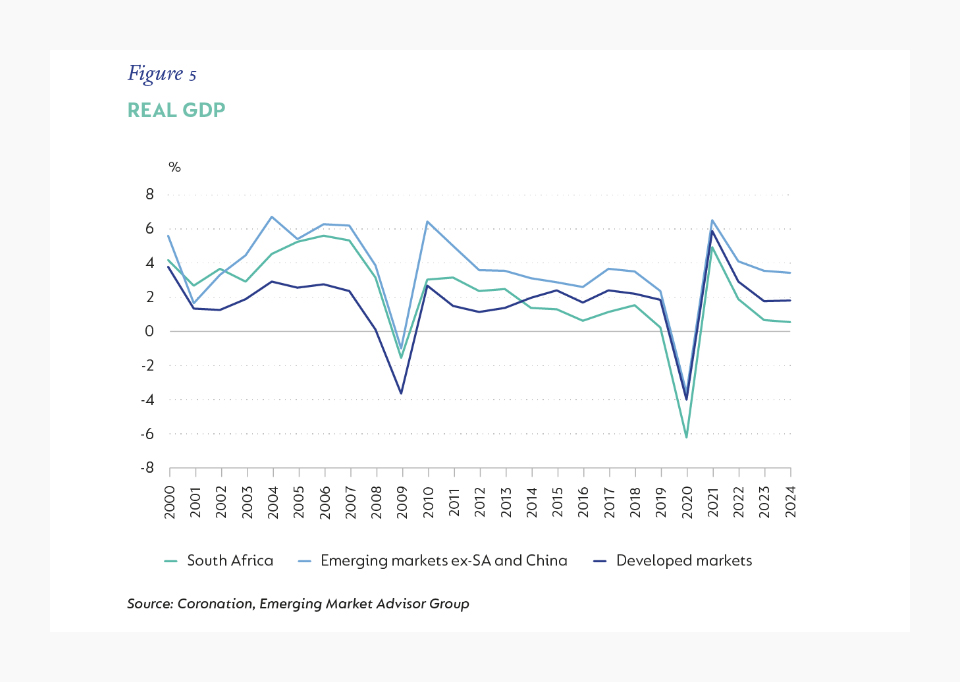
“Low growth remains a key inhibitor to true fiscal consolidation, and real growth closer to 3% is now needed to stabilise the deficit and debt profile,” Maharaj said.
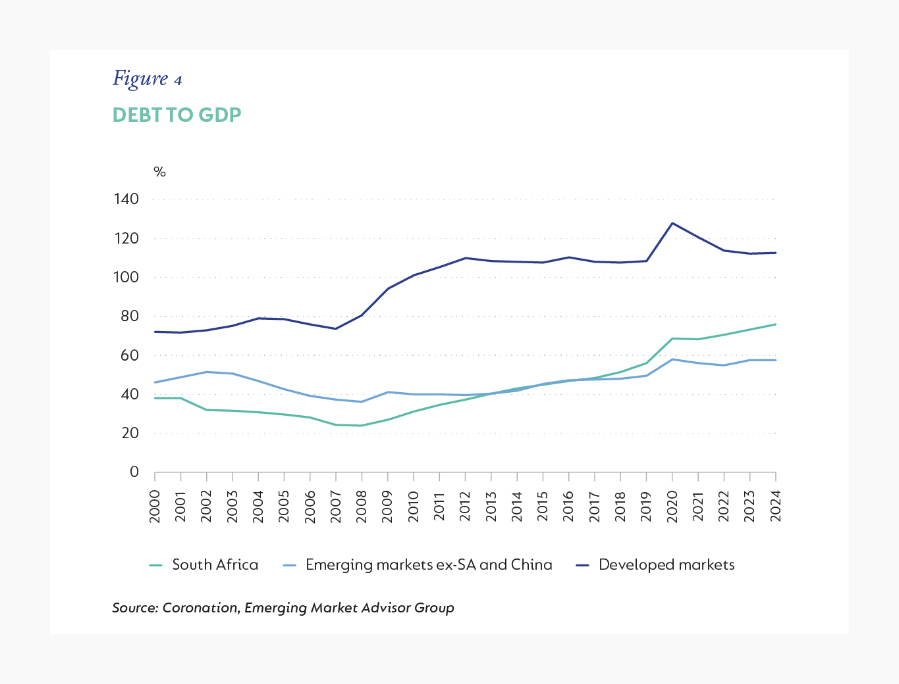
Maharaj and Coronation forecast South Africa’s debt-to-GDP ratio to average close to 80% over the coming years. This is far higher than the National Treasury’s which forecasts debt to stabilise at just over 77% in the current year and decline thereafter.
Fiscal consolidation
There has been a notable improvement in the management of government finances since Enoch Godongwana was appointed Finance Minister in 2021.
Godongwana has spearheaded the National Treasury’s implementation of fiscal consolidation over the past five years, slowing down the rate of growth in its debt pile.
The process of fiscal consolidation is painful, with it aiming to limit growth in government spending to below inflation, while raising tax revenue through enhanced compliance and no income tax bracket adjustments.
In effect, taxpayers pay the government for less, with state spending reduced to ensure that its debt-to-GDP ratio stabilises.
This is now the case in South Africa, with the debt-to-GDP ratio beginning to stabilise as the government runs consecutive primary budget surpluses.
These surpluses mean that the government is bringing in more tax revenue than it is spending on providing services. The calculation excludes debt-servicing costs.
However, while this improvement is notable, it comes after 15 years of financial mismanagement at the government level.
South Africa’s debt-to-GDP ratio was a mere 26% in 2008/09. In the following years, it has surged to over 76% as state spending ramped up without a corresponding increase in economic growth.
The government spent an increasing share of its revenue on consumption, particularly salaries, rather than investment in infrastructure.
Maharaj noted that South Africa’s debt-to-GDP ratio has doubled over the past decade, which is significantly faster than its peer countries. On average, emerging markets only saw their debt-to-GDP ratios rise by 1.2 times.
“Therefore, at current levels, it seems that SA bond valuations have run ahead of fundamentals, baking in a fair deal of good news, requiring a significant acceleration in reform momentum to propel growth closer to the required 3%,” Maharaj said.
Previously, Coronation’s economics unit has shown that the country’s debt-to-GDP ratio will continue growing into the 2030s at current economic growth rates.
This would be catastrophic for the country, with the Reserve Bank warning that even at current levels, South Africa is at risk of entering a debt trap.
 Loading ...





Comments