ANC wants to nationalise the South African Reserve Bank


ANC Secretary-General Fikile Mbalula has reiterated the party’s plan to nationalise the South African Reserve Bank (SARB).
Mbalula was addressing a rally in Mogwase in Rustenburg ahead of the ANC’s January 8 celebrations on Saturday, 10 January 2026.
He told ANC supporters that they should never apologise for taking part in the South African economy.
“This economy is not only about tenders. It’s about owning the mines. It is about participating in the means of production of this economy,” he said.
“It’s about ensuring that young people do emerge from being entrepreneurs to become petty bourgeoisie.”
The petty bourgeoisie is a Marxist term for the “little” middle class, comprising small business owners, shopkeepers, artisans, and self-employed individuals.
They own some means of production but must also work, placing them between the wealthy bourgeoisie (owners) and the proletariat (workers).
They aspire to the upper-class lifestyle but often feel threatened by both big capital and the working class.
This, according to Marxist theory, leads to unstable political views, sometimes supporting progressive causes but often acting as a reactionary force.
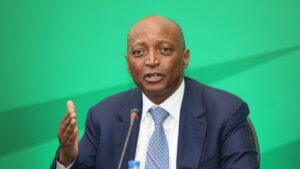
He said it should not be the case that billionaire Patrice Motsepe is the only black entrepreneur and businessman to have become wealthy.
“That is why nationalization of the South African Reserve Bank is a resolution of the ANC. It must be implemented,” Mbalula said.
“Comrades, expropriation of land without compensation when we get back our power must be implemented.”
He said the ANC has lost many opportunities when it lost its majority in the 2024 general elections in South Africa.
However, he added that the ANC should stop complaining and not behave as if it were not in power. “We are governing this country,” he said.
Nationalising the South African Reserve Bank will not change much

The South African Reserve Bank has over 800 shareholders, including notable entities such as Absa, the Anton Rupert Trust, Discovery, and FirstRand Bank.
The SARB is one of only nine central banks worldwide with private shareholders. It is the oldest central bank in Africa and the fourth-oldest central bank outside Europe.
The shareholders have no rights or involvement in determining monetary policy, financial stability policy or regulation and supervision of the financial sector.
Although nationalising the South African Reserve Bank (SARB) has been used as a political plaything, the National Treasury is against it.
Changing the ownership structure of the South African Reserve Bank could generate fears among investors and create uncertainty about property rights.
Chris Axelson, the National Treasury’s Deputy Director-General for Tax and the Financial Sector, shared his views on the matter last year.
He said that although full ownership of the central bank by the state may be desirable, it will potentially have huge cost implications and require significant trade-offs.
One of these trade-offs is the negative impact on investment and on economic growth in South Africa.
Renowned economist Dawie Roodt argues that, theoretically speaking, nothing seriously bad should necessarily come from nationalising the SARB.
However, he warned that when politicians become too close to the entity that prints the country’s money, it is more often than not concerning.
The South African constitution guarantees the South African Reserve Bank its monetary policy independence.
Even if the bank is nationalised, monetary policy would still be independent. However, Roodt said it was in the loan replacements that concern arose.
“It’s about what happens to the pot of gold in the Reserve Bank. What happens when the politicians decide to spend it on all kinds of silly things?” he asked.





Comments