Say goodbye to the US dollar as you know it


The US dollar has weakened substantially against emerging market currencies, including the rand, in 2025, which is easing the financial constraints on these economies.
Typically, a weaker US dollar corresponds to faster emerging market growth, as the debt repayments these countries have to make in the greenback are reduced.
Furthermore, it makes their exports more competitive, results in imports being cheaper, which pushes inflation lower, and enhances the global buying power of their citizens.
This is feedback from Reserve Bank Governor Lesetja Kganyago, who explained some of the factors behind the easing of financial conditions in South Africa.
One of the main factors the Reserve Bank watches closely is the strength and stability of the rand in comparison to the US dollar.
This is important because a weaker rand makes it significantly more expensive to import goods into South Africa, particularly fuel, which pushes inflation higher.
The effect of a weaker dollar on South Africa’s debt burden is less pronounced due to the country being able to issue most of its debt in its own currency.
This is a major advantage South Africa has over many of its emerging market peers, as it is not exposed to the disastrous effects that currency fluctuations can have on a government’s financial health.
Kganyago explained to Newzroom Afrika that the Reserve Bank expects inflation to rise slightly in 2026 to peak at 3.6% in the middle of the year and then come back down to 3% by the end of the year.
One of the drivers behind this forecast is the dollar’s weakness, which substantially reduces the chance of an inflation spike in South Africa.
“The interest aspect of this scenario is that with a weaker dollar, growth in South Africa rises due to increased exports, as they look cheaper on global markets,” Kganyago said.
Kganyago also explained that a forgotten benefit of lower inflation is a more stable currency, which makes it more attractive to foreign investors as the value of their investment is not eroded.
Efficient Group chief economist Dawie Roodt also pointed out this benefit, saying that a volatile currency has cost South Africa significant investment over the past 15 years.
“Foreigners do not want to buy our bonds because they buy the rand and then the bonds, running a risk that when they sell the bonds and take the money out of the rand, it has weakened and they have lost on the deal,” Roodt said.
“But, if foreigners believe that our inflation rate is going to be relatively low and stable, that means the exchange rate will be relatively stable, and they are likely to take more of a chance on South African bonds and equities.”
Pillars of dollar strength are eroding

The fundamentals underpinning a strong US dollar are slowly being eroded, with rising government debt, significant policy shifts, and fears of low returns from American assets in the coming decade giving investors cause for concern.
This means the greenback is likely to weaken further in the coming years. However, this will not happen in a straight line, with periods of strength likely.
Historically, shifts from investors out of the US dollar have been short-term cyclical rotations as commodity prices soared and emerging markets generated strong returns.
What makes this time different, according to Old Mutual portfolio manager Zain Wilson, is that the dollar’s weakness has been driven by changes in US fundamentals.
The fundamentals underpinning US exceptionalism are slowly fading, Wilson explained, bringing the dollar down with them.
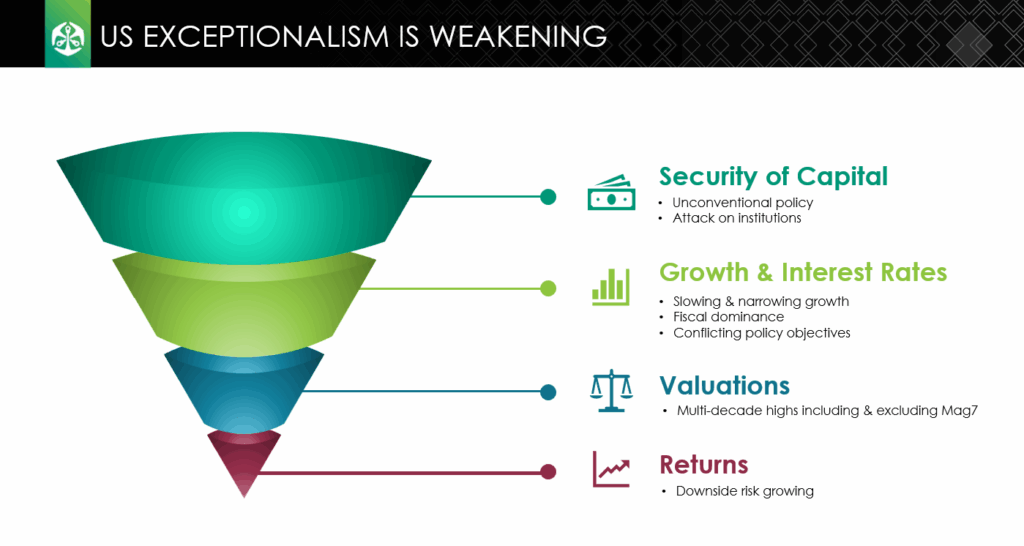
Wilson explained that the US financial markets have sucked up global liquidity over the past 15 years, driven by four key factors that created the perfect mix for a strong economy, a soaring stock market, and a strengthening dollar –
- Security of capital: Policy certainty, strong private property rights, and a tight lid on inflation assured investors that their capital was safe in the United States.
- Growth and interest rates: The United States economy outperformed global peers and relatively elevated interest rates attracted capital to American assets.
- Valuations: The soaring United States stock market was driven largely by earnings growth from American companies and not valuation expansion.
- Returns: US assets, particularly equities, produced exceptionally high returns for investors, creating a feedback loop which attracted investors.
One of the side effects of these factors was a much stronger dollar as money flowed into US assets. This was boosted by the lack of alternatives, as the American economy and financial markets dominated.
In many cases, these factors are still apparent, Wilson said. However, they are slowly being eroded by factors well within the United States’ control.
Wilson explained that security of capital and strong economic growth are the most important factors and that these are being eroded at the fastest pace.
In particular, unconventional policy and increased uncertainty are making investors increasingly question the security of their capital in the United States.
This has been exacerbated by attacks on key institutions, particularly the Federal Reserve, from United States President Donald Trump.
Investors are also increasingly concerned about America’s financial health, with the Federal government running record deficits outside of wartime.
The US government is now sitting on a debt pile worth more than $38 trillion, increasing fears of a financial cliff and concerns that it will look to inflate away this debt, thereby making capital less secure.
Wilson added that increased pressure on the Federal Reserve, coupled with slowing growth and rising inflation, have increased the chances of a major monetary policy mistake that could result in stagflation and severely impact US economic growth.
The key factors underpinning US exceptionalism can be seen in the graphic below, with some of the issues eroding these factors listed alongside.






Comments