South African rand can drop below R17/USD


The rand could strengthen to dip below R17 to the United States dollar in December or January, as the seasonal effects over the holiday period are expected to boost the rand.
This is because investors tend to be less risk-averse and busy over this period, spelling good news for South Africa’s currency.
Investec chief economist Annabel Bishop explained that December and January tend to see some rand strength as risk aversion drops off to a degree.
She said this, combined with often thin trade at the end of the year, could see the rand be more successful in piercing the R17/USD mark.
The rand achieved this in November 2025, briefly dipping below R17/USD to reach R16.95/USD for the first time in two years, following the tabling of the National Treasury’s Medium-Term Budget Policy Statement (MTBPS).
While the rand weakened back above the R17/USD threshold shortly after, this has been considered the crowning achievement in a strong year for the local currency.
Bishop pointed out that the rand has averaged R17.89 to the US dollar in 2025 to date, which is ahead of its average for 2024, which was R18.33/USD.
However, she added that this is not much stronger, at only a 2.0% appreciation, with the US dollar 1.5% weaker on its own.
“The rand has largely ignored developments domestically, strengthening on its own against the US dollar by only 0.5% this year on average to date versus last year as a whole, and essentially flat against the euro and pound,” she said.
Bishop explained that while the rand has essentially been flattish in 2024 and 2025 against the US dollar, 2026 is expected to pull somewhat stronger.
However, she noted that the rand is not expected to see substantial strength currently. The graph below shows the rand’s performance against the United States dollar in 2025 to date.
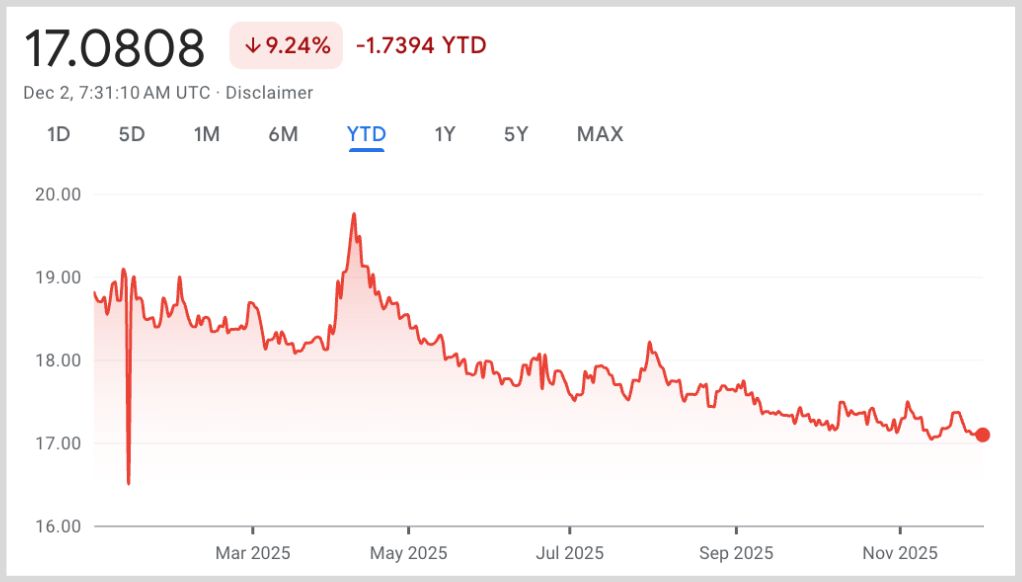
The year for the rand
Bishop said 2026 could see a stronger year for the rand, as the local currency has space to make some gains next year without necessarily needing to rely on US dollar weakness.
She said the lift in South Africa’s GDP outlook has aided the domestic currency in 2025, along with the country’s recent S&P credit rating upgrade, removal from the greylist, sensible budget in the MTBPS, and ongoing improvements at state-owned enterprises.
While Bishop believes the rand has room to continue some of these gains in 2026, she warned that politics and trade policy will remain in the spotlight in the US.
This will impact global risk sentiment and, in turn, affect the global financial market’s risk appetite, with risk averse sentiments normally spelling bad news for emerging market currencies like the rand.
Bishop added that the lift in global risk sentiment over October and November has also seen increased appetite for US equities, particularly tech stocks.
“Lower interest rates, improved views on economic growth and brighter earnings prospects have fuelled a revival in market sentiment for a second successive month,” she said, adding that this has come at the expense of foreign selling of South African bonds.
“The shift in investor flows has seen the rand see less strength in October and November than it did in the third quarter of 2025, when foreign appetite for SA bonds was substantially elevated, with strengthening risk appetite shifting into the US stock market.”
However, she said overall the sharp lift in the global outlook has also translated through into an improved outlook for South Africa’s economic growth.
Along with the other fundamentals boosting South Africa’s outlook, the rand has room to strengthen ever further in 2026.
Bishop expects South Africa’s GDP in the third quarter of 2025 to grow by 1.2%, saying October and November saw the country’s 2025 GDP growth forecast revised up each month by 0.1% year-on-year, and December could see a further lift to 1.3%.






Comments