South African rand rollercoaster continues


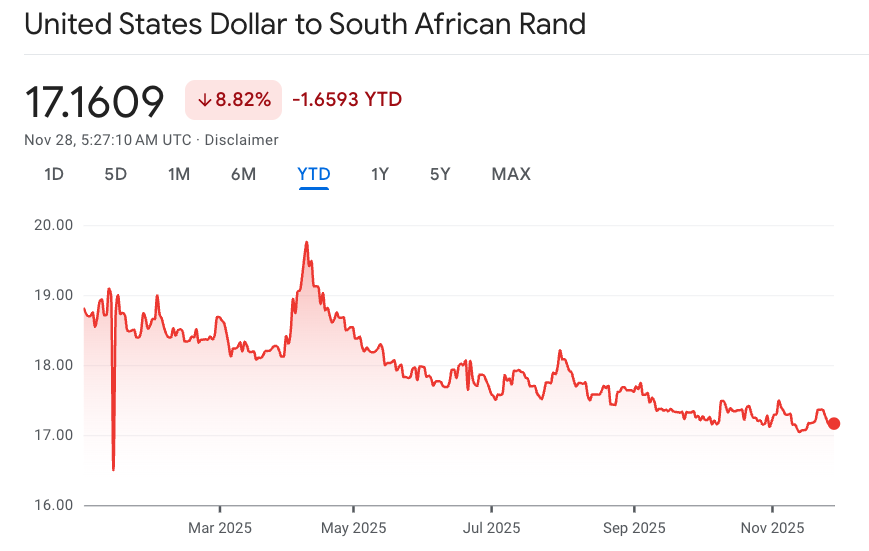
South Africa’s rand recently saw one of its strongest weeks yet, but is now back on the retreat, with increased volatility expected for the rest of the year.
This is despite the country’s recent credit rating upgrade from S&P Global, which has seen South Africa inch one step closer to investment-grade status.
After temporarily breaching the R17/USD level in mid-November, the rand has moved back above this key resistance level.
The rand strengthened to R16.95/USD after Finance Minister Enoch Godongwana delivered the Medium-Term Budget Policy Statement (MTBPS).
While the local currency has since weakened, hovering around the R17.50/USD level, it has also seen some strength against the euro and pound over the past month.
Investec chief economist Annabel Bishop attributed the rand’s retreat to some modest strength in the United States dollar, along with selling, as the greenback was buoyed by a more hawkish US Federal Reserve and the end of the government shutdown.
The end of the US government shutdown meant a slew of economic data was published, with risk aversion rising somewhat as markets await those outcomes.
In particular, the market will be holding its breath to see how this delayed data could affect the United States’ interest rate cutting cycle.
The US Federal Reserve recently indicated that it is unlikely to cut at every consecutive meeting, which has also contributed to some US dollar strength, putting pressure on the rand.
However, the rand has also had some tailwinds in recent weeks, from an optimistic MTBPS to S&P Global’s decision to upgrade South Africa’s credit rating and keep the country’s outlook positive.
S&P upped South Africa to a BB rating from BB- previously, citing South Africa’s improving growth and fiscal trajectory.
In addition, the rating agency was pleased with the reduction in the state’s contingent liabilities, largely tied to performance improvements at Eskom.
Volatility set to continue
Bishop explained that, while South Africa has seen a number of “rand-positive” factors recently, movements in hard currencies like the US dollar often have more of an impact than the rand’s movements themselves.
In other words, while the country has experienced factors that would normally strengthen the rand, movements in currencies like the US dollar often matter more than what the rand does on its own.
In addition, Bishop explained that the rand had largely discounted the S&P upgrade already, running instead on the movements of international currencies.
This is why the local currency may not have reacted as positively as many had hoped in response to the upgrade.
However, this is not to say that the rand is doomed to remain weak for the remainder of the year.
Following the rand’s brief R17/USD breach on Wednesday, 12 October, DCG chief economist Chifipa Mhango explained that a stronger rand brings both relief and responsibility.
“On the upside, a firmer currency lowers import costs, helps ease inflation, improves foreign-dominated debt-servicing conditions, and boosts investor confidence,” he said.
“But sustaining these gains will require South Africa to accelerate reforms in energy, water and logistics, strengthen governance at SOEs and municipalities, and lift the country’s growth potential.”
“Ultimately, the real test is whether a stronger rand can translate into greater industrial competitiveness, job creation and broad-based economic growth.”
Mhango added that, while volatility remains an inherent feature of emerging-market currencies, he is cautiously optimistic about the rand’s medium-term performance.
He explained that if South Africa maintains fiscal discipline, accelerates infrastructure delivery, and continues improving the ease of doing business, the rand will remain supported.
“Sustainable currency strength ultimately rests on stronger growth and deeper structural reforms,” he said.




Comments