South African provinces spend R450 billion on one thing


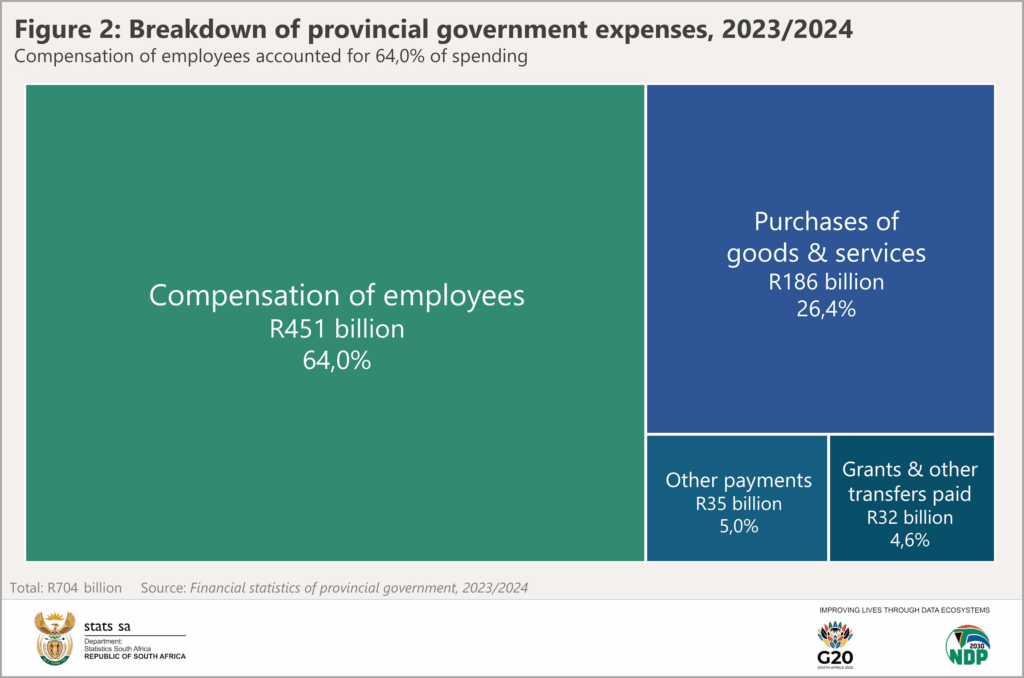
South Africa’s provincial government spent R451 billion on employee compensation in the 2023/24 financial year.
This means the provincial wage bill accounted for 64% of total provincial government expenditure, as this spending item continues to grow above inflation year after year.
This is true at both the provincial and national levels, with South Africa’s substantial wage bill being the third largest in the world relative to the size of its economy.
Statistics South Africa recently revealed that provincial government expenditure amounted to R704 billion in the 2023/2024 financial year.
Of this total, employee compensation was the main cost driver, accounting for almost two-thirds, followed by purchases of goods and services at 26.4% and “other payments” at 5%.
In the employee compensation category, civil servants working in education constituted the highest share of spending, with pre-primary and primary education leading the pack at 26.6%.
“Education and health are the two leading responsibilities of provincial government,” Stats SA explained.
“These two mammoth tasks require a large number of teachers, education personnel, nurses, doctors and health care workers.”
The agency further pointed out how the provincial government’s wage bill has grown over the past decade.
In 2014/2015, employee compensation amounted to R271 billion. A decade later, in 2023/24, it rose to R451 billion in 2023/2024. This equates to an annual growth rate of 5.8%.
This mimics the trends seen in the national public sector wage bill, which has grown rapidly over the past few decades.
Anchor Capital economist Casey Sprake explained that, since around 2008, South Africa’s economy has stagnated, largely due to an underinvestment in infrastructure and other productive expenditures.
“Rather than crowding in investment through infrastructure spending or productivity-enhancing reforms, much of the fiscal expansion was absorbed by a rapidly growing public-sector wage bill,” she said.
“South Africa currently carries the third-largest public sector wage bill in the world relative to the size of its economy, with compensation costs amounting to circa 10.5% of GDP.”
She pointed out that this is well above levels seen in advanced economies such as the United States, the United Kingdom, Australia, and Japan.
“This has resulted in an economy that is saddled with permanently higher expenditure levels, rising sovereign risk premiums, and elevated real borrowing costs across the economy,” she said.
Paying the public
South Africa’s public servants will receive a 5.5% increase in the 2025/26 financial year, which is set to cost the government R7.3 billion.
Over the next three years, as the National Treasury honours the public sector wage agreement, the government will spend R23.3 billion to implement the agreed-upon increases.
This is set to significantly strain the government’s already limited finances while not resulting in any improved productivity or resultant faster economic growth.
The National Treasury previously said the substantial growth in employee compensation reflects the growing burden on public servants.
The ratio of the number of people served per public servant has increased from 32 in 1994 to 48 in 2024. The Treasury argued that as demand for services increases, it puts pressure on public servants.
However, it is notable that the bulk of salary increases in the past decade have gone to middle management and senior employees rather than increasing the size of the public service.
According to the Treasury’s data, a trend in government employees’ compensation over the past decade is that higher earners receive a greater share of the wage bill.
This is primarily due to increased cost-of-living adjustments and the need to attract and retain skilled professionals in the public sector.
The Treasury has said these higher average remuneration costs have become more expensive over time, limiting the government’s ability to grow the public servant headcount due to affordability constraints effectively.
To address the problem of South Africa’s ever-growing wage bill, the Treasury has announced an early retirement programme.
South Africa’s 2025 Budget provided R11 billion in funding to encourage older public servants to retire early, with hopes of achieving a younger and relatively cheaper state workforce.
As part of this programme, up to 30,000 state employees are expected to opt for early retirement, which could result in savings of R7.1 billion per year.
Sprake pointed out that the National Treasury has faced escalating fiscal pressures in recent years.
In particular, gross loan debt is projected to peak at 76.2% of GDP in 2025/26, with debt-service costs approaching R390 billion.
This means that almost a quarter of every rand collected in revenue is allocated to interest payments.
“This rising debt burden is feeding directly into higher long-term bond yields, raising borrowing costs for both the government and the private sector,” she explained.
“Moreover, the Treasury’s reliance on ‘stealth taxes’ such as bracket creep, rather than expenditure cuts or structural reforms, signals weakening fiscal discipline and a reduced capacity to contain spending growth.”
 Loading ...




Comments