Reserve Bank’s Kganyago warns of big threat to interest rates in South Africa


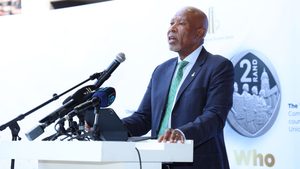
Reserve Bank Governor Lesetja Kganyago warned that the government will need to rein in administered price increases, as they play a big role in keeping South Africa’s inflation high.
Consequently, the above-inflation increases in administered prices also mean that the Reserve Bank has to keep interest rates higher for longer, impacting the country’s growth.
Kganyago made these comments following the announcement on Thursday, 18 September, that the Monetary Policy Committee (MPC) had voted to keep interest rates unchanged.
This will keep South Africa’s repo rate at 7% and the prime lending rate at 10.50% for at least the next two months.
Kganyago explained that the MPC expects headline inflation to rise over the next few months, peaking at around 4%, which informed its decision to keep rates unchanged.
The Reserve Bank expects headline inflation to average 3.4% this year, and 3.6% next year, before reverting to 3% during 2027.
The governor explained that one of the factors that influenced the MPC’s higher inflation outlook was higher electricity price inflation of nearly 8% rather than 6%, given the recent pricing correction by the National Energy Regulator of South Africa (Nersa).
In August 2025, Nersa reached an out-of-court settlement agreement with Eskom on the Sixth Multi-Year Price Determination (MYPD6).
As part of this settlement, Nersa acknowledged errors in depreciation and asset valuation that had underestimated Eskom’s allowable revenue.
As a result, the regulator agreed that Eskom is entitled to an additional R54 billion across the MYPD6 period.
This additional R54 billion will be phased into tariff increases of around 8.8% per year for the 2026/27 and 2027/28 financial years, up from earlier projections of 5.4% and 6.2%.
Bureau for Economic Research’s (BER) Roy Havemann warned that these increases present an inflationary threat, which could keep South Africa’s interest rates higher for longer.
Havemann explained that this Eskom–NERSA tariff settlement will put upward pressure on inflation over the medium term.
“Electricity tariffs feed directly into the CPI basket, where administered prices already make up a sizable share,” he explained.
Kganyago confirmed this outlook in his announcement on Thursday, explaining that the serious dysfunction in administered prices undermines purchasing power and weakens growth.
“The solution to this crisis is not a higher level of inflation, but rather sector-specific reforms to improve efficiency,” he said.
The rise in Eskom’s electricity tariffs compared to inflation can be seen in the graph below.

South Africa’s administered price problem
Kganyago expanded on this view in a question and answer session following the interest rate announcement.
He explained that while the MPC focused on the effect of electricity prices in particular, it is not the only factor that influenced the committee to revise its inflation forecast higher.
“We did mention the issue of food prices of both meat and vegetables, and we had also mentioned that fuel price inflation is not declining as fast as it was in the past, and that means that we ended up revising inflation higher,” he said.
“It could have been even higher if it were not accompanied by the fact that we have got a stronger exchange rate assumption that was brought into the picture.”
However, he said the fact that administered prices are rising faster than inflation is no reason for South Africa to “tolerate” higher inflation.
“If anything, those higher admin prices are not only a problem for inflation, but they actually also have an impact on growth,” he warned.
“So we are going to have to rein in administered prices, and reining in admin prices would entail process of engagement with the administrative price setters.”
Administered prices for services like electricity have been a thorn in the Reserve Bank’s side for years.
These prices’ often above-inflation increases have made managing inflation increasingly difficult and kept interest rates higher for longer.
Electricity tariffs make up the largest share, around 26%, of the administered price basket, and have a larger impact than, for example, fuel prices, which only make up about 3.8% of the basket.
Furthermore, electricity prices are effectively permanent increases, while fuel prices are highly volatile and have contributed to bringing inflation down in 2025.





Comments