South Africa set to miss its energy target by a country mile


South Africa’s National Development Plan (NDP), published in 2012, set a target of 29,000 MW of electricity by 2030. It is nowhere close to meeting this target.
On 15 August 2012, the former Minister in the Presidency of the National Planning Commission, Trevor Manuel, launched the plan during a joint sitting of both houses of Parliament.
Manuel said the NDP was the product of thousands of inputs and perspectives from South Africans.
“We received comments from individuals and organisations and engaged with government departments, provinces, municipalities, state-owned enterprises and agencies,” he said.
“They spoke about the ravages of crime on their lives and their communities. They expressed concern that good policies are poorly implemented and therefore fail.”
These consultations and feedback were used to develop the NDP, which set overarching objectives and key targets for various sectors and made 119 recommendations on how to achieve these targets.
“It is a plan for a better future in which no person lives in poverty, where no one goes hungry, where there is work for all,” he said.
The NDP stated that South Africa should produce sufficient energy to support industry at competitive prices and ensure access for poor households.
It set strict targets for additional energy generation capacity. It stated that the country would need an additional 29,000 MW of electricity by 2030.
About 10,900 MW of existing capacity is to be retired, implying new build of more than 40,000 MW.
This energy production should happen while reducing carbon emissions per unit of power by about one-third.
It suggested implementing the 2010 Integrated Resource Plan to reduce carbon emissions from the electricity industry from 0.9 kg per kilowatt-hour to 0.6 kg per kilowatt-hour.
The government stated that 20,000 MW of the new 40,000 MW capacity needs to come from renewable energy sources.
The government’s performance
When the NDP was adopted in 2012, Eskom’s total installed capacity was 44,175 MW, with approximately 2,064 MW being renewable energy.
As 10,900 MW of existing capacity was to be retired and a new build of more than 40,000 MW, this would imply 73,000 MW of generation capacity in 2030.
This would imply that Eskom’s total installed power capacity would need to be around 73,000 MW in 2030, with roughly 22,000 MW coming from renewable energy sources.
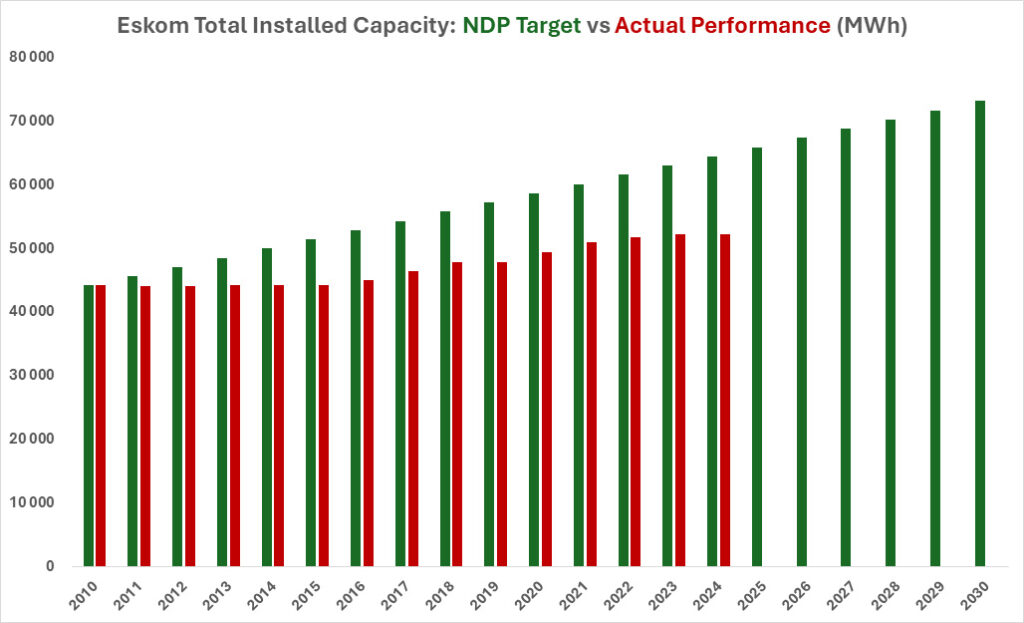
Eskom’s latest 2025 data shows that the power utility increased its total capacity to only 53,902 MW.
This is significantly lower than the 73,000 MW of installed generation capacity that the government is targeting by 2030.
If Eskom were on track to meet its target, it would have a total installed capacity of 64,500 MW in 2025, meaning the government is way off schedule.
In addition to this, the total renewable energy capacity was reported at 7,022 MW in 2025, also well behind the target.
Most of the added renewable energy capacity is from independent power providers and not Eskom-installed capacity. Eskom-owned renewable energy stands at 3,432 MW.
Considering the government’s poor performance, it is hardly surprising that South Africa has endured regular load shedding over the last few years.
The chart below shows the NDP target versus the actual performance of the government and Eskom.


Comments