Eskom’s big load-shedding lie


Eskom is attempting to convince South Africans that its Generation Recovery Plan and improved performance are solely responsible for the reduction in load-shedding. This is not true.
Significantly lower electricity demand, driven by increased private solar installations and poor economic growth, is a significant contributing factor to less load-shedding.
On Wednesday, 14 May 2025, Eskom CEO Dan Marokane provided an update on their 2025 Winter Outlook during a parliamentary portfolio committee hearing on electricity and energy.
He said Eskom had achieved significant operational improvements over the last six months, despite sporadic incidents of load-shedding.
“These improvements are supported by the long duration of no load-shedding days,” he said, admitting that operational setbacks caused six incidents of blackouts in 2025.
“We place our performance improvement squarely on the progress in the Generation Recovery Plan. This is what has driven the 311 days of no load-shedding,” he said.
“It is the execution of the plan and staying the course that yielded the results that we saw. We want to return to a position where we can replicate this.”
Marokane added that Eskom supplied South Africa with more electricity and reduced load-shedding without excessive use of diesel.
Marokane’s claim that lower load-shedding was solely the result of Eskom’s operational improvement, without burning excessive diesel, is not supported by data.
One of the biggest factors which helped reduce load-shedding is businesses and households installing rooftop photovoltaic (PV) solar and battery backup.
As these households and businesses generate their own electricity, it takes significant pressure off Eskom’s national grid.
The South African Photovoltaic Industry Association (SAPVIA) estimated that South Africa’s total solar PV capacity increased to 8.97 GW in 2024.
This capacity included 6.1 GW from private-sector rooftop solar installations and 2.8 GW from public procurement.
Theoretically, the 6.1 GW from private-sector rooftop solar installations equates to 6 stages of load-shedding if they generate electricity at peak levels.
Another factor contributing to lower electricity demand from Eskom is the lower industrial activity in South Africa.
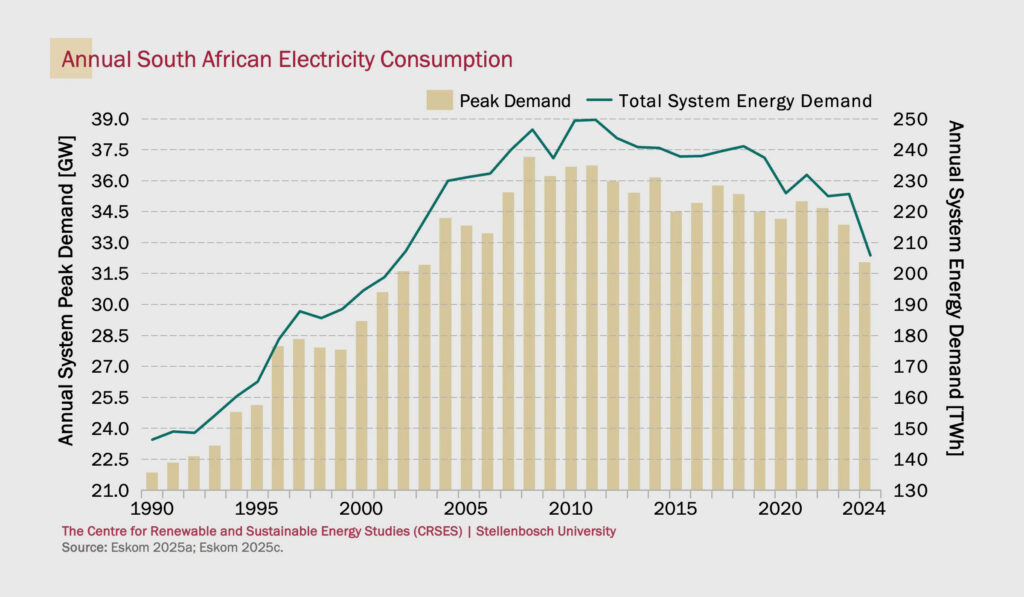
The combination of these factors resulted in Eskom’s peak demand decreasing from around 36 GWh in 2011 to just under 28 GWh in 2024.
The lower peak demand played a significant role in South Africa not experiencing load-shedding for a prolonged period.
So, although Eskom’s performance improved slightly over the last year, it is certainly not the sole reason for the load-shedding reprieve.
The diagram below, courtesy of the Centre for Renewable and Sustainable Energy Studies (CRSES) at Stellenbosch University, shows how South Africa’s electricity consumption changed over time.
Eskom celebrates improved performance despite missing targets
Marokane praised Eskom’s performance and the impact of its Generation Recovery Plan, saying they have made excellent progress.
However, the power utility missed its own performance targets of 60% energy availability factor (EAF) by March 2023, 65% by March 2024, and 70% by March 2025.
Eskom stated that if its EAF improved to around 70%, load-shedding would be a thing of the past, and South Africa would achieve electricity security.
From 1 April to 8 May 2025, Eskom’s EAF was 56.77%. This is lower than the 58.97% recorded during the same period last year and significantly below its 70% target.
This shows that Eskom is not performing nearly as well as it planned. In fact, it is performing so poorly that it needs to burn significant amounts of diesel to keep the lights on.
In the current financial year, Eskom spent R2.43 billion on fuel for the Open-Cycle Gas Turbine (OCGT) fleet, generating 415.91 GWh.
This is much higher than the 175.20 GWh generated during the same period last year, which raises doubts about Marokane’s claim that they are not burning excessive diesel.
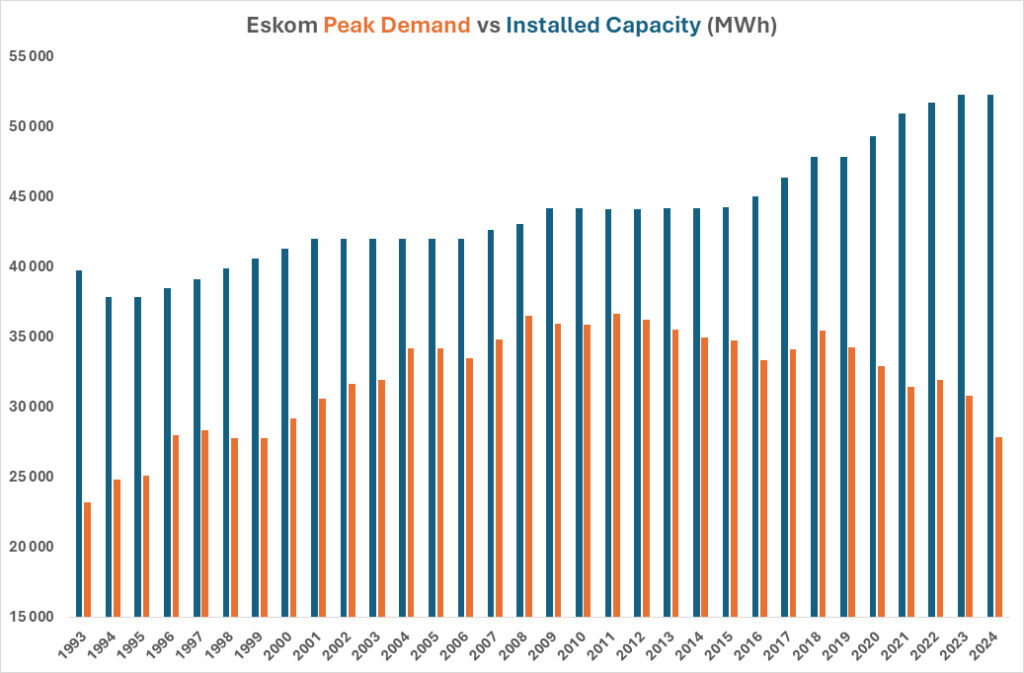
What is striking is that Eskom needs to burn billions in diesel, and still needs to implement load-shedding, despite having far more installed capacity.
Over the past 30 years, Eskom has increased its installed capacity from 39.7 GW to its current capacity of 52.3 GW.
This means that it should easily be able to meet demand. However, its poor performance, illustrated by the low EAF, has prevented this.
The chart below shows the difference between Eskom’s installed capacity in peak demand, painting a dismal picture of Eskom’s performance.





Comments