Petrol price cut on the cards for South Africa in May


South African motorists can expect some relief at the pumps in May, with forecasts showing a 20 cents per litre cut for petrol prices and 40 cents for diesel.
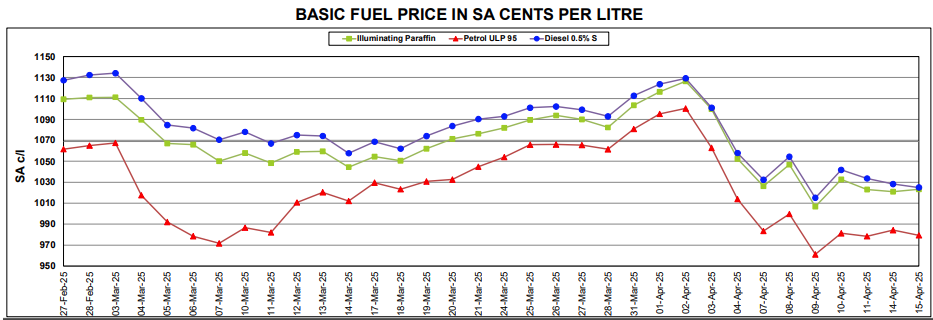
This is largely due to a significant decline in the price of oil over the past few weeks following United States President Donald Trump’s announcement of tariffs on imports into the world’s largest economy.
Trump has since walked back the higher reciprocal tariffs, delaying them for 90 days for every country besides China. The 10% across-the-board tariff increase remains in effect.
This has spiked fears of a recession in the United States and other major economies, significantly reducing the outlook for oil demand.
The rand has also made a modest recovery against the greenback after hitting its weakest level ever towards the beginning of April.
South Africa’s Central Energy Fund tracks the price of oil and the rand-dollar exchange rate to forecast potential changes in fuel prices.
Its latest data indicates the following changes are possible for May, with significant changes likely to occur before the official price is announced.
- Petrol 93 – decrease of 18 cents per litre
- Petrol 95 – decrease of 20 cents per litre
- Diesel 0.05% – decrease of 39 cents per litre
- Diesel 0.005% – decrease of 40 cents per litre
The global oil price has been in freefall over the past few weeks, with tariffs spiking fears of a recession and weaker demand.
Demand from the world’s largest importer, China, is already weak, given its slowing economic growth and rapid switch to alternative sources of energy.
The price of a barrel of oil has cratered by 7.1% in the last month on the back of the announcement of tariffs to $66.52 per barrel.
This is near the lowest level in four years, and the decline is compounded by Iraq’s plan to cut its oil exports as it faces pressure to adhere to its Organisation for Petroleum Exporting Countries (OPEC) production target.
Oil prices are expected to increase as the United States has vowed to reduce Iran’s oil exports to zero through various means, including sanctions on refineries in China.
On the other hand, the rand has strengthened back below R19/USD due to the pause in tariffs on goods imported into the United States.
Ongoing talks between members of the Government of National Unity (GNU) have also calmed investor fears about the ruling coalition’s collapse less than one year after its formation.
Investec chief economist Annabel Bishop said it was expected that an improvement in the tariff regime globally would strengthen the rand.
Bishop said markets have seen some calm recently following last week’s turmoil, and the rand is likely to continue to strengthen to the R18.60/USD mark and then see further strength this quarter.
She explained that, globally, the US dollar’s extreme weakness would normally have pushed up the value of the rand at the cross significantly.
However, the difficulties faced by the GNU last week caused severe market concerns and a collapse in the rand instead.
As the rand strengthens, the US dollar continues to slide to multiyear lows, causing other currencies, such as the euro, to gain against it.
She explained that the negative impact of the trade war on commodity prices has also weakened the rand, as the domestic currency was hit from many sides.
The rand is currently trading at R18.87 to the US dollar, and further weakening of the greenback is expected as recession fears ramp up in the world’s largest economy.





Comments