Electricity price warning for South Africans


South Africa’s revised carbon tax and reduced tax-free allowances will compel carbon-intensive industries like Eskom to invest in cleaner technologies and could impact the utility’s electricity pricing strategies.
Latita Africa’s head of global strategy, Roxanna Naidoo, recently warned that the government’s ‘carrot and stick’ approach to carbon emissions will feature more stick and less carrot in the coming years.
This is because the incentives are set to become less generous and the deterrents more onerous.
“In other words, the tax-free carbon allowance is shrinking, and the carbon tax rate is rising,” she explained. “This will have significant implications across various industries, especially carbon-intensive ones.”
The Carbon Tax Act was first implemented in June 2019 in response to climate change. It aims to reduce greenhouse gas emissions in a sustainable, cost-effective, and affordable manner.
The South African Revenue Service (SARS) explains on its website that South Africa’s carbon tax gives effect to the ‘polluter-pays-principle’.
In other words, it helps to ensure that firms and consumers consider the negative adverse costs of climate change in their future production, consumption, and investment decisions.
This tax was recently revised to accelerate the country’s ambition of reaching net-zero emissions by 2050. Phase 2 of the carbon tax framework is set to commence in 2026.
Naidoo highlighted one of the biggest changes as a cut in the tax-free carbon allowance from 60% to 30% by 2026. “This is meant to encourage companies to reduce their carbon emissions,” she explained.
In addition, every year until 2030, there will be a further annual reduction of this allowance by 2.5 percentage points.
Meanwhile, the government is also increasing the offset allowance for combustion emissions from 10% to 25% to encourage companies to invest in approved carbon offset projects and reduce their carbon tax liability.
Electricity prices in South Africa

“This escalation in operational costs may compel these sectors to invest in cleaner technologies and enhance energy efficiency to mitigate financial impacts,” she said.
Naidoo explained that the reduction in tax-free allowances will substantially raise the tax liabilities in traditionally carbon-intensive industries such as mining, steel, and cement production.
However, while the increased offset allowance offers some relief by permitting greater use of carbon offsets, she warned it may not fully counterbalance the heightened tax burden.
Therefore, the energy sector, including Eskom, which relies heavily on coal-fired power generation, will also face increased financial pressure.
“Here, the revised tax structure aims to encourage a shift towards renewable energy sources without directly passing additional costs onto consumers,” Naidoo explained.
“However, the transition may necessitate significant investment in renewable infrastructure and could influence electricity pricing strategies.”
If these electricity pricing strategies are adjusted and result in higher prices as Eskom “passes the buck” to consumers, it could be devastating to South Africans.
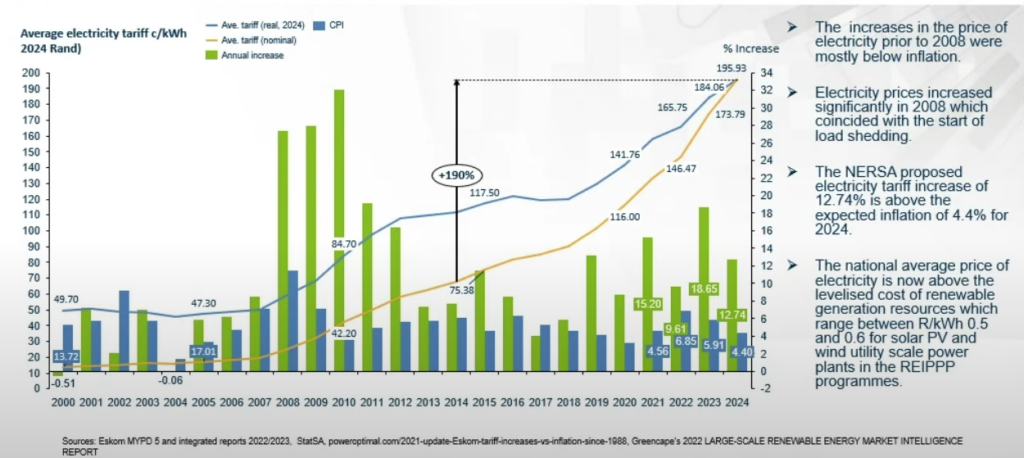
The average national tariff charged for electricity in South Africa has risen by 190% since 2014, with repeated above-inflation increases threatening to make it unaffordable.
The Council for Scientific and Industrial Research (CSIR) explained in its annual report that these repeated increases point out the need for alternative energy sources in South Africa.
This is because Eskom’s unreliable coal fleet continues to be a major driver of the rising electricity price.
The CSIR also pointed out that above-inflation increases were not always the norm in South Africa, with annual price changes before 2008 being mostly below inflation.
At the turn of the century, South Africa had cheap and abundant electricity, which enabled heavy industry to thrive in the country.
However, today, the local industry is globally uncompetitive due to rising input costs, of which electricity is a large part.
“While South Africa’s stricter carbon tax policy will present challenges, particularly for carbon-intensive sectors, it also offers opportunities for innovation, investment in cleaner technologies, and alignment with global carbon pricing mechanisms,” Naidoo said.
She advised industries to proactively adapt to these changes to maintain competitiveness and contribute to national and global climate objectives.
 Loading ...


Comments