Eskom plan to build a new nuclear power station next to exclusive South African millionaire town


Eskom has completed preliminary public consultations to develop a nuclear reactor at Thyspunt, between Oyster Bay and Cape St Francis.
This reactor is part of the government’s latest Integrated Resource Plan (IRP), which includes the development of 5,200 MW of new nuclear power in South Africa.
The country has one operating nuclear power plant at Koeberg in the Western Cape, which has a nameplate capacity of 1,940 MW across two units.
Koeberg has operated since 1985, and its two units have recently received 20-year licence extensions that will extend operations into the 2040s.
Its plan to develop a new plant in Thyspunt has gathered momentum with the publication of the IRP in 2025.
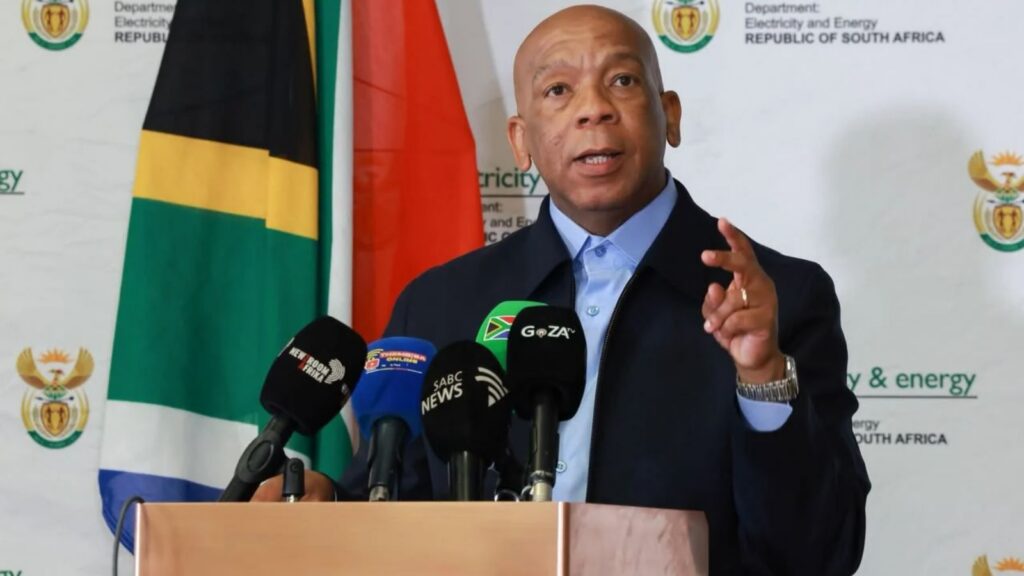
Electricity Minister Kgosienstho Ramokgopa revealed that Eskom has taken a major step forward by concluding preliminary public consultations.
Responding to a parliamentary question from MP Edwin Baptie, Ramokgopa said the completed public participation activities relate to the start of the environmental impact assessment.
“The environmental impact assessment and the nuclear regulatory process, which are being conducted in parallel, have not been concluded,” Ramokgopa said.
“The Final Scoping Report was submitted to the Department of Forestry, Fisheries and the Environment on 6 July 2026 and the project is proceeding to the detailed environmental impact assessment phase.”
Ramokgopa said Eskom is yet to choose a reactor vendor or a final reactor design for the proposed nuclear power station at Thyspunt.
“The environmental application is based on a technology-neutral Plant Parameter Envelope that defines the parameters within which the environmental impacts can be assessed,” Ramokgopa said.
“The application provides for a nuclear power station with a total generating capacity of up ot 5,200 MW and associated infrastructure.”
Ramokgopa explained that the final technology to be used on the site will be determined once government approval is required.
This will occur before the technology is procured and the nuclear licensing processes can take place.
Taking Thyspunt nuclear

Thyspunt is ideal for the development of a nuclear power plant, as it is very similar to Koeberg in nature.
An Environmental Scoping Report has recommended that further studies only be pursued at Thyspunt as opposed to alternative sites, such as Bantamsklip.
The report explained that Thyspunt has well-developed electrical infrastructure thanks to the development of nearby wind farms.
“From a spatial, technical, and infrastructure perspective, Thyspunt offers clear advantages,” the report read. Crucially, the land is already owned by Eskom.
“Specialist screening undertaken to date has not identified any unmitigable environmental constraints at Thyspunt. It is therefore recommended as the preferred site to be taken forward in the assessment process”.
Ramokgopa explained in his parliamentary response that this initial environmental investigation considered population distribution, road networks, transport capacity, and emergency planning around Thyspunt.
The next step is to update the baseline information and will require further assessment of transport, traffic, municipal services, and supporting infrastructure.
“The project feasibility work has identified the capacity of local, provincial, and national authorities to deliver the required supporting infrastructure,” Ramokgopa said.
However, the minister was unable to provide an estimate of how much the new plant will cost because the reactor technology has not been decided.
“Current programme planning is examining funding mechanisms that could include private-sector participation, public-private partnerships, and project finance,” Ramokgopa said.
The plan to use Thyspunt has been met with opposition from residents in St Francis and the SA Heritage Resources Agency, which made the area a Grade I Cultural Landscape in January 2025.
Ramokgopa has previously dismissed such opposition, saying that it conflates politics with engineering and that experts should be left alone to do their work.
“We conflated politics with engineering. It is a very simple engineering problem to build 5,200 MW of nuclear power without the intervention of politics,” Ramokgopa said.
Ramokgopa explained further that politics has shifted in recent years to include nuclear as a ‘green’ source of energy and as a vital part of energy security.
“We are going to build those plants. We are talking about a nuclear industrialisation plan. It is not only about the reactors, but it is also about playing in the nuclear fuel cycle,” Ramokgopa said.
“We are going to do it. We are going to announce the construction and then separate the engineers from the politics. We will procure nuclear as a backbone for electricity generation in South Africa.”
Login or register for unlimited free access.



Conversation
22 commentsThis article needs fact checking on the details, unfortunately as it stands it is misleading the reader. Eskom currently has permission to do a feasibility study for a nuclear power station, nothing more.
The actual envisaged timing of nuclear in the resource plan referred to by the Minister is right at the end of a plan that stretches for decades. The nuclear has been slotted in by the planners when the overall power demand in the economy has grown a lot from today, and nuclear forms a small part of the planned overall supply even at that late stage. This suggests that if it fails to materialise, there would be alternatives. Nuclear builds carry costs hard to afford especially to an economy in the shape SA is today, so it makes sense to delay it to a long term option.
Why then this publicity for what is really only the redoing of a feasibility study for long term planning purposes ? For a balanced view, one would expect to also hear concrete details about short and medium term plans as well, and about the feasiblity studies for those. One should mention that this study is not the first one for the site. The most recent completed study was rejected. For the new study, being done again by consultants, there have been instructions to widen the scope of sites from just the one Eskom wanted to cover, showing the preliminary nature of the work. That is all that is actually happening. Repeated studies and accumulating costs for consultants, and jobs retained by relevant Eskom staff.