Eskom is selling less electricity than it did 20 years ago, but is making 785% more revenue



Despite improved generation capacity, Eskom now sells less electricity than it did two decades ago.
Over the same period, its revenue has surged by 785.3%, driven by a rise in electricity tariffs, which have increased by 1,105%.
According to its annual reports, over the 2007 to 2026 financial period, Eskom’s electricity sales have trended downward.
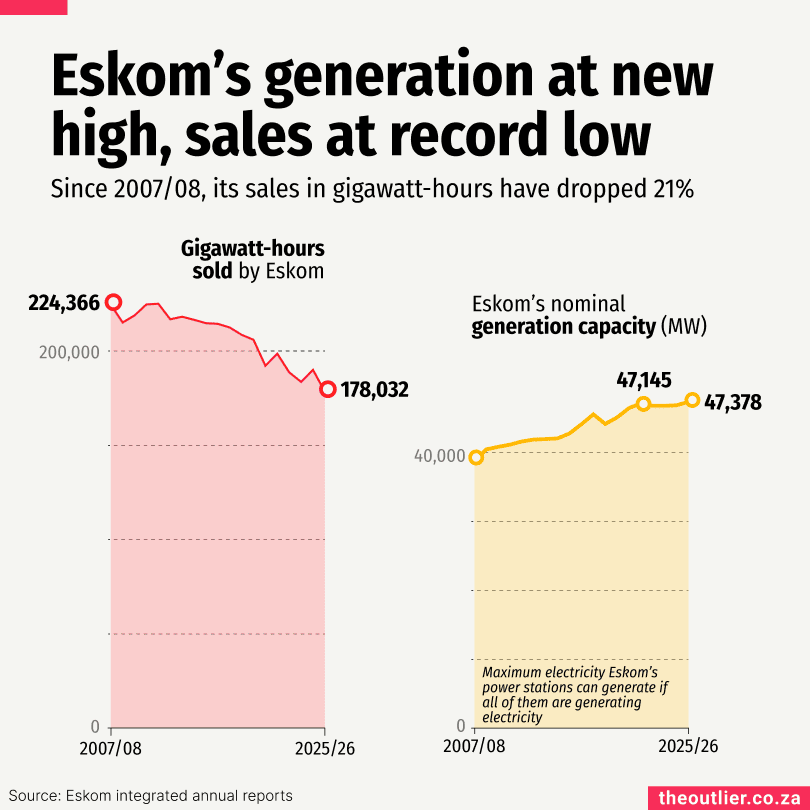
In the 2007 financial year, Eskom sold 218,120 GWh of electricity. However, by FY26, electricity sales had fallen to 178,032 GWh.
Over the course of two decades, this represented a 18.38% contraction in electricity sales.
By FY26, electricity sales had fallen to a two-decade low, and Eskom was producing less electricity than it did 20 years ago.
Interestingly, over the same period, Eskom’s generation capacity reached a historic high.
Evidence of this is evident in Eskom’s nominal power station capacity, which represents the maximum electricity output of its power stations at full capacity.
Notably, in FY26, Eskom’s nominal generation capacity reached a record high of 47,378 MW, representing a 25.46% increase from FY07.
This highlights that despite the expansion in generation capacity, Eskom’s electricity sales still contracted by 18.38% over the same period.
Against this backdrop, revenue moved sharply in the opposite direction, growing from R40.1 billion in FY07 to R354.7 billion in FY26.
This represented an increase in the Group’s revenue of 785.3% over the 20-year financial period.
However, despite revenue rising to 8.85 times its FY07 level, this masked a more challenging profitability picture.
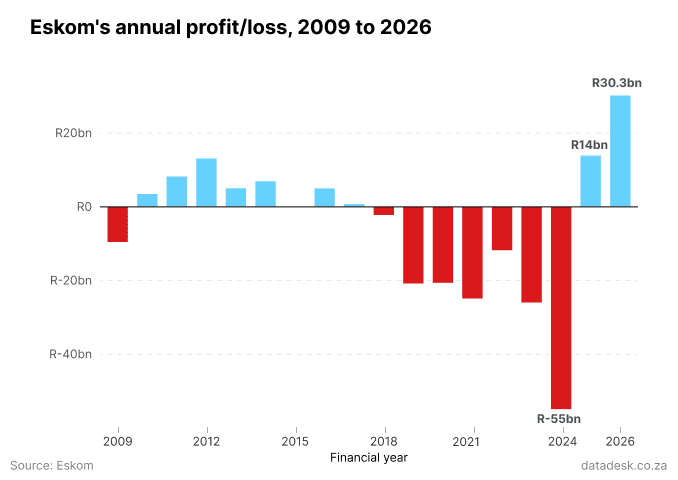
From FY18 to FY24, Eskom’s after-tax profit fell into negative territory for seven consecutive years, as illustrated in the graph below, courtesy of The Outlier.
However, FY26 marked a notable turnaround, with the utility recording profit after tax for the second consecutive financial year, amounting to R30.3 billion.
Notably, the surge in revenue was largely driven by the rise in electricity tariffs, which increased by 1,105% over two decades.
To put this into perspective, by the 2026 financial year, the price per unit of electricity was 12.05 times the price recorded in the 2007 financial year.
From revenue cushion to tariff spiral
While the rise in electricity tariffs provided a cushion of support against the contraction in electricity sales, it proved to be a double-edged sword.
On the one hand, it helped sustain revenue growth amid declining electricity sales. However, it also played a key role in weakening demand.
Historically, Eskom’s mandate as a state-owned utility was to provide reliable and affordable electricity to support South Africa’s economic development.
In the pursuit of this mandate, Eskom’s pricing structure prioritised affordability but fell short in recovering the true economic cost of supplying electricity.
This further constrained the utility’s ability to accumulate the capital reserves needed to finance future generation capacity.
Against this backdrop, the National Energy Regulator of South Africa (NERSA) approved tariffs to improve cost recovery and strengthen Eskom’s financial position.
While these tariffs helped support its financial standing, they also contributed to the gradual weakening in electricity demand.
Over time, decades of load shedding, accompanied by rising tariffs, led both households and businesses to turn to alternative sources of electricity.
This transition away from the grid toward alternative power sources, such as rooftop solar PV systems, further reduced Eskom’s consumer pool.
As fewer consumers purchased electricity from Eskom, the utility faced the challenge of recovering its fixed cost base from a shrinking customer base.
This, in turn, increased pressure on Eskom to seek higher tariff increases from NERSA, potentially making alternative electricity sources more attractive to consumers.
Municipal debt further compounded the utility’s financial burden, a burden that becomes clearer when traced back to the 2007 financial year.
In FY07, municipal debt was nearly negligible and not yet considered a macro risk to the utility.
However, fast-forwarding to the 2026 financial year paints a very different picture, with municipal debt amounting to R111.6 billion.
Highlighting the growing financial risk posed by municipal debt, Eskom projects municipal arrears to breach R358 billion by the 2031 financial year.
This mounting financial strain has left the utility increasingly dependent on state bailouts, such as the 2025 Eskom Debt Relief Amendment Act.
Despite these financial pressures, Eskom’s generation performance has improved in recent years.
Evidence of this is given in May 2026, when Eskom achieved 365 consecutive days without load-shedding.
However, this improved generation capacity has coincided with a fall in demand, leaving the utility with a very different challenge from the one it faced two decades ago.
While Eskom once struggled to meet demand, it now faces surplus capacity with weaker demand to absorb it.





Comments