Government must pick its poison as fuel price disaster looms for South Africa


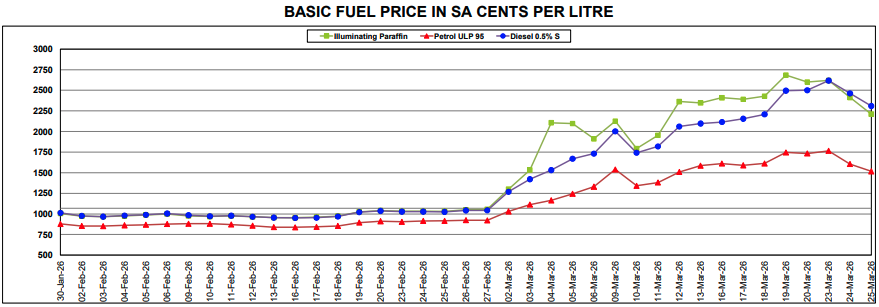
With South Africans set to face sky-high petrol and diesel prices in April, and potentially for months afterwards, calls have grown for the government to implement temporary relief from the fuel levy.
However, this puts the government in a difficult position, as it must choose between providing immediate relief for consumers or costing the fiscus at least R8 billion a month, with potential implications later down the line.
This difficult decision was outlined by the Bureau for Economic Research’s Lisette IJssel de Schepper in its latest Weekly Review.
Ijssel de Schepper’s comments come as South African consumers are in for an expensive month in April.
NWU Business School economist Professor Raymond Parsons described it as “triple price shocks” waiting for consumers.
“There is the combined impact of the spike in fuel prices from the global oil price blow, the higher fuel and Road Accident Fund levies, the adjusted carbon tax, as well as increased Eskom tariffs,” he explained.
On the global oil price and Eskom tariff front, there is very little the government can do.
The National Energy Regulator of South Africa has already authorised an average 8.76% tariff increase for direct customers, effective 1 April 2026, and global oil prices have been highly volatile amid the ongoing Middle East war.
Therefore, the attention has turned to something the government can control – fuel levies and taxes.
In South Africa, the price motorists pay at the pump is determined by a range of factors, including global oil prices, the rand/US dollar exchange rate, and administered prices such as fuel levies.
With Brent crude oil currently over $100 a barrel and the rand weaker than R17/USD, mostly due to the US/Israel-Iran war, South African motorists were set to feel the pain of higher fuel prices in April, regardless.
Therefore, it is the last factor that has become a major point of contention, as nearly a third of the fuel price in South Africa is made up of taxes, including the General Fuel Levy (GFL), Road Accident Fund (RAF) Levy, and the Carbon Tax.
All three of these taxes are slated to increase at the start of April, which, compounded by high oil prices and a weak rand, will see petrol prices rise by more than R5 and diesel prices by over R10 a litre.
Between a rock and a hard place
In the 2026 Budget, delivered prior to the outbreak of the Middle East war, the National Treasury announced that all three fuel levies would be increased, effective 1 April.
The GFL will increase by 9 cents per litre of petrol and 8 cents for diesel, while the RAF Levy will increase by 7 cents per litre.
The Carbon Tax, the only levy to face an above-inflation increase, is set to increase by 5 cents per litre of petrol and 6 cents for diesel.
Now, in light of the many factors set to put pressure on South African consumers’ wallets next month, there have been calls for temporary relief from the fuel levy.
Ijssel de Schepper said this form of relief would not be new, as a similar measure was implemented when oil prices surged following the Russian invasion of Ukraine in 2022.
“South Africa’s petrol prices did the same, and the government temporarily held the levy back by R1.50 and later R0.75 per litre,” she said. “We understand this is once again under consideration.”
However, Ijssel de Schepper warned that this relief would not come without a price, as it would come at a high cost to the fiscus.
She pointed out that the government received about R8.1 billion in levies per month in 2025/26, with a total tax take of R97.3 billion for the year.
In 2026/27, the Treasury projects that fuel levies will generate R104.87 billion in revenue, which equates to around R8.74 billion a month.
While Ijssel de Schepper noted that any relief is likely to be temporary, this hit to the fiscus will come at a time when South Africa’s fiscal and economic recovery is still fragile.
Following the Monetary Policy Committee’s (MPC) recent decision to keep interest rates unchanged at its March meeting, Parsons said it is likely that South Africa’s economic recovery will now be interrupted this year.
“The MPC has left its GDP growth forecasts unchanged for now, but with downside risks,” he said.
“There is no evidence of demand inflation in the economy, and disposable income is now likely to be diminished by highly elevated costs.”
“The oil price supply-shock could easily become a demand-shock for South Africa later.”





Comments