Say goodbye to petrol stations as you know them in South Africa


Petrol stations in South Africa are coming under immense pressure amid declining fuel demand, rising costs, and fresh competition.
This has pushed many to pivot into becoming convenience retail hubs, to reduce their reliance on fuel sales and grow their businesses.
The case example of this has been the revamp of the Sasol on Jan Smuts in Rosebank to become a Pantry by Marble, where fuel sales are secondary to the retail experience.
On a more mass market level, the trend has been seen with the rise of FreshStop, which has over 330 stores and 126 Seattle Coffee outlets in Caltex and Astron Energy fuel stations.
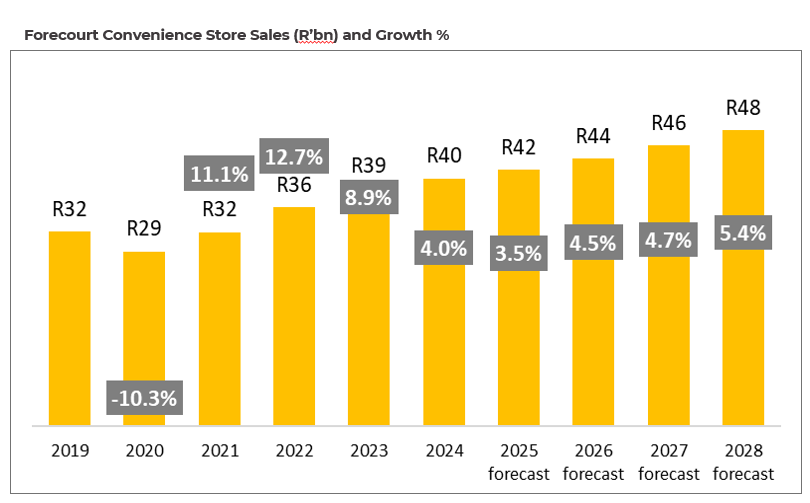
Major retailers, such as Woolworths, Pick n Pay, and Shoprite, are investing heavily in this space as the market becomes increasingly lucrative, with over R40 billion in retail sales recorded at petrol station forecourts in 2025.
At the same time, fuel consumption has declined at a steady rate of around 5% per annum over the past few years, indicating that the trend is now structural.
This decline is due to a stagnant economy, which reduces demand, vehicles becoming increasingly efficient, and the rise of hybrid and full-electric vehicles in South Africa.
Another factor to note has been the steady rise in the fuel price over the past decade on the back of a weaker rand and rising taxes levied on sales at the pump. This has a negative effect on demand as motorists look to use less fuel to save money.
Despite declining fuel sales, Trade Intelligence’s forecourt analyst Nicola Allen pointed out that the number of petrol station forecourts in South Africa has continued to grow.
This has increased market saturation and intensified competitive pressure on profitability in this space, with some forecourts suffering significant declines in fuel sales volume since 2019.
Allen explained that operators are effectively cannibalising one another in a saturated market, with some reporting fuel sales declines of up to 20%.
This has been compounded by rising operational costs, unregulated competition from informal and foreign-owned retailers, and illicit fuel trading.
A saving grace

In this situation, forecourt retail has emerged as a saving grace for petrol station forecourts, serving as a key growth driver and reducing businesses’ reliance on fuel sales.
The segment grew by 3% to R40 billion in sales, with it now contributing 15% to South Africa’s fast-moving consumer goods convenience channel.
While still significantly smaller than informal retail, which generated R207 billion worth of sales, forecourt retail is now larger than the corner shops market in South Africa.
As fuel sales have declined by over 4% year-on-year since 2019, rising convenience sales have stabilised overall forecourt income.
“Forecourt stores are no longer just an add-on to fuel – they are becoming a central pillar of the business. For many operators, they represent the most viable path to sustained growth,” Allen said.
These retail stores are increasingly becoming popular in their own right, with nearly half of all their shoppers not purchasing fuel at all.
Allen pointed out that over one in five customers now see them as a destination rather than a stopgap, with their perception shifting towards that of traditional retail stores.
However, this has increasingly put these stores in competition with supermarkets, quick-service restaurants, and delivery platforms.
This has eroded the traditional advantage that convenience retailers had in charging a premium for their convenience. Now, price is a major barrier to entry.
As a result, forecourt operators are increasingly investing in partnerships, food services, and customer experience.
Collaborations with major retailers and quick-service restaurant brands are expanding while food offerings, from barista coffee to hot meals, are becoming central to driving footfall and profitability.
This is most notable with Caltex/Astron Energy and its partnership with FreshStop, which has proven to be highly successful.
Major retailers are not far behind, with Woolworths partnering with Engen forecourts across South Africa and Pick n Pay with BP stations.
Other notable partnerships include those with banks, with petrol stations leveraging these rewards programmes to influence where motorists refuel.
However, the main advantage of petrol station forecourts is their proximity to customers, which is extremely attractive to major retailers as they push into this market.
Trade Intelligence estimates that 849 forecourts host branded retail stores, a 26% increase over five years. At over 330 stores, FreshStop has over a third of the market.






Comments