Billionaire-backed petrol station giant pumping billions into South Africa


Astron Energy is pumping R6 billion into upgrading its petroleum refinery in Cape Town as the company continues to increase its presence in South Africa and throughout the continent.
This refinery is key for Astron’s owner, Glencore, as it is able to produce around 100,000 barrels of refined petroleum products per day.
As the third-largest refinery in the country, it has also become increasingly important for South Africa, as it is one of the last bulwarks against becoming completely reliant on importing finished petroleum products.
The refinery is estimated to generate R95 billion in revenue for the local economy and supports over 50,000 jobs.
Glencore’s CEO, South African-born and educated Gary Nagle, has maintained that the refinery is cash-generative for the company.
As testament to this fact, the company has announced a R6 billion upgrade of the facility in Cape Town. This makes it one of the largest private investments in South Africa in recent years.
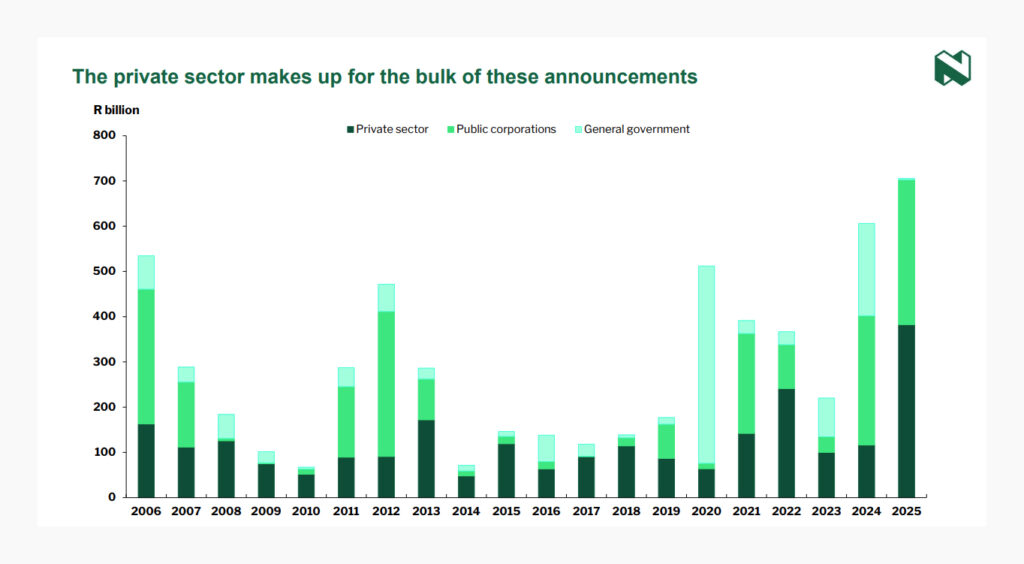
The project was listed as part of Nedbank’s Capital Expenditure Project Listing 2025 report, which details fixed investment plans in South Africa.
This report revealed a strong increase in fixed investment plans in 2025, driven largely by the private sector, as the government’s weak balance sheet prevents it from investing heavily.
Nedbank said the value of newly announced plans rose to R705.6 billion in 2025, with private companies committing R382.5 billion.
Two of the largest private investments in South Africa are from the telecommunications giants Vodacom and MTN, which announced plans to invest R85.2 billion and R45 billion, respectively.
Private investment in South Africa outside of these two companies is dominated by renewable energy projects, as businesses continue to reduce their reliance on Eskom and cut their electricity costs.
Nedbank pointed out that 80% of projects are energy-related, with the vast majority coming from companies turning to alternative energy sources for a stable electricity supply that is not exposed to Eskom’s repeated above-inflation increases.
Astron Energy taking over South Africa
Astron Energy is steadily taking over South Africa’s petrol station forecourts, with the company rebranding Caltex outlets as it brings all of its African business under one brand.
While Nagle has been a strong defender of Astron’s refinery, it was his predecessor Ivan Glasenberg who led Glencore’s acquisition of Astron in 2017.
Present-day Glencore is Glasenberg’s brainchild, with the South African-born and educated billionaire successfully transforming the company into a modern commodity-trading giant.
Glasenberg grew up in the Johannesburg suburb of Illovo and was educated at Hyde Park High School.
He attended the University of the Witwatersrand, which would become a training ground for many of Glencore’s commodity traders.
He made the company in his image, with many of its best traders a replica of Glasenberg – a South African accountant with an insatiable appetite for work.
Glasenberg and Glencore came knocking in 2017 and snapped up Chevron’s South African assets for $1 billion, investing heavily to upgrade the company’s infrastructure.
Glencore incorporated Chevron’s assets, including Caltex, into its Astron Energy brand and began investing in rebranding its 800 petrol stations in South Africa.
The R6 billion upgrade of its refinery is the latest example of Glencore investing in Astron’s local assets to turn it into a petroleum giant.
Astron has a storied history in South Africa, albeit in different guises. Founded in 1911, the company has over 100 years of continuous operation in the country, fuelling South Africa’s industrialisation on the way to becoming a global giant.
Originally called the Texaco Company, the corporation floundered as it imported raw crude for transport across South Africa.
It unveiled its Caltex brand in 1936, created as a byproduct of the formation of Chevron South Africa, which was a joint venture between Texaco and Standard Oil.
It opened its refinery in Cape Town in 1966, which is one of the few refineries still operating in South Africa, producing around 100,000 barrels of refined petroleum products per day.
Astron also operates a lubricants manufacturing plant in Durban, which it has invested heavily in to create a world-class facility able to produce 60 million litres of lubricants a year.
The plant produces Astron’s flagship brands such as Havoline and Delo, alongside specialised lubricants for industrial users.
Astron Energy petrol stations





Comments