Bad to worse for petrol prices in December


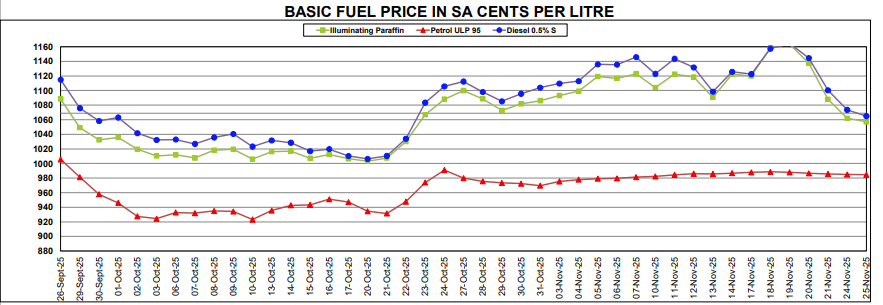
The latest data from the Central Energy Fund (CEF) indicates larger increases to petrol and diesel prices in December than initially expected at the beginning of November.
This is largely due to a rise in oil prices over the past month, with the United States intensifying its sanctions on Russia’s largest oil companies and global economic growth expected to surprise to the upside.
As a result, the projected oil surplus may not be as wide as initially anticipated, with increased demand absorbing some of the pickup in supply from major producers.
At the same time, the rand has been largely range-bound between R17.20/USD and R17.50/USD, despite momentarily dipping below R17/USD after the Finance Minister’s Medium-Term Budget Policy Statement (MTBPS).
This has resulted in the CEF’s projections indicating a larger-than-expected increase in fuel prices in December. Its latest data indicates the following changes –
- Petrol 93 – increase of 19 cents per litre
- Petrol 95 – increase of 24 cents per litre
- Diesel 0.05% – increase of 69 cents per litre
- Diesel 0.005% – increase of 86 cents per litre
One of the main reasons why diesel prices are expected to increase more sharply is the lack of refinery capacity in Europe and the United States, putting pressure on supply.
These changes are only projections and are likely to change before the official announcement by the Department of Mineral and Petroleum Resources at the end of November.
The good news is that the rand has strengthened in recent days, while international oil prices have retreated from their monthly highs. This is likely to translate into lower increases when the official announcement is made.
However, the department uses monthly averages when determining the price of fuel in South Africa, and so these benefits are unlikely to turn the projected increases into cuts.
The oil price has declined in recent days as there appears to be progress on ending the Russia-Ukraine war, with the United States proposing a 28-point peace plan.
Peace in the region may see sanctions on Russian oil companies lifted, increasing supply amid lacklustre demand, which will push down prices.
This is likely to continue oil’s downward trend, with prices already coming under pressure from increasing supply from members of the Organisation for Petroleum Exporting Countries (OPEC).
Oil prices have fallen by over 20% since the middle of June as OPEC lifted production caps on its members, with supply expected to exceed demand by a record four million barrels a day in 2026.
The decline in oil prices has been coupled with a strengthening rand on the back of expected rate cuts in the United States, increased investor appetite for South African bonds, and improving government finances.
The currency briefly dipped below R17 to the dollar following the MTBPS on 12 November, which projected a wider primary surplus for the current year and a stabilisation in South Africa’s debt-to-GDP ratio.
A combination of declining oil prices and a stronger rand, if continued, is likely to translate into further relief throughout 2026.





Comments