Andre de Ruyter vs Eskom on how sabotage disappeared


Incidents of crime, corruption, and sabotage at Eskom have been significantly reduced through the implementation of a five-step plan by the utility’s board and the creation of a specialised police unit.
This stands in stark contrast to the period when Andre de Ruyter was the utility’s CEO, where deliberate damage to Eskom’s infrastructure was blamed for two stages of load-shedding.
The former CEO himself has pointed to the work done by the South African Police Service (SAPS) in tackling organised crime at the utility.
Sabotage and corruption, or at least their impact on Eskom’s operations, seemingly disappeared overnight after De Ruyter vacated the helm.
De Ruyter repeatedly blamed sabotage and corruption at Eskom for the utility’s dismal operational performance, with record load-shedding experienced during his tenure.
“Eskom’s various power stations have experienced widespread sabotage, criminality, and destructive and unlawful industrial action,” De Ruyter said in an affidavit during a court case.
He explained that sabotage was not the only factor in the utility’s dismal performance last year, but that “it is clear that damage to Eskom property and operations has been deliberate”.
The former CEO estimated that the sustained sabotage campaign accounted for around two stages of load-shedding.
Electricity Minister Kgosientsho Ramokgopa also bemoaned the widespread corruption at the utility, warning that it threatened to undo any progress made in bringing load-shedding to an end.
However, despite the severity of the sabotage and corruption, it seemingly ended just after De Ruyter left the utility on 27 February 2023.
“The word had clearly gone out that sabotage and corruption had gone too far and that it should stop,” De Ruyter claimed.
Eskom chairman Mteto Nyati pointed to the utility’s own efforts to crack down on crime, fraud, and corruption as the main driving force behind this disappearance.
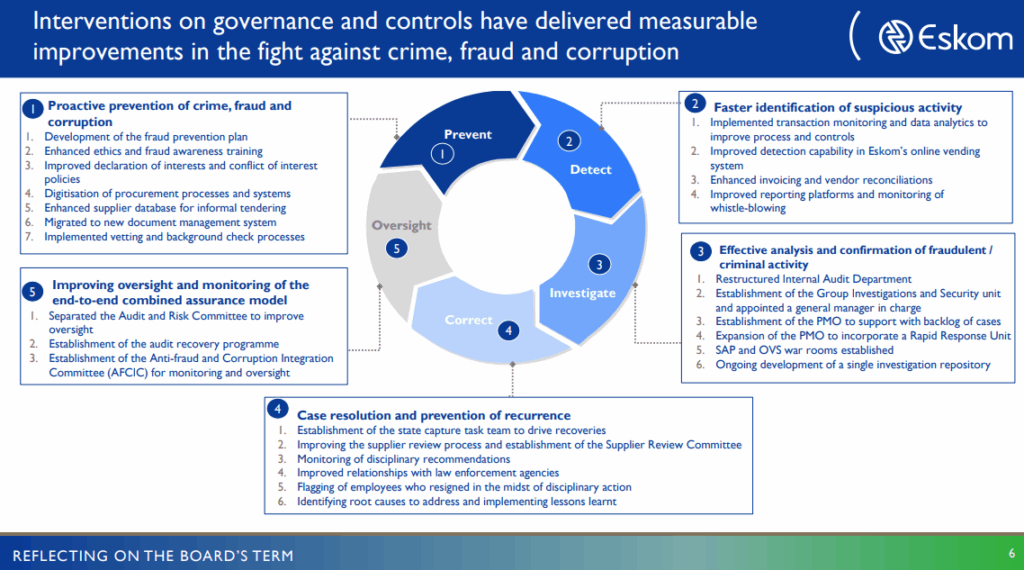
During the utility’s latest annual results presentation, Nyati outlined Eskom’s five-step plan to bring an end to criminal activity at the utility.
This plan is meant to be implemented in conjunction with efforts from law enforcement agencies to arrest those responsible and prosecute them.
It focuses heavily on the preventative measures the utility took, improved oversight, and enhanced consequence management.
This plan includes the following five steps –
- Proactive prevention of crime, fraud, and corruption
- Faster identification of suspicious activity
- Effective analysis and confirmation of fraudulent and criminal activity
- Case resolution and prevention of recurrence
- Improve oversight and monitoring of the end-to-end combined assurance model
How these steps work together can be seen in the graphic below from Nyati’s presentation.
Police, Russia, and coal
Eskom’s own initiatives were coupled with a major crackdown from police on organised crime at the utility and its suppliers.
De Ruyter praised the police’s efforts to end crime and corruption at Eskom during the recent BizNews Investment Conference.
“What is less well known is that SAPS instituted a specialised unit, a 24/7 unit, looking at crime and corruption at Eskom, De Ruyter said.
“They obviously did not make a big meal out of it because that would have vindicated what I was saying, but they did.”
Despite the unit’s successes, De Ruyter warned that it has recently been deprived of funding and its operations have been scaled back dramatically.
Another factor the former Eskom CEO pointed to as a reason for the end of sabotage is the sharp fall in coal prices after an initial spike during the outbreak of the Russian invasion of Ukraine.
“Immediately after the invasion, the Russian supply of gas into Western Europe stopped and they had to buy coal from South Africa.”
As a result of this, coal prices soared to record highs, resulting in immense profits being raked in by miners and exporters. Criminal syndicates were not going to miss out on this.
“That spike in coal prices created a huge arbitrage between Eskom contract prices and export prices for exactly the same quality of coal,” De Ruyter said.
“That coal could then be stolen from Eskom and exported from South Africa to Western Europe, and that is exactly what happened.”
“That is why a lot of our operational issues can indirectly be attributed to Mr Putin in Russia, which is kind of weird when you think of it, but that is the butterfly effect.”
It follows from De Ruyter’s reasoning that he thinks sabotage and criminality declined at Eskom after his tenure due to the stabilisation and decline in coal prices.
A forgotten factor in the end of sabotage at Eskom was a major shift in how maintenance was conducted at the utility, with a shift away from contractors to original equipment manufacturers (OEMs).
This has not only improved the quality of Eskom’s maintenance and overall performance, but also removed a crucial incentive that resulted in widespread sabotage.
Using OEMs for maintenance enables Eskom to enter into service-level agreements for maintenance, making it easier for the utility to hold service providers to account.
In this case, if maintenance is inadequate and the unit trips shortly after returning to service, the OEM fixes it at their own cost. This incentivises them to conduct high-quality maintenance.
Previously, most maintenance was conducted by contractors. This created an incentive for power stations to experience frequent breakdowns, creating more work for contractors.
This resulted in many of them conducting poor maintenance and, in some cases, engaging in sabotage to prolong contracts or get new business.





Comments