Andre de Ruyter reveals why he left Eskom


Andre de Ruyter lost patience with the slow pace at which the government moved to tackle criminality at Eskom and provide him with adequate political cover in resolving the utility’s struggles.
De Ruyter oversaw the worst load-shedding in South Africa’s history as Eskom CEO, with critics pointing to his poor leadership and low staff morale as reasons for the utility’s underperformance.
Some of the other criticism levelled at De Ruyter by his successors include his intense focus on adding renewable energy to the grid at the expense of improving the performance of Eskom’s coal fleet.
Electricity Minister Kgosientsho Ramokgopa went as far to say that De Ruyter showed the government and Eskom what not to do in appointing someone without the right skills and experience in the electricity sector.
However, De Ruyter himself thinks his mistakes lie elsewhere, such as in trusting politicians to support him and even taking the top job at Eskom in the first place.
De Ruyter told attendees at the second annual BizNews Investment Conference that in hindsight he should have thought a lot harder about becoming Eskom CEO.
“I think the first thing is to have asked myself far more deeply about whether I should take the job or not,” De Ruyter said in response to a question about what he could have done differently.
“In retrospect, I would have probably been like most people and say, ‘You need to have your head read’, and that is what I should have done.”
De Ruyter explained that he was going into the job expecting far better political cover from government officials. In hindsight, this decision to trust politicians was wrong.
The former Eskom CEO infamously revealed in an interview on eNCA that there were at least two ministers and more high-ranking government officials involved in crime syndicates crippling the utility.
Gwede Mantashe, then Minister of Mineral Resources and Energy, told De Ruyter to stop being a policeman and focus on his job. He also said De Ruyter was not suited for the job.
“I should have insisted on clearer and stronger commitments to political support. When the going got tough, I was quite frequently left out and hung to dry,” De Ruyter said.
“I think if I look at the lack of support in addressing criminality at Eskom, which has been well-documented, the fight was never going to be won.”
“That is frankly why I lost patience with the pace at which things were being done. I should have asked for more guarantees in writing.”
De Ruyter’s explosive allegations

De Ruyter resigned from his position as Eskom CEO in December 2022 after the country was subjected to 188 days of power outages throughout that year.
He had been subjected to intense political scrutiny, ranging from his focus on green energy to efforts to clean up the utility.
While he was initially expected to stay on until the end of March 2023, De Ruyter abruptly left the utility in February 2023 after an explosive interview on eNCA with Annika Larsen.
In the interview, De Ruyter alleged that there is knowledge and support of corruption at the highest levels of the ANC and the government.
He estimated that R1 billion gets stolen from Eskom every month and that his report of high-level corruption was dismissed.
“The minister in question looked at a senior official and said, ‘I guess it was inevitable that it would come out anyway’. It suggests that it was not news,” De Ruyter said.
“The response was that you have to be pragmatic. To pursue the greater good, you have to enable some people to eat a little bit. It is entrenched.”
He revealed that there are at least four Mpumalanga-based organised crime cartels that operate in Eskom. “We know of at least four organised crime cartels operating in Mpumalanga operating in Eskom,” he said.
“Some of them also have an interest in Transnet, which we see in our inability to use rail to get coal to the Majuba Power Station.”
The four criminal cartels are sophisticated, well-organised, and even adopted language associated with the Mafia, like captains and soldiers.
“They have a hit squad of between 60 and 70 highly trained and well-armed people. People get assassinated in Mpumalanga,” he said.
“The media may have become desensitised to the killings, but pretty much every week, there is an assassination.” He said it shows that crime and corruption at Eskom are deeply entrenched and highly organised.
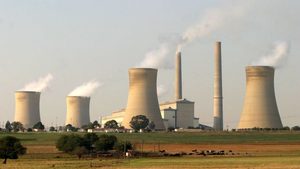
The criminal networks have extended their tentacles to many Eskom workers who sabotage and vandalise power stations on their behalf.
“The person who committed the sabotage is not the kingpin. It is an ordinary employee, and you cannot post policemen to look over everyone’s shoulder,” he said.
At the time, De Ruyter said that he placed a target on his back by intensifying Eskom’s efforts to fight crime and corruption. He allegedly survived an assassination attempt in December 2022 after high levels of cyanide were found in his blood.
He was also criticised heavily for his focus on adding renewable energy generation to the grid. This criticism was motivated by a the inability for criminal elements to benefit, De Ruyter alleged.
“Why else [except for vested interests] would you so absolutely resist even the commencement of the transition?” he asked.
De Ruyter raised the issue with one of his colleagues, which he describes as a wise woman, and her response was telling. “But Andre, you are naive. You are not showing the comrades a way to eat,” she said.
“There are so many vested interests in the coal value chain that the threat of decarbonisation is so eagerly opposed.”



Comments