Trouble for South Africa’s biggest employer


Despite small and medium-sized enterprises (SMMEs) accounting for most of South Africa’s employment and being integral to the country’s economic growth, they face a number of challenges that make it difficult to stay afloat and scale.
The State of the SMME report conducted by World Wide Worx on behalf of Shoprite explained that the success of these businesses is crucial to South Africa’s economy.
According to the Banking Association of South Africa (BASA), SMMEs make up an estimated 91% of formalised businesses in South Africa.
They employ about 60% of the labour force and have a total economic output that accounts for roughly 34% of the GDP.
Despite being such a large part of the country’s economy, many of South Africa’s small and medium-sized businesses struggle financially.
“The success of SMMEs is integral to South Africa’s economic recovery and growth,” said Enterprise and Government Relations Executive of The Shoprite Group Maude Modise.
“As crucial drivers of job creation and innovation, these businesses play a pivotal role in building a more resilient economic landscape.”
However, she pointed out that while these businesses hold immense potential, they often encounter an array of complex challenges, including limited access to capital, lacklustre infrastructure, and geographic disparities.
The report found that small businesses of all sizes face their own challenges.
“Start-ups bring dynamism and fresh ideas but struggle with limited resources and market access,” said Editor and journalist at World Wide Worx Arthur Goldstuck.
“Midsized businesses contribute significantly to profitability and job creation, yet their scalability is often constrained by workforce management and regulatory complexities.”
“Mature businesses, while more stable, contend with macroeconomic pressures and the need for sustained innovation to remain competitive.”
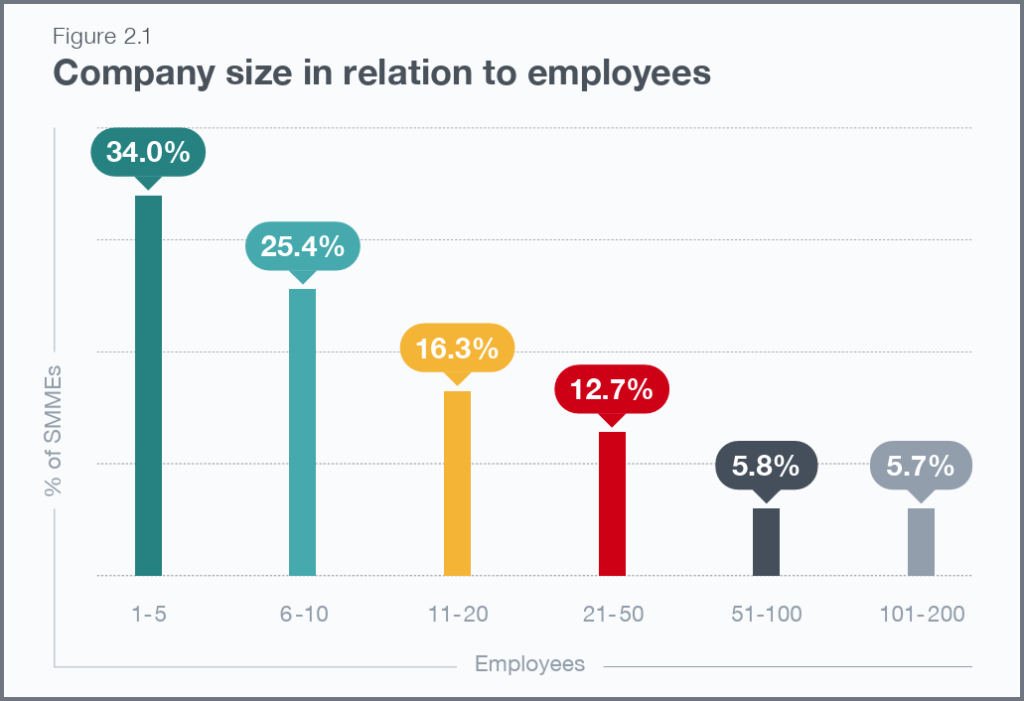
The majority of South African SMMEs are small enterprises, with 34% employing 1 to 5 individuals and 25.4% employing 6 to 10 people.
Together, these micro and small enterprises constitute nearly 60% of the sector.
Mid-sized businesses with 11 to 50 employees account for 29% of SMMEs, and larger businesses employing 51 to 200 individuals make up 11.5%.
Sustainability of SMMEs
Another metric the report looked at was the longevity of SMMEs, which provides valuable insights into their resilience and adaptability.
Nearly 30% of SMMEs have operated for over 20 years, showcasing their ability to withstand market fluctuations and maintain stability.
Businesses operating for 11 to 20 years constitute 25.6%, while start-ups, defined as businesses in operation for less than five years, account for 20.5%.
“Start-ups often encounter significant hurdles, including establishing a customer base, navigating regulatory environments, and accessing seed funding,” the report read.
However, they also bring dynamism to the economy, with many start-ups bringing innovation but facing challenges in achieving stability, while older businesses benefit from established networks and operational resilience.
“In contrast, businesses with over 20 years of operation benefit from established networks, repeat customers, and refined operational frameworks, which contribute to their longevity and success,” the report explained.
“To support start-ups and younger businesses, it is essential to create ecosystems that provide mentorship, market access, and tailored financial solutions.”
“Simultaneously, encouraging established businesses to share knowledge and resources can strengthen the overall SMME sector.”
The report also looked at the economic impact of SMMEs and found that it varies with size and maturity.
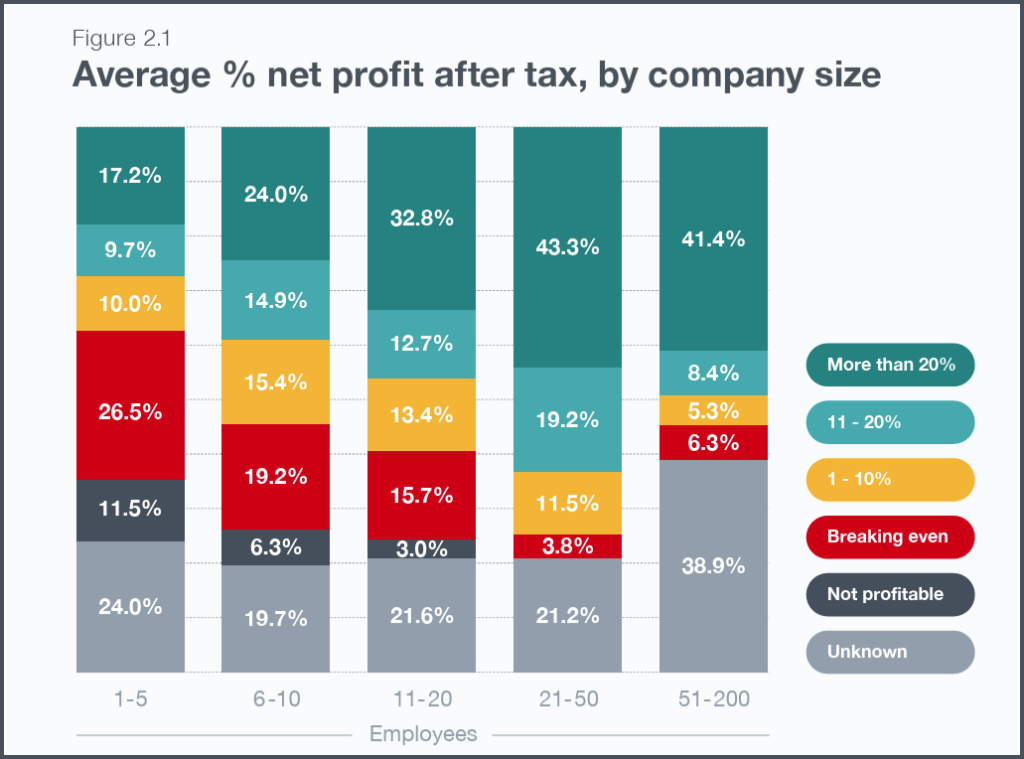
Start-ups faced great financial risks, with 25% breaking even and 10.1% reporting losses due to high initial costs and uncertain revenue streams.
However, mid-sized businesses emerged as significant contributors to profitability and job creation.
Among businesses with 21 to 50 employees, 43.3% reported net profit margins exceeding 20%, reflecting their scalability and operational efficiency.
Larger businesses, which employ between 51 to 200 employees, often act as industry anchors, creating supply chain linkages and generating stable employment.
“However, their growth can be constrained by macroeconomic challenges, including inflation, interest rate fluctuations, and regulatory complexities.”
“To enhance the economic contributions of SMMEs, stakeholders must focus on enabling growth across all sizes. For smaller businesses, this includes providing access to low-cost capital and simplifying compliance processes.”
Scaling support through advanced technology and market expansion strategies can unlock additional value for mid-sized and larger businesses.
“Mid-sized businesses contribute significantly to profitability, while smaller businesses require support to overcome financial vulnerabilities.”
 Loading ...





Comments