Car dealerships shooting the lights out in South Africa


Combined Motor Holdings (CMH) expects to report a significant jump in earnings for its 2026 financial year. This comes as car sales in South Africa surged in 2025, with local dealerships benefiting.
On Tuesday, 7 April, CMH released a trading statement for the financial year ended 28 February 2026.
CMH is an investment holding company with well-established roots in the retail motor sector. The company has 102 dealerships and 36 brands in its portfolio.
In its latest trading statement, the company informed shareholders that its headline earnings per share (HEPS) and earnings per share (EPS) are expected to increase significantly compared to the 2025 financial year.
CMH expects the following changes to its 2026 financial year earnings compared to 2025 –
- HEPS – increase by 25% to 35% to between 504.0 and 544.3 cents
- EPS – increase by 25% to 35% to between 503.9 and 544.2 cents
These strong results come after a strong year for local car sales in 2025, with naamsa describing it as a “landmark performance” for the new vehicle market.
The industry body said the market finally recovered above 2019 pre-pandemic levels and hit highs not seen in a decade.
It said this upward swing was closely tied to broader economic improvements, including interest rate cuts, record-low vehicle inflation, and an influx of affordable model imports.
“Reflecting on the challenges of 2025, the industry welcomed the positive economic variables that continued to support consumer spending throughout 2025,” naamsa said in a press release on 7 January 2026.
“The welcomed upswing in new vehicle sales surprised to the upside, achieving sound double-digit growth.”
“This surge was further underpinned by political stability and a significant easing of vehicle inflation, which hit a record low of 1.5% – the lowest since tracking began in 2008.”
naamsa explained that the influx of affordable models in South Africa’s market also contributed to the country’s intensely competitive trading environment.
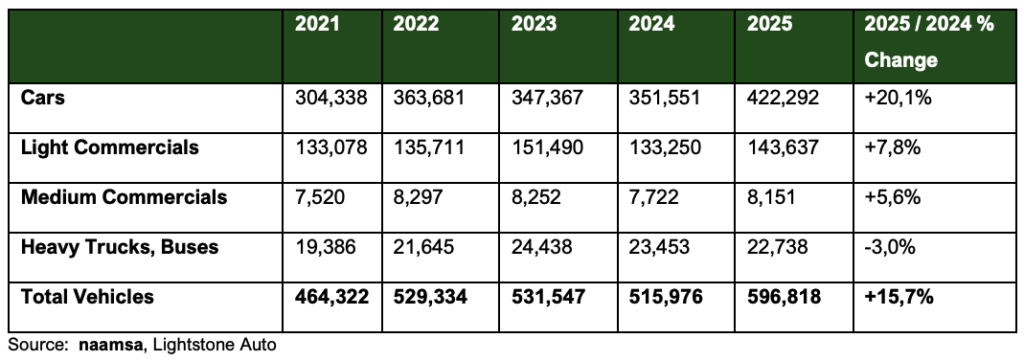
The table below, courtesy of naamsa, shows South Africa’s annual aggregate industry sales by sector from 2021 to 2025.
Car sales up in 2025
naamsa data showed that car sales increased by 20.1% in 2025 compared to 2024, while light commercial vehicles saw sales up 7.8%.
Medium commercial vehicle sales increased by 5.6%, with only heavy trucks and buses recording a decline in sales of 3%.
Overall, vehicle sales in South Africa increased by 15.7% in 2025 compared to 2024.
In its January press release, naamsa said the vehicle market’s strong performance is expected to continue in 2026.
The industry body said the full impact of 2025’s interest rate relief and lower inflation points toward a further boost in consumer disposable income for 2026.
“The new vehicle market momentum is upward, and 2026 new vehicle sales are poised for a further upper single-digit to lower double-digit improvement of 9% to 11% over 2025 levels,” it said.
It should be noted that these comments were made before the outbreak of the US/Israel-Iran war, which could have a knock-on effect on car sales in South Africa.
Near the end of March, AutoTrader said enquiries for hybrid and electric vehicles (EVs) in South Africa have surged while those for petrol- and diesel-powered alternatives have plunged.
This came amid surging oil prices due to the Middle East war, with fears of fuel shortages and increasing prices sparking heightened interest in EVs and hybrid vehicles.
AutoTrader said this could be a shock that irreversibly alters South Africa’s new and used car markets, likening it to the surge in delivery platforms kickstarted by pandemic-era lockdowns.
The company warned that, as motorists purchase hybrid and EVs, they are unlikely to return to those powered by fossil fuels.
Coupled with the declining price of alternatives to petrol and diesel cars, South Africa’s car market could change dramatically over the coming years.