The South African brothers who became multi-millionaires through online education


In 2008, brothers Sam and Rob Paddock founded GetSmarter, a platform that transformed online education in South Africa, and sold for R1.4 billion less than a decade later.
Today, GetSmarter partners with the world’s leading universities, including Cambridge, Harvard, and the London School of Economics, across 195 countries.
Sam and Rob joined their father’s Cape Town-based law firm, Paddocks, in 2006 as equity partners, bringing marketing and technology expertise.
They were always looking for new opportunities, which, unfortunately, led to several failed business ventures.
For example, Rob had seen steel-frame houses in Australia and was convinced they were the next big thing, but unfortunately, after investing a lot of time and money, the idea never took off.
Another idea was the “Back-up Box”, a product that supplies backup power to homes during a grid failure, which they thought would be successful since South Africa was experiencing its first major load-shedding period in 2008.
In theory, people should have been banging down their door to buy this product. However, this, too, was a complete flop. Fortunately, another opportunity would soon present itself.
Paddocks had long had a partnership with the University of Cape Town (UCT) Law Faculty. Their father, Graham, was one of South Africa’s top sectional title lawyers.
He had created an online course in partnership with UCT, which could be accessed across South Africa, with only the final component being offered in-person.
“It was a very popular course, but it was also one of the most profitable activities that Paddocks was involved in,” Sam told Leader.
Compared to their other business ventures, online learning seemed like a natural fit, especially since the short course had the fastest growth and the best margins.
It soon became apparent that this was something worth pursuing. They started by expanding the course, adding a blended-learning property course in Johannesburg.
Founding GetSmarter

Sam and Rob also began thinking about other ways to expand on this online short-course concept. The idea came in the form of wine.
Not too long before, Sam had started an e-commerce wine site, GetWine, with a friend, and it was enjoying steady growth.
“I started thinking about how we could leverage that business and database, and came up with the idea of doing a short online course on wine evaluation,” Sam explained. “We approached a professor from the University of Stellenbosch, and he agreed to come on board.”
Since they didn’t think it made sense to run a wine evaluation course under the Paddocks brand, they knew they had to develop their own concept and branding.
“We started marketing the course at the end of 2007, and it went live under the GetSmarter banner in February 2008,” Rob said.
The idea reached heights they hadn’t imagined, with 281 students signing up for their course. This is particularly notable given that online learning was still very new in South Africa, and many people were quite wary of it.
“It was the two of us and one salesperson, who doubled up as the course co-ordinator,” Sam said. “But we could see the potential, and we could incubate the business inside Paddocks.”
It wasn’t long, though, before Sam and Rob decided to leave Paddocks for good and pursue the GetSmarter business full-time.
The problem with online learning
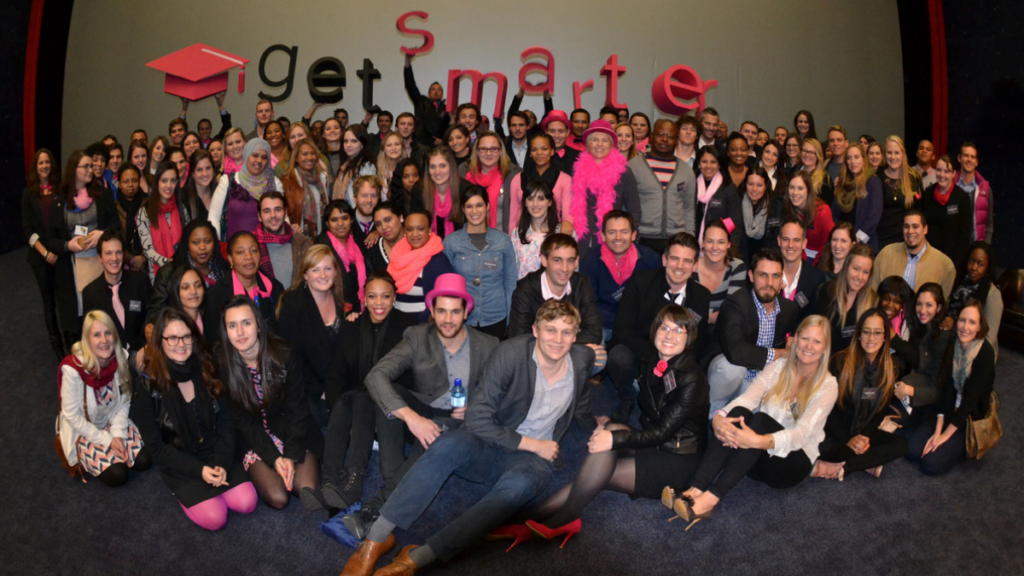
The GetSmarter business was looking to solve a very troubling problem within the online education space.
At the 2018 Design Indaba, Rob explained that, even though approximately 300,000 students register to study at UNISA every year, only 9% of undergraduates complete their degrees.
“Why is it that the promise of distance education is so tragically unrealised? How many thousands, if not millions, of working professionals are engaging in distance learning programs every single year, and only a fraction of them are completing?” he asked.
“This is one of the things that GetSmarter sought to solve,” Rob said. When they started looking at distance education and what wasn’t working, they found a very interesting study from Open University in the United Kingdom.
“In a one-year postgraduate programme with a 22% completion rate, the researchers changed one variable, and that was to make a phone call right at the beginning of the programme,” he said.
This phone call entailed an administrator calling students to welcome them to the programme and orient them about what the next few weeks would entail.
This was the only variable changed, and they found, shockingly, that this single phone call increased the completion rate by 4.3%.
The following year, they decided to add ongoing phone and email correspondence, which increased completion rates by 40%.
“This really led us to the concept of a high-touch approach to online education,” Rob said. “In 2013, we fundamentally reimagined the work that we were doing with our students.”
They decided to put people back at the centre of online learning by, for example, dividing students into small tutorial groups with subject-matter experts and referring them to student success managers who track their progress.
As a result, they were able to achieve a 91% completion rate for their courses. Their approach also allowed the company to keep expanding.
By 2013, the business had grown to 70 people, with 30,000 working professionals having gained new skills by completing a GetSmarter online short course.
By 2016, GetSmarter began partnering with leading global universities, including the Massachusetts Institute of Technology (MIT).
A R1.4 billion deal

They were also drawing the attention of international investors. In 2017, the company was officially acquired by the United States-based, NASDAQ-listed technology firm 2U, for $103 million (R1.4 billion).
This was recognised as the largest acquisition of a South African EdTech company at the time.
“It was a totally surreal moment in time for us,” Sam said at the 2018 Design Indaba. “These South Africans who hailed from the tip of Africa who had managed as a collective to both play and win on a global stage.”
Under 2U, GetSmarter continued to grow. By 2018, the company had 350 staff members located across three continents and a portfolio of over 80 online short courses.
By 2019, over 100,000 students successfully completed GetSmarter online short courses. Today, GetSmarter offers over 230 online short courses across 195 countries.
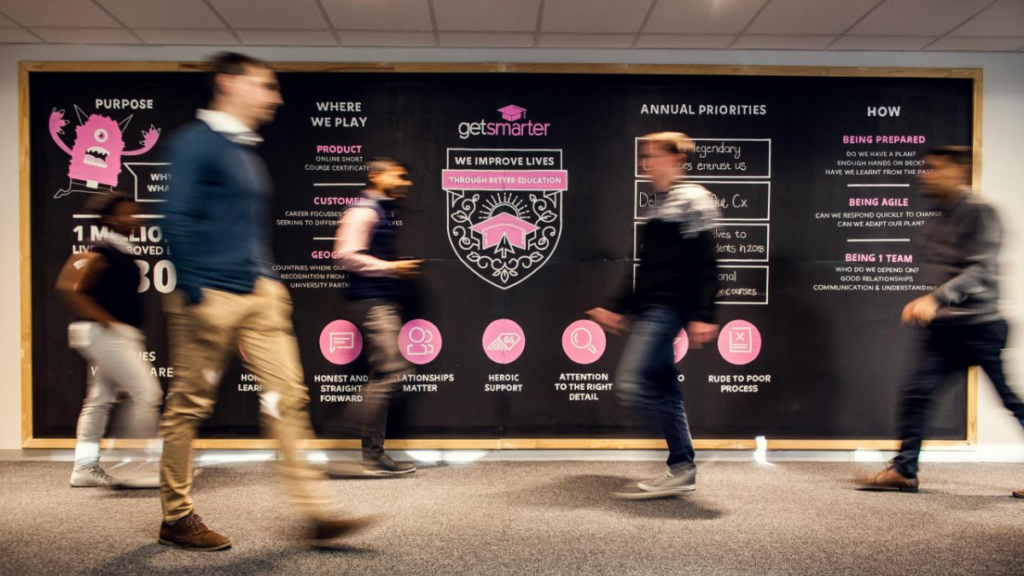
They are partnered with more than 18 universities, including leading institutions such as Harvard University, the University of Cambridge and MIT. The company aims to improve 1 million lives through better online education by 2030.
Following the acquisition, Sam and Rob exited the GetSmarter business to pursue new ventures. However, they both remain within the education space.
Rob is currently the CEO of the London-based Valenture Institute, which partners with the world’s leading education institutions and offers fully supported online high school programmes and pre-college certificates.
Sam founded Next Gen Learning (NGL) in 2024 to inspire the next generation of learning products.
“With a nod to the past and a handshake with the future, we have looked at how we humans love to learn, using methods proven to work in education and advances in programmable human voice to propel students’ learning ROI in a shorter time for more impact,” NGL said.
“We call this Deeper Learning Faster – an approach powered by the passion of humans, driven by the science of learning, and future-proofed by the adaptability of AI.”
Sam and Rob Paddock










Comments