Discovery Vitality’s secret sauce


Discovery Vitality has an unrivalled data set, which it is using to provide personalised nudges and incentives to improve individual behaviour towards finances and health.
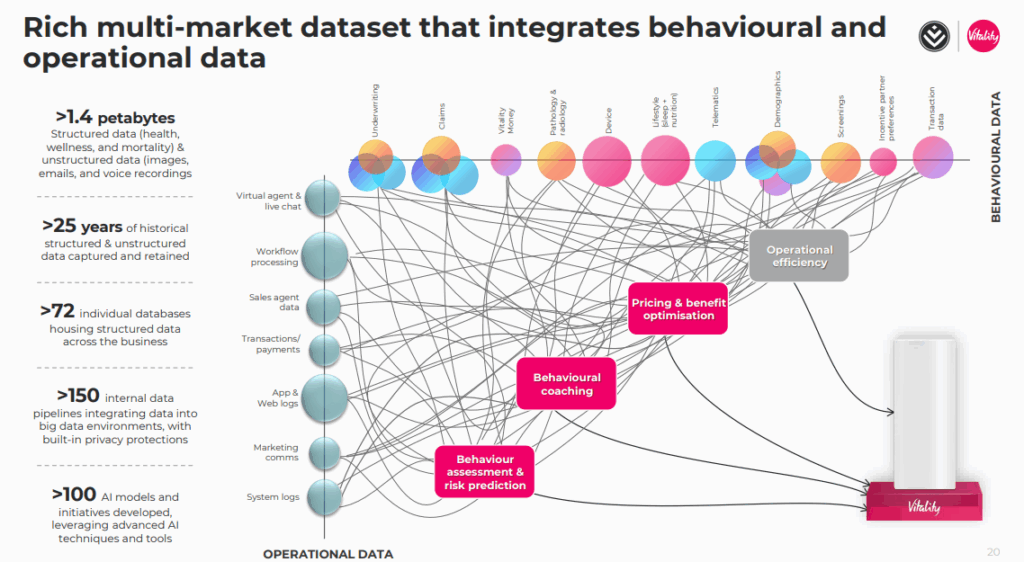
This set, collected over a quarter of a century, now amounts to over 1.4 petabytes of structured data from across Discovery’s health, wellness, and mortality businesses.
The structured data is coupled with unstructured data from images, emails, and voice recordings to create a complete data set that Discovery believes is the most unique in the world.
CEO Adrian Gore said as much during the company’s latest annual results presentation, with Discovery Health CEO Dr Ron Whelan repeating the claim amidst the release of the company’s Personal Health Pathways offering.
This offering, in many ways, is the epitome of what Discovery is trying to do with its data set – provide personalised information, nudges, and incentives to improve individual behaviour and reduce risk for the insurer.
The shared-value model forms the basis of everything Discovery does and is the bedrock upon which its Vitality Rewards, through Discovery Miles, are built.
Vitality CEO Dinesh Govender explained to Daily Investor that what makes this data set unique is not that Discovery collects it, but that it is able to combine it in-house.
The combination of data across banking, healthcare, life insurance, investing, physical activity, and now sleep is something no other company can do or has done so far.
Govender pointed to the world-class operations of the Mayo Clinic and Cleveland Clinic as examples. These institutions have the most detailed health data in the world and produce high-quality research and insights from it.
However, they do not have the personal activity data that Discovery has from its clients, nor their spending behaviour, or historic life insurance claims data.
Govender did not stop there, saying the data that Vitality has even rivals that of American tech giants in some cases.
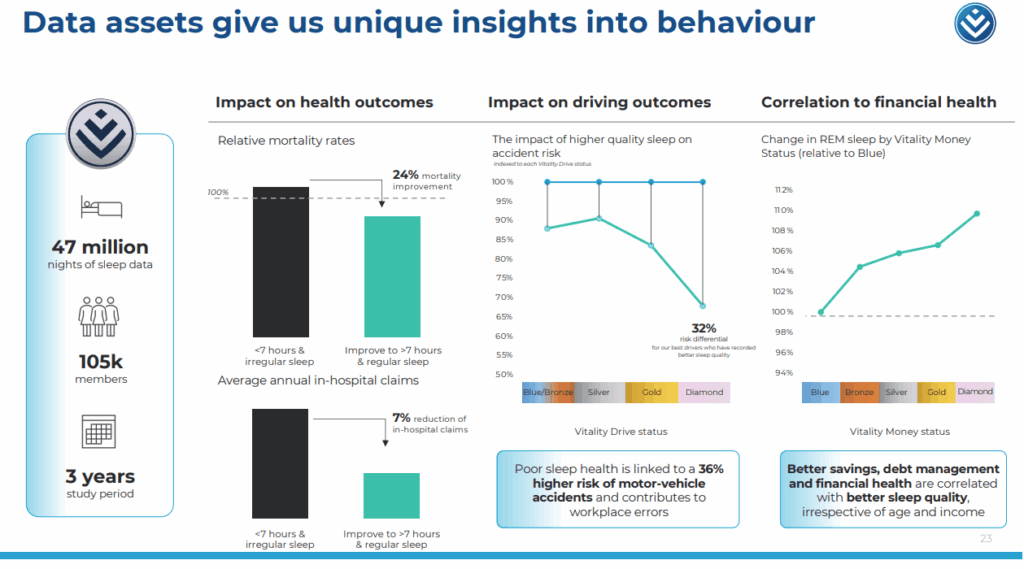
He explained that Vitality’s new Sleep Score model is based upon 47 million nights’ worth of sleep, whereas Apple’s version is based on around 5 million nights’ worth.
This data is then coupled with Vitality’s existing data on individual health claims, chronic medication information, hospital admissions data, and physical activity.
As a result, Vitality can personally nudge and incentivise physical activity and sleeping patterns that are best suited to an individual’s health.
Govender explained that a particular individual may have a chronic illness that requires more deep sleep than REM sleep and vice versa.
Layered on top of that is spending data, so Vitality knows where, when, and what you are eating, which impacts physical activity and health.
“And we can link all of that to your sleep data, all of that to your health, your exercise, and nutrition data, to come up with really powerful insights and powerful changes,” Govender said.
“Very few other organisations in the world can do that. I actually don’t know who else could do that right now based on the data they have.”
Discovery’s immense data set can be seen in the graphic below, shared by Gore at the company’s most recent annual results presentation, followed by an example of how the data works in relation to Vitality Sleep Score.
How Vitality ‘tricks’ you
Vitality uses this data to not only personalise nudges and advice, but also ‘trick’ you into sustaining positive behavioural changes over the long run.
It does this by bringing forward rewards for behaviour changes into the present, giving individuals instant gratification for activities that have long-term benefits.
These longer-term benefits are then sustained through larger rewards earned over a more substantial period of time.
It does this through a combination of its micro-rewards, such as smoothies and Discovery Miles, which are given as immediate gratification and longer-term big rewards, such as free flights with Discovery Travel.
These rewards give a short-term incentive for habits with long-term health benefits while encouraging the healthy habits to continue for longer so Vitality members can receive larger rewards.
Govender explained that it is important for these rewards to be tangible and be felt immediately, giving members instant gratification for exercise, healthy eating, and good financial behaviour.
In the case of Vitality’s new sleep score, Govender outlined the need to attract client attention to tackling healthy behaviours and implementing change.
Most people do not track their sleep, physical activity, or spending behaviour, and so an ‘instant’ reward is needed to bring attention to the behavioural pattern.
From there, Vitality has to encourage the individual to consistently track the behaviour and can begin nudging them to make positive changes.
These changes are then sustained for a significant period of time, typically about ten weeks, through regular rewards to create a habit.
This model has been extended across Discovery’s businesses to include banking and investing through Vitality Money.
For example, Discovery Bank’s relatively new home loans offering leverage this model to reduce the interest charged on the mortgage, depending on the client’s financial behaviour.
As the risk of default recedes over time with the client making more monthly repayments, Discovery Bank can lower the interest rate to reward this good behaviour.
This benefits the client through reduced interest rates and the bank through reduced risk.
Over time, Discovery plans to make its rewards and nudges increasingly personal through machine learning and artificial intelligence to keep people engaged.
The best example of this, so far, is its Personal Health Pathways, which provides personalised recommendations and insights for an individual to improve their health.
This may include a prompt to visit a GP for a checkup, identify potential risks to individual health based on broader healthcare data, or something as simple as encourage an individual to sleep more.





Comments