Major state-owned bank gave out R630 million in loans that it was legally not allowed to


South Africa’s Land Bank approved and disbursed R630 million through a unit that operated outside its statutory mandate. The bank ultimately lost a substantial portion of the money.
The episode forms part of a wider history of lending and governance problems at the state-owned bank, which defaulted on R41 billion in debt in 2020.
During the 2007 financial year, the Land for Development Finance Unit (LDFU) approved and disbursed loans for land and property development.
An independent forensic investigation completed in September 2007 identified alleged irregularities in the origination, management and administration of these facilities.
In October 2007, the bank’s board introduced a moratorium on new approvals and payouts. The final disbursement took place that month.
The board formally discontinued the unit in July 2008. Its remaining portfolio was classified as a discontinued operation, all interest accruals were frozen, and the loans were treated as non-performing.
The initial losses amounted to 60% of the original capital disbursed. However, the bank’s annual reports show that the recovery process continued for years, with the remaining exposure ultimately written down to zero.
By the 2019 financial year, the gross LDFU loan balance stood at R67.9 million, against which the bank had recognised an impairment allowance of R61.6 million.
In 2020, the remaining gross balance of R62.1 million was fully impaired following the receipt of final dividends from liquidated estates. This reduced its carrying value to zero.
The bank’s financial difficulties reached a critical point in April 2020, when it failed to meet maturing debt obligations.
The default triggered cross-defaults across listed and unlisted debt instruments totalling R41 billion.
Land Bank’s funding model contributed to its vulnerability. Unlike commercial banks, it does not take deposits and relied heavily on wholesale debt markets to fund its lending.
It used instruments such as commercial paper, floating-rate notes and promissory notes. This created a mismatch between its long-term agricultural loans and shorter-term funding liabilities.
Credit rating downgrades in January and March 2020 further weakened its ability to refinance maturing debt.
Investors became less willing to provide funding, while accelerated repayment clauses were triggered on certain credit facilities.
At the same time, drought, animal diseases and other pressures weakened farmers’ finances, contributing to rising bad debts. Land Bank recorded impairment charges of R1.8 billion in the 2020 financial year.
Governance problems added to the pressure, with the Auditor-General issuing a disclaimer of audit opinion for 2019/20.
They specifically pointed to major control weaknesses and problems with the bank’s expected credit loss models.
Following the default, Land Bank entered a standstill on capital and interest payments. Interest payments resumed in August 2020, while capital repayments remained subject to restructuring negotiations.
Land Bank gets a R10 billion lifeline

Land Bank’s recovery required years of negotiations with lenders and support from National Treasury.
The bank received R10 billion in capital injections between 2020 and 2023. This included R3 billion in 2020, R5 billion in 2021, and R1 billion in each of 2022 and 2023.
It also introduced a five-year strategy in 2022 aimed at rebuilding the institution and restoring its financial sustainability.
Lending activities resumed that year, although the bank remained constrained by its limited access to fresh funding.
Land Bank’s loan book contracted as existing facilities were repaid and new lending remained restricted.
Gross loans fell from R45.1 billion in 2020 to R36.9 billion in 2021 and R18.8 billion in 2023. By 2025, the figure had declined to R15.4 billion.
The non-performing loan ratio also remained high, increasing from 32.5% in 2021 to 51.9% in 2023 and 53.2% in 2024. This was partly because the performing loan book shrank faster than the value of non-performing loans could be reduced.
Land Bank formally implemented its debt restructuring agreement with commercial lenders on 16 September 2024.
The agreement, known as Liability Solution 5, ended its four-year event of default and unlocked R5.6 billion in recapitalisation equity that had been held in escrow.
By the 2025 financial year, the bank had repaid 76.8% of its debt liabilities. However, it failed to meet its credit loss ratio covenant under the restructuring agreement.
They received a two-year grace period to remedy the breach, running until September 2026.
Controversial debt collection practices
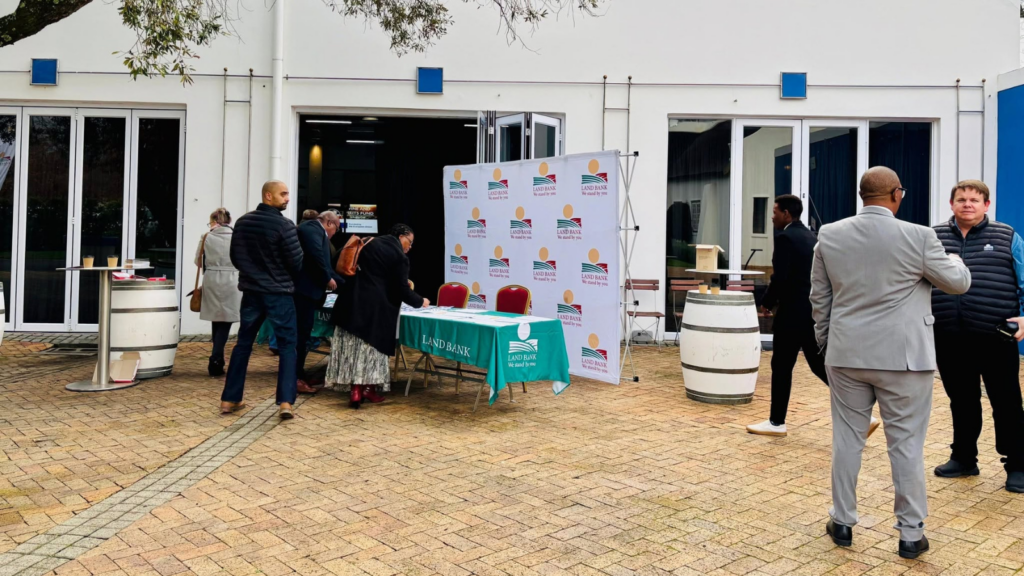
Land Bank’s lending and recovery practices have also come under renewed scrutiny in recent years.
In July 2026, the Democratic Alliance alleged that the bank had pursued farm liquidations without establishing its legal standing to recover certain debts.
The party said some underlying lending agreements were signed with agricultural credit intermediaries rather than directly with Land Bank.
It alleged that the bank had failed in several court cases to produce the cession agreements needed to establish its right to recover the debts.
The DA also cited a case in which a farming company’s assets, valued at R14 million, were auctioned for R6 million.
An independent report by Adams & Adams, delivered to Land Bank in February 2024, recorded allegations of irregular legal appointments, misrepresented legal standing and abusive treatment of farmers.
The Freedom Front Plus has separately submitted a petition on behalf of 150 commercial farmers and farming entities facing liquidation or asset attachments.
The farmers argued that Land Bank does not have the legal standing to attach their assets because they did not enter into direct loan agreements with the bank.
These remain allegations raised by political parties and affected farmers, rather than findings established in the bank’s annual financial statements.
Despite resolving its debt default, Land Bank continues to face high levels of non-performing loans and limited lending capacity.
It is now moving towards a blended-finance model, combining government grants with debt funding, while seeking a longer-term capital and funding arrangement from National Treasury.
Log in or register for free access to all articles.






Conversation
3 commentsBlack excellence at its best…