Warning for South Africans who shop online and get deliveries to their house


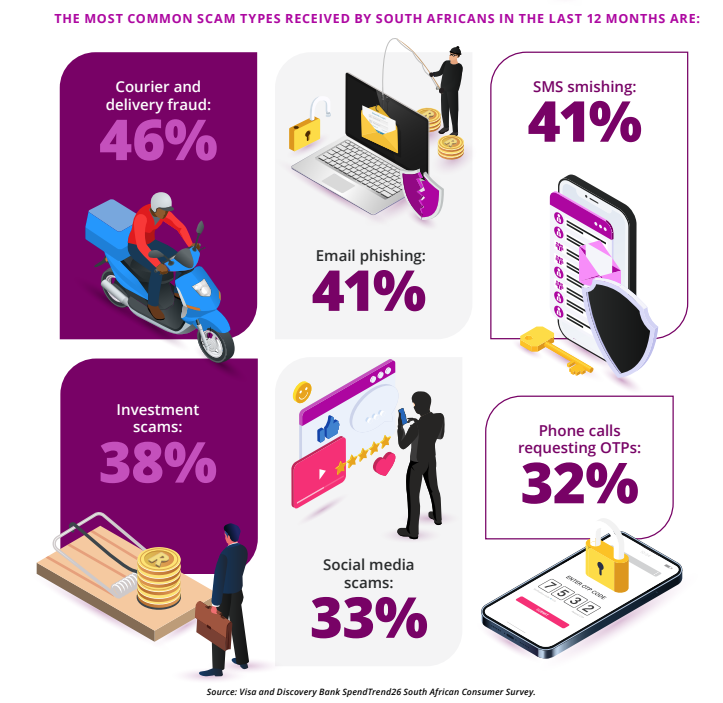
Courier and delivery fraud is the most common type of scam in South Africa, ahead of email phishing, investment scams, and social media scams.
The growth in this type of scam comes as online shopping becomes increasingly popular, particularly for groceries and basic necessities.
It is also one of the more difficult types of scams for financial institutions to combat, with it involving false SMSes, emails, and in-person scams.
This was revealed by Discovery Bank and Visa in the SpendTrend26 report, which analysed consumer spending behaviour over the past year.
The report is based on 2.6 billion transactions from over 20 million credit cards, Discovery Bank client data, and a 1,000-person survey.
Much of the report focuses on where South Africans spend their money and how they spend it, with Discovery Bank analysing trends to inform the products and services it offers.
In the latest report, the bank did a deep dive on fraud, with it implementing its own systems to effectively eradicate EFT fraud and other scams.
However, the SpendTrend report noted that while measured fraud rates are declining due to stronger controls, threats are becoming more sophisticated.
This has led to overall fraud declining, but the impact could be far more severe. WesBank, for example, noted that most fraud victims lose more than R12,500 per incident.
“While traditional controls are improving outcomes, newer threats – such as QR code scams and mobile compromise – are designed to bypass them,” the report read.
“Increasingly, fraud relies less on system breaches and more on manipulating people through urgency, trust, and impersonation.”
Discovery Bank CEO Hylton Kallner noted that South Africans are more alert and proactive, with many actively managing their risk and fraud exposure.
Nearly two-thirds of South Africans surveyed have been victims of fraud or have had a close friend or family member affected by scams.
Virtually all respondents said they actively scrutinise messages and take steps to reduce fraud risk when paying or shopping online.
Courier and delivery fraud is the most common type of fraud in South Africa, with 46% of respondents experiencing it in the past year.
This surpasses the more traditional email phishing, investment scams, social media scams, or SMS phishing.
Courier and delivery fraud often occurs when an individual is waiting for their delivery, with fraudsters sending emails, SMSes, or instant messages claiming that payments are required to clear customs or complete the delivery.
They often pretended to be prominent courier or e-commerce companies like The Courier Guy, Fastway, or DHL, or the Post Office.
Victims who made payment not only lost money on an order that would never be delivered, but also potentially exposed their card or bank account details to fraudsters.
Eradicating EFT fraud
Discovery Bank has poured immense resources into tackling fraud within its retail banking base through machine learning and artificial intelligence (AI).
In particular, the bank has cracked down on EFT fraud, with Discovery CEO Adrian Gore pointing to it as clear evidence of the company’s AI investments bearing fruit.
These investments include high-profile projects with Google and more particular product-specific enhancements, such as fraud detection.
A reduction in fraud is a clear benefit for Discovery Bank clients, but it also helps the bank in keeping more deposits on its platform and building trust with customers.
Discovery Bank CEO Hylton Kallner told Daily Investor that every transaction passing through the bank’s infrastructure is monitored in real time. This is an impressive feat, with the bank tracking 9.5 million daily ‘data events’.
“That is the data intelligence we have been working on. Effectively, what we have done is build out AI monitoring of every transaction in real time,” Kallner explained.
“If we identify anything that is out of range in terms of the client’s profile, their historic behaviour, or the beneficiary, our system flags it.”
This not only alerts Discovery Bank to the heightened risk of fraud but also enables it to send a push notification to the client to warn of the danger and prevent a fraudulent transaction.
Kallner explained that the main challenge with the system is not necessarily the risk of missing fraud, but the potential for false positives that make banking on the platform cumbersome and slow.
“The challenge here is false positives. False positives, when you stop a payment that was legitimate, are the worst experience a client can have,” Kallner said.
“So, what we aim to do is optimise our system to minimise the number of false positives without sacrificing the protection of the client.”
This all begins with the AI system analysing the beneficiary selected for the payment to understand whether it is a common recipient.
If it is a common recipient with a high level of trust, the system then looks at recent activity around the beneficiary, using Discovery Bank’s transaction data to understand how clients interact with it.
“If people like you do not interact with that beneficiary often or if there has been suspicious activity around that beneficiary itself, then the risk is immediately raised,” Kallner said.
“Importantly, this is happening every single time, on every single transaction individually and in real time. The risk is being assessed constantly.”
If the risk is elevated, the bank will send the client a Trust Alert and explain why the transaction has been flagged. This forces the client to pause and reassess the transaction.
Kallner said that if the transaction exceeds a specific threshold, it will be blocked.






Comments