World Bank’s plan to save South Africa’s economy


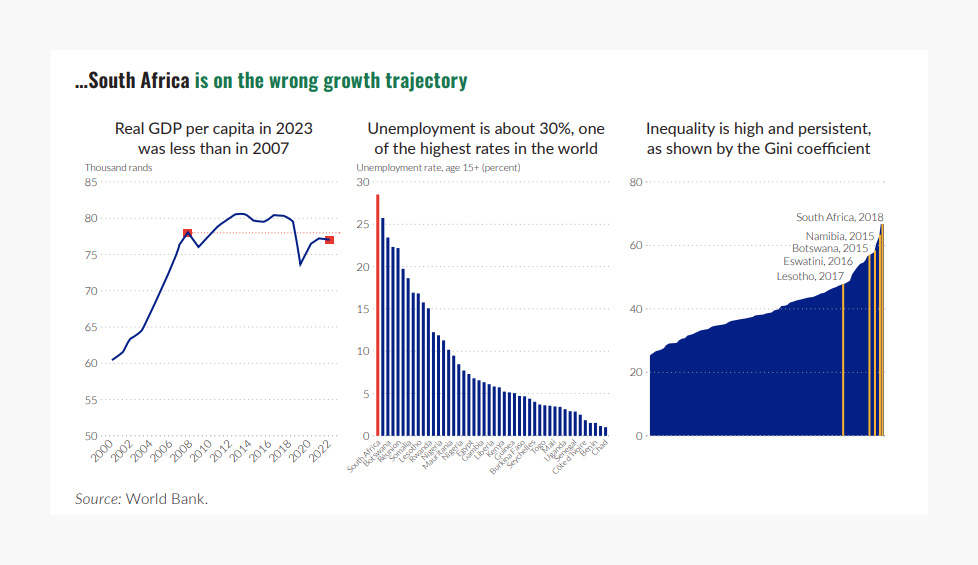
The World Bank has revealed a two-step plan to revive South Africa’s economy and stimulate growth to the levels needed to bring down unemployment.
In the institution’s Driving Inclusive Growth in South Africa report, released in mid-February, the bank said that South Africa is in a much better position now than it has been for the past decade, even compared to a year ago.
Twelve months ago, the country was plagued by intense load-shedding, logistical bottlenecks, and the looming uncertainty of a national election.
At the beginning of 2025, the picture appears to have flipped, with load-shedding significantly reduced and strong progress made in making the country’s logistics network more efficient.
Most importantly, the national elections at the end of May created a new political context that offered the country a generational opportunity to drive economic growth through reforms.
“The new political context emerging from the May 2024 elections provides a unique opportunity for South Africa,” the World Bank said.
“The alignment of economic and political incentives, in the sense that improving the economy is essential for gaining political power, offers a platform to launch a decisive transformation process.”
It said that such alignment was the key driver of successful economic transformations in China in the 1980s, Vietnam in the 1990s, and Poland in the 2010s.
“Those successes were anchored on a development bargain, whereby the country’s elites shifted from protecting their own positions to gambling on a growth-based future,” the bank said.
The formation of the Government of National Unity (GNU) has the potential to free politicians from historical party ideology and patronage networks.
This is particularly applicable to the ANC and President Cyril Ramaphosa. The GNU offers Ramaphosa the freedom to drive reform that increases the private sector’s role in the economy.
The plan to revive growth
The World Bank said that short-term results are vital to achieving successful economic transformation. These short-term wins create the momentum necessary to drive structural changes.
To do so, it proposed addressing two major shortcomings in South Africa’s economic model – the lack of market competition and inefficient institutions.
The World Bank explained that South Africa has to strengthen and broaden market competition to revive economic growth.
“Today, many of South Africa’s markets lack dynamism. Firm entry and exit are a third of the average of a typical middle-income country,” the lender said.
This is one of the major driving factors behind the country’s high unemployment rate, with South Africans unable to find stable and productive jobs.
Market competition, while ensuring greater economic inclusion and enhanced household welfare, is the best way to dynamise an economy as it boosts efficiency and promotes innovation.
South Africa could rebalance its economic model by making it easier for foreign and domestic investors and young workers to enter markets and reducing the protection of incumbents.
The reduction of protection for incumbents includes state-owned enterprises which are, for the most part, monopolies that are highly inefficient.
This creates a status quo that negatively impacts the success of small firms, which lack the capacity or financial means to navigate the complex system of rules and regulations.
This, in turn, significantly hinders the ability of low-skill workers to find jobs. Even if they do find employment, they face a heavy income tax burden.
Secondly, South Africa must make its institutions more efficient and supportive rather than the excessive burden they currently impose on private businesses.
The World Bank said the burden of institutions has become excessive – not only for businesses and citizens but also for public administration.
South African policymakers have attempted, often with good intentions, to correct market or historical failures by intervening through hard regulations, such as Black Empowerment policies, local content, and collective labour bargaining.
Today, these interventions have become so cumbersome that they smother the implementation capacity of the public administration, especially local officials, and open spaces for corruption.
As an example, the World Bank raised the government’s plan to bring phones and information technology to its population.
The government introduced competition to the telecommunication market in the early 2000s, making South Africa one of the middle-income countries with the highest rates of digital penetration and exports.
In parallel, the private sector also benefited. MTN, a South African multinational mobile telecommunications provider, is now operating in 22 countries worldwide.
The same approach has been used in aviation transport, with the emergence of several regional private companies and, more recently, in power generation, where competition has led to an unprecedented increase in renewable energy.
The World Bank said there are no obvious reasons why such an approach, coupled with smart regulations, cannot be applied to other sectors.






Comments