South Africa’s hidden R655 billion goldmine


The removal of South Africa’s non-tariff trade barriers and participation in the African Continental Free Trade Area (AfCTFA) could boost the country’s exports by 29% in the coming years.
This would translate into R655 billion in additional exports from South Africa, greatly boosting economic growth and foreign exchange earnings.
These potential benefits were revealed in a recent report from the International Monetary Fund (IMF) following consultations with the National Treasury and the Reserve Bank.
The report analysed the opportunities the AfCTFA offers South Africa and how the country could fully leverage the benefits of free trade on the continent.
South Africa began trading under the new AfCFTA on 31 January 2024, enabling local companies to export certain products duty-free or with reduced import charges to twelve African states.
Research from the IMF indicates that the AfCTFA can result in an intra-African trade surge, possibly leading to a real per capita income rise of over 10% for most nations.
As the continent’s largest exporter, the agreement is set to boost exports from South Africa and translate into improved economic growth.
This decision may also inspire global corporations to invest and produce goods in South Africa, enhancing its position as a gateway into Africa.
The IMF said the agreement could increase South Africa’s goods and services exports to the region by between 10% and 24% by reducing barriers to trade.
This will require commitments as part of the AfCTFA to be fully implemented and accompanied by broader reforms to improve the wider economic environment.
Such measures would boost economic growth, generate employment, and improve living standards, with the potential for real GDP per capita to rise by 13.2% in South Africa.
Further benefits could come from South Africa’s role as the regional hub for African value chains due to its economic size and more advanced economy than its neighbours.
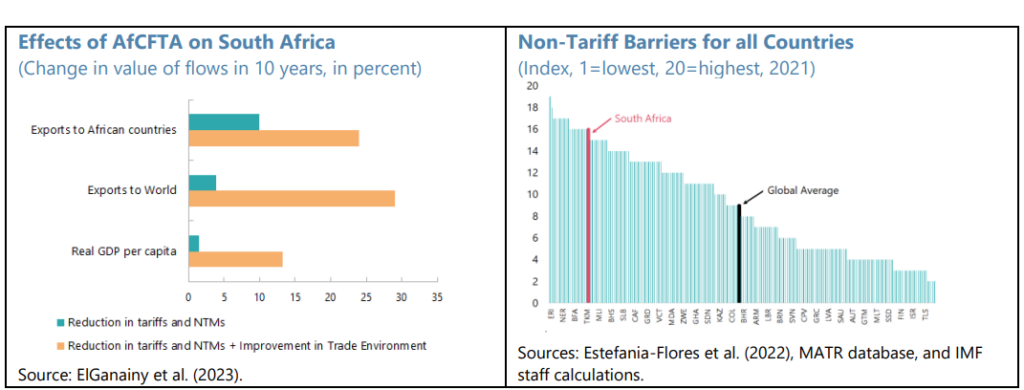
However, the IMF cautioned that while South Africa has relatively low tariffs, it also has extremely high non-tariff barriers to trade.
These include localisation incentive programmes, technical standards and import licence requirements, alongside burdensome customs procedures.
The IMF said this can lead to high trading costs and restrict the development of regional and global value chains. These barriers would have to be removed for South Africa to fully benefit from the AfCTFA.
The AfCFTA’s commitments to trade facilitation, customs, and transit can reduce administrative costs for traders, which is particularly important for complex value chains with multiple border crossings.
As a result, the IMF suggested that South Africa prioritise making trade with its neighbours more efficient, as outlined by the AfCTFA.
This could have benefits that extend beyond trade with Africa, with improved efficiency and lower trading costs boosting trade with partners worldwide.
If all the measures are implemented, the IMF said South Africa’s potential benefit could be closer to a 29% increase in exports.
With the country exporting a total of R2.2 trillion worth in the past year, a 29% increase would translate into R655 billion more in exports.
The IMF explained further that South Africa is well-poised to capitalise on the AfCTFA as the country is in a much better position now than it was just twelve months ago.
This time last year, there were very few reasons to be positive about South Africa, with load-shedding at elevated levels, a looming election, and stagnant economic growth.
At the end of 2024, however, the mood was very different. Load-shedding now seems a thing of the past and will most likely never again be as severe as in 2022 and 2023.
The election also saw the formation of a Government of National Unity, which ensured that South Africa’s future was no longer dependent on the decisions of a single political party.
Reform of the logistics sector is also gathering momentum. Late in 2024, Transnet published its Rail Network Statement, which paves the way for private players to run trains on its tracks.
However, the IMF is not riding high on this optimism and remains cautious about South Africa’s economic future, given global uncertainty and local reforms taking longer than expected.
The institution’s assessment showed that the balance risks remain tilted to the downside. As a result, its forecast for South Africa’s economic growth is below consensus at 1.5% in 2025.





Comments